
Building a luxury men’s cardigan brand from the ground up isn’t about guesswork—it’s about a clear roadmap, disciplined specifications, and partners who can execute at small volumes without punishing markups. This guide shows you how to move from idea to first drop with real-world ranges for lead times, quality standards, MOQ tiers, and landed cost.
You’ll learn how to define “luxury” for your market, select yarns that balance feel and risk, set tolerances that keep sizing consistent in bulk, and pressure-test costs at 50–500 units. No hype—just the playbook founders actually use.
Roadmap & timeline to your first drop (50–500 units)
Think in phases: discovery and positioning, tech pack creation, sampling and approvals, bulk production, import, and launch. For small-batch knitwear, public factory pages commonly cite sampling bands of roughly 3–7 days for straightforward styles and bulk windows around 3–6 weeks when yarn is readily available and styles are standard gauges. For example, one low-MOQ knit supplier describes “sample 3–7 days” with “bulk 3–4 weeks” on typical runs, consistent with other small-batch references published between 2024 and 2026. See representative examples from a low‑MOQ knitwear factory and marketplace listings in 2024–2026 postings: the low‑MOQ note at Knitwear.io and comparable timeframes on Brothers Textile listings.
Planning guardrails: lock your line plan and colorways early. Stock‑service yarns (ready-colored yarn held by spinners) compress both sampling and bulk timelines because you skip custom dye MOQs and lead times.
Approval gates: lab‑dip → proto → PPS (pre‑production sample) → bulk. Each gate should have specific test requirements and fit confirmations.
These time bands shift with seasonality, gauge complexity, stitch patterns, and yarn availability. Always reconfirm current bands with your chosen luxury men’s cardigan manufacturer during RFQ.
References for typical ranges and operating models appear across public documents, including Fast Retailing operations reports (for apparel supply cadence) and representative factory pages. Use external evidence to triangulate your plan rather than relying on a single quote.
What “luxury” really means for men’s cardigans
Luxury isn’t just cashmere on the label. In knitwear, it’s material pedigree and transparency, consistent construction at the target gauge, clean finishing, and credible compliance signals your customers recognize. EU buyer guidance notes that certifications like GOTS, GRS, and RWS increasingly support traceability for knitwear entering Western markets. See the CBI program’s overview in its knitwear market entry guidance, which outlines expectations for standards and documentation.
Materials pedigree and safety: OEKO‑TEX Standard 100 tests finished goods and components for harmful substances—an accessible way to communicate safety across sizes and colors. Read the standard explainer from the OEKO‑TEX Association in its official overview.
Traceability of animal and recycled inputs: If you’re using merino or other wool, the Responsible Wool Standard (RWS) strengthens animal‑welfare and chain‑of‑custody claims; for recycled yarns, the Global Recycled Standard (GRS) is widely recognized; for organic fibers, GOTS sets rigorous criteria across the supply chain. See the GOTS program’s 2023 report and Textile Exchange resources for context.
Does every luxury men’s cardigan need all these labels? Not necessarily. But aligning your materials and claims with one or two credible frameworks makes your launch story both true and checkable.
Authoritative resources:
EU buyer guidance on certifications for knitwear: the CBI’s knitwear market entry page — “Market entry: Knitwear”
OEKO‑TEX Standard 100 overview — “OEKO‑TEX Standard 100”
GOTS 2023 report — “GOTS Annual Report 2023”
Materials and testing you can’t skip
Cashmere vs. blends: Pure cashmere telegraphs luxury but increases cost and sensitivity to pilling; blends (cashmere/merino, cashmere/silk) can maintain a refined hand at better durability and price. When you’re validating demand at 50–200 units, a cashmere‑rich blend in stock‑service colors often beats bespoke pure cashmere that drags you into dye MOQs and long lead times.
Pilling resistance (ISO 12945): Surface fuzzing and pills undermine perceived quality fast. ISO 12945 provides methods (Martindale and ICI Pilling Box) to grade resistance from 1–5, with 5 best. A straightforward primer is available in a technical explainer of ISO 12945 standards; you’ll also find method summaries discussing Martindale vs. random tumble approaches.
Shrinkage and dimensional stability (ISO 6330 / AATCC 135): Knits move. Test your fabric/garment under ISO 6330 or AATCC 135 to determine percent change after specified wash/dry cycles. Then bake those results into your pattern allowances and the factory’s washing/blocking formula. The ISO 6330 page outlines domestic laundering procedures commonly referenced by brands.
Colorfastness and related tests: Pair your pilling and shrinkage tests with colorfastness to washing and rubbing. Require PPS and bulk test packs and keep the reports with your tech files.
Useful sources: ISO pilling explainer — “ISO 12945 textile pilling and fuzzing test standards”; ISO laundering summary — “ISO 6330 domestic washing and drying procedures”.
Tech packs, gauges, and tolerances
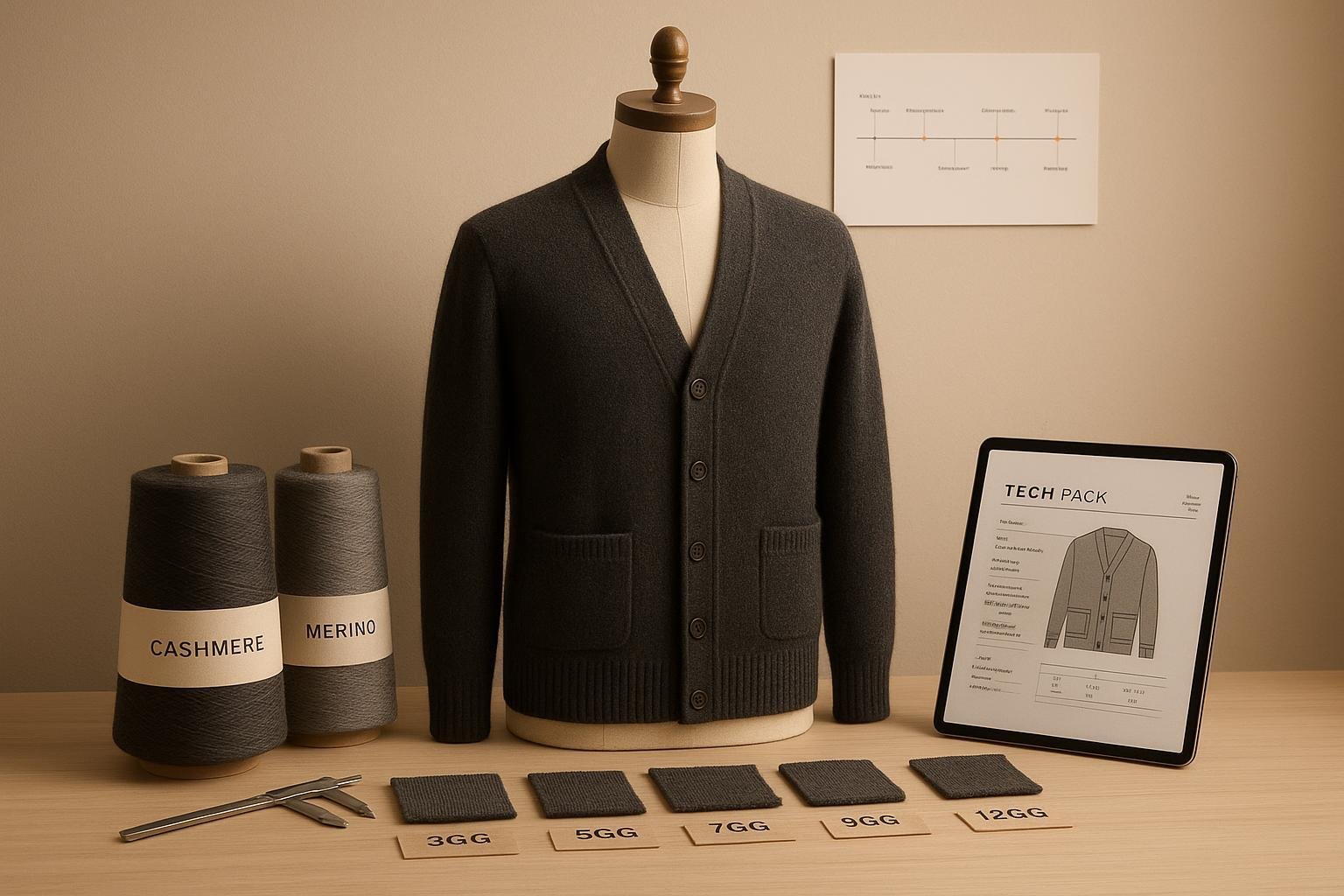
Your tech pack is the blueprint. For luxury cardigans, specify gauge (e.g., 7GG, 12GG), stitch density, construction notes (fully fashioned vs. cut‑and‑sew), yarn count, trims and buttons, handfeel targets, and—critically—washing and blocking SOPs. Why? Because your final measurements are set after finishing, not before.
Tolerance planning: For core measurements (chest, body length, sleeve length), knitwear programs frequently use ±1–1.5 cm tolerance on flat measurements, tightening for critical details. Industry guides and tooling platforms echo this range for premium runs. See a production-focused knitwear QC guide for how in‑line checks and blocking templates keep your dimensions in-band.
The must-haves in your tech pack:
Gauge and stitch density targets with acceptable bands.
Golden sample policy and PPS requirements.
Size curve and measurement chart with tolerances.
Washing formula (temperature, detergent type, time) and blocking board diagram.
Labels and compliance: fiber content, country of origin, care symbols aligned to tested methods.
For background on QC and tolerances, review a practitioner’s knitwear QC overview — “Knitwear QC guide”.
Sampling to approval: a practical playbook
Here’s a workable cadence for a first cardigan style:
Lab‑dips: Approve color on your actual yarn base. If you’re mixing fibers (e.g., cashmere/merino), confirm how the blend takes dye.
Proto sample (fit): Validate silhouette, gauge, handfeel, and blocking. Capture measurement deltas post‑wash.
PPS (pre‑production sample): This is your “ready for bulk” specimen with approved trims, labels, and final knitting program. Run lab tests (pilling, shrinkage, colorfastness) on PPS lot yarn.
Bulk: Lock production windows after PPS sign‑off. Use in‑line panel checks and post‑wash blocking boards. Final AQL at 2.5 major/4.0 minor is common for apparel; premium programs sometimes tighten major to 1.5. See the AQL method overview from QIMA — “Acceptable Quality Limit (AQL) guide”.
Time-wise, many small‑batch suppliers can complete a straightforward proto in about a week and PPS in another week if stock‑service yarn is used and communication is crisp. Bulk spans a few weeks for standard gauges, contingent on capacity and seasonality. Always cross‑check these claims against recent public examples and your vendor’s current schedule.
Cost and MOQ strategy without the “small‑order penalty”
Small orders don’t have to mean painful unit costs. The trick is to tie price breaks to setup amortization and yarn logistics rather than blanket surcharges. Start with a realistic ladder and adjust as you validate demand.
Illustrative ladder for a cashmere‑rich cardigan (stock‑service blend, standard trims; for comparison and planning only):
Tier (units per color) | Yarn & dye assumption | Setup amortization impact | Illustrative ex‑factory unit range (USD) |
|---|---|---|---|
50 | Stock‑service, no bespoke dye | Highest (single changeover, learning) | $62–$78 |
100 | Stock‑service | High → Moderate | $54–$68 |
200 | Stock‑service | Moderate | $48–$60 |
500 | Stock‑service | Lower (stable run) | $42–$54 |
What moves you down the ladder:
Consolidate trims and limit size curve breadth (e.g., S–XL for the first drop).
Fix gauge and stitch program to reduce re‑setup time.
Choose stock‑service yarn colors to avoid dye‑lot MOQs and weeks of waiting.
Commit to a repeat order on approval (with an option window) to justify better pricing.
If you must go bespoke color or pure cashmere with spinner MOQs, consider a two‑stage plan: validate with a cashmere‑rich blend at 50–200 units, then roll bespoke in the second drop once you have sell‑through data. When talking to a luxury men’s cardigan manufacturer, ask them to show the math behind each break instead of applying a flat “small‑order” surcharge.
Secondary keyword context: If you’re comparing partners, evaluate whether a “cashmere cardigan OEM low MOQ” option is feasible using stock‑service yarns and standard gauges before you jump to a bespoke dye path.
Duties, HS codes, and landed cost (U.S.)
Your FOB price is only the start. For U.S. imports, men’s knitted cardigans fall within HTS Chapter 61, most often heading 6110. Exact 10‑digit classification (and the duty rate) depends on fiber content and construction. Review the official HTS search for 6110 and Chapter 61 documentation on the U.S. International Trade Commission site for authoritative definitions.
Duty examples in recent U.S. Customs rulings show mid‑teens to low‑thirties percent ad valorem rates for various knitted garments, depending on subheading and fiber type. See, for instance, a CBP ruling that cites a 14.9% rate in one case and other rulings showing higher rates for man‑made fiber categories. Use these as illustrations, then confirm your exact code and rate with a broker or internal trade team.
Landed cost components typically include customs value, duty, Merchandise Processing Fee (MPF), brokerage, freight and insurance, and any applicable taxes. A practical overview is available in two guides to calculating landed costs aimed at e‑commerce brands; they break down components and trade‑offs when choosing DDP vs. DDU terms with carriers and brokers.
Helpful links:
U.S. HTS search for 6110 — “HTS 6110 search” and Chapter 61 PDF — “HTS Chapter 61 (official)”
CBP examples — “Ruling N340925” and “Ruling N325268”
Landed cost primers — “Guide to calculating landed costs” and “What is landed cost”
Choosing a luxury men’s cardigan manufacturer: how a low‑MOQ launch works in practice
Disclosure: AzKnit is our product.
Here’s a neutral, representative workflow for a 100–300‑unit launch when partnering with a small‑batch‑friendly factory:
Yarn and design: Select a cashmere/extra‑fine merino blend from stock‑service colors; lock 12GG for a refined hand.
Sampling: Target a first proto inside a week, PPS in the following week with lab tests (ISO 12945 pilling, ISO 6330/AATCC 135 shrinkage) on PPS yarn lot. Public examples suggest 3–7 days for simple protos and a few weeks for bulk when stock yarn is used; use these ranges to sanity‑check schedules.
Bulk: Plan a 3–4‑week window for standard gauges when capacity is available; define AQL at 2.5 major/4.0 minor and in‑line panel checks.
Fit consistency: Retain golden samples and blocking boards; enforce ±1–1.5 cm tolerances on core measures.
A manufacturer like AzKnit supports rapid prototyping (commonly cited 3–5 days) and short bulk cycles (often quoted around three weeks) for straightforward styles and stock‑service yarns, with minimums starting near 50–100 units depending on complexity. These capabilities are representative of what to look for when you evaluate partners for a low‑risk, speed‑to‑market launch.
For balance, compare this model with two other viable approaches:
Spinner‑led model: Source bespoke pure cashmere from a spinner and align dye MOQs; expect longer lead times but tighter control over fiber provenance and color.
Marketplace‑mediated model: Use a platform listing multiple small factories that advertise “sample 3–7 days; bulk 3–4 weeks” for cashmere/merino items. Vet carefully; time bands are feasible for standard work but can stretch with complexity.
The key is not the logo on the factory door—it’s whether your partner can show SOPs for washing/blocking, transparent price ladders from 50 to 500 units, and the test reports that back your claims.
Supplier vetting and SLAs that prevent surprises
Documentation: Ask for recent test reports (pilling per ISO 12945, shrinkage per ISO 6330 or AATCC 135) and examples of AQL reports. Review whether the lab is accredited.
Process control: Request washing and blocking SOPs, sample blocking boards, gauge ranges (e.g., 3GG–16GG), and evidence of in‑line panel checks.
Certifications and claims: If they mention OEKO‑TEX, RWS, GRS, or GOTS, request current scope certificates and confirm which tiers of the supply chain they cover.
SLA basics: Define sampling windows (e.g., proto 3–7 days; PPS one week later for simple styles), bulk windows by gauge and yarn source, approval gates, and QC responsibilities including rework paths. Place penalties and expedite rules in writing.
Reference on AQL norms: see QIMA’s concise “AQL guide”.
Next steps
If you’re mapping a first drop today, start by locking one hero cardigan with a cashmere‑rich stock‑service yarn, a tight size curve, and a realistic price ladder. Build your spec with gauge, stitch density, and finishing SOPs; line up PPS lab tests, and confirm your HTS classification for landed‑cost planning.
If you need a small‑batch partner for a low‑risk launch, you can explore a factory that supports fast prototyping, low MOQs, and transparent QC practices. A partner like AzKnit can be part of your shortlist; evaluate them with the same SOP, price‑ladder, and certificate checklist you’d apply to any private label knitwear factory.
Sources and further reading (selected):
Certifications and market entry: “Market entry: Knitwear” (CBI), “OEKO‑TEX Standard 100”, “GOTS Annual Report 2023”
Testing and QC: “ISO 12945 textile pilling and fuzzing test standards”, “ISO 6330 domestic washing and drying procedures”, “AQL guide”, “Knitwear QC guide”
Duties and landed cost: “HTS 6110 search”, “HTS Chapter 61 (official)”, “Guide to calculating landed costs”, “What is landed cost”