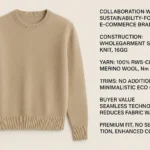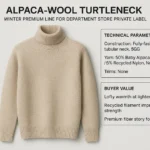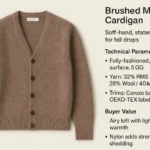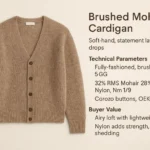

When your total order is capped at 50 units, every size and color decision carries real cost and delivery risk. This guide shows how to plan a 2 colors × 5 sizes run, model per‑color surcharge scenarios (with a per‑piece surcharge when a color falls below a 25‑piece minimum), reserve yarn sensibly, and read simple price ladders at 50/100/200. You’ll get spreadsheet‑ready mini‑calculators you can reuse with any supplier.
Key takeaways
Start with realistic size‑curve presets, then round carefully so the sum still equals 50.
Use a per‑color minimum of 25; if any color is below 25, apply a per‑piece surcharge (e.g., 15%) only to that color’s shortfall units.
Estimate yarn by garment grams → kg, add reserve (tops 3–5%; hoodies 5–8%), then round up cone counts.
Map cost to price ladders (50/100/200) to see marginal savings and decide whether a higher tier is worth it.
Keep it supplier‑agnostic: treat every numeric default as an adjustable assumption and validate with your factory.
Pick your baseline size curve
Choose the preset closest to your market and silhouette. These are example distributions; replace with your sales data when possible.
Preset (edit to fit) | Sizes | Ratio |
|---|---|---|
NA men’s knit tops | S, M, L, XL, XXL | 15%, 35%, 30%, 15%, 5% |
NA women’s knit tops | XS, S, M, L, XL | 10%, 25%, 30%, 25%, 10% |
EU unisex hoodies relaxed | XS, S, M, L, XL, 2XL, 3XL | 5%, 20%, 25%, 25%, 15%, 7%, 3% |
Why these? Adult tops typically center on M/L, with slimmer tails on the extremes; relaxed unisex fits broaden the tail. Treat them as starting points.
The 7‑step workflow for size and color splits at 50 MOQ
Confirm assumptions
Total units = 50
Colors = 2
Sizes = 5 (or 7 for the hoodie preset—trim to 5 if you must)
Per‑color minimum = 25; below‑min triggers per‑piece surcharge
Yarn mode = stock or custom‑dyed (affects lead time, not the math below)
Allocate sizes by curve
Multiply 50 by each size ratio; keep decimals for now.
Round with largest‑remainder method
Round down each size to an integer, then add 1 piece to sizes with the largest decimal remainders until the total reaches 50.
Split across colors
If you plan equal color demand, split each size roughly 50/50; otherwise bias toward your hero color. Keep integer counts.
Check per‑color minimums
Sum each color. If a color < 25, mark the shortfall units for surcharge.
Estimate yarn and cones
Yarn kg = Σ(size_qty × grams_per_garment)/1000; then add reserve (tops 3–5%; hoodies 5–8%).
Cone count = CEILING(yarn_kg ÷ cone_weight_kg).
Map to price ladders
Assign the order to a tier (50/100/200). Your unit price falls at higher tiers because fixed costs are spread over more units.
Mini‑calculators you can paste into any spreadsheet
All inputs are editable. Replace example numbers with your own quotes and garment weights.
Size allocation (largest‑remainder)
Input: Total_Qty, size ratios r1…r5 summing to 1.
Base = FLOOR(Total_Qty × r_i). Remainder_i = Total_Qty × r_i − Base_i.
Allocate 1 extra unit to sizes with the largest remainders until Σ Base_i + extras = Total_Qty.
Per‑color minimum and surcharge (per‑piece % model)
Inputs: PerColorMin=25; SurchargeRate=0.15.
For each color: Shortfall = MAX(0, PerColorMin − ColorQty).
SurchargeUnits = Shortfall; SurchargeAmount = SurchargeUnits × UnitCost × SurchargeRate.
UnitCost here is your ladder unit price before surcharge; you can also model the surcharge as a separate line item.
Yarn estimate with reserve and cone rounding
Inputs: grams per garment per size (g_S…g_XXL), ReservePct (e.g., 0.04), ConeWeightKg (e.g., 2.0).
YarnKg = (Σ size_qty × grams_per_size)/1000 × (1 + ReservePct).
Cones = CEILING(YarnKg ÷ ConeWeightKg).
Price ladder mapping (50/100/200)
Inputs: Tier50, Tier100, Tier200 unit prices from your quote.
If Total_Qty ≤ 50 ⇒ UnitPrice = Tier50; if 51–100 ⇒ Tier100; if 101–200 ⇒ Tier200. Show the three side‑by‑side to reveal marginal savings.
Note: These are explanatory models. Validate per‑piece surcharge policies and any setup fees with your supplier.
Worked Example A: NA men’s knit top, 2 colors × 5 sizes
Assumptions (edit as needed): Total 50; ratios S 15%, M 35%, L 30%, XL 15%, XXL 5%. Per‑color minimum = 25; below‑min surcharge = 15%. Garment grams (approx.): S 280, M 300, L 320, XL 340, XXL 360. Cone weight = 2 kg. Price ladder (illustrative): $12 at 50, $11.40 at 100, $10.80 at 200.
Size allocation (50 total)
Raw: S 7.5, M 17.5, L 15, XL 7.5, XXL 2.5 → After largest‑remainder rounding: S 8, M 18, L 15, XL 7, XXL 2.
Split across 2 colors (equal demand example)
Color A: S 4, M 9, L 8, XL 4, XXL 1 → Total 26
Color B: S 4, M 9, L 7, XL 3, XXL 1 → Total 24
Per‑color minimum check and surcharge
Color A = 26 (≥25) → no surcharge.
Color B = 24 (<25) → Shortfall = 1 unit. Surcharge amount = 1 × $12 × 0.15 = $1.80.
Yarn estimate and cones
Yarn kg pre‑reserve = (8×280 + 18×300 + 15×320 + 7×340 + 2×360)/1000 = (2240 + 5400 + 4800 + 2380 + 720)/1000 = 15.54 kg.
Add 4% reserve (tops 3–5%): 15.54 × 1.04 = 16.16 kg.
Cones at 2 kg each: CEILING(16.16/2) = 9 cones.
Price ladder
At 50 units, UnitPrice = $12. Total before surcharge = 50 × $12 = $600.
Add surcharge for Color B shortfall (1 unit × 15% of $12) = $1.80.
Illustrative total = $601.80 (ex‑works; excludes trims, labels, freight, duties).
Tip: If you bias more sizes to Color B to reach 25, you can eliminate the surcharge but watch sell‑through risk.
Worked Example B: EU unisex hoodie relaxed, higher reserve
Assumptions (edit as needed): Use a 5‑size subset (S–2XL) from the hoodie preset to keep the model compact. Ratios S 22%, M 28%, L 28%, XL 15%, 2XL 7% (normalized to 100% for five sizes). Per‑color minimum = 25; below‑min surcharge = 15%. Hoodie grams: S 520, M 560, L 600, XL 640, 2XL 700. Reserve = 7%. Cone weight = 3 kg. Price ladder (illustrative): $18 at 50, $17.10 at 100, $16.40 at 200.
Size allocation (50 total)
Raw: S 11, M 14, L 14, XL 7.5, 2XL 3.5 → After rounding: S 11, M 14, L 14, XL 7, 2XL 4.
Split across 2 colors (skewed demand example: 60/40 toward Color A)
Color A: S 7, M 9, L 9, XL 4, 2XL 1 → Total 30
Color B: S 4, M 5, L 5, XL 3, 2XL 3 → Total 20
Per‑color minimum check and surcharge
Color A = 30 (≥25) → no surcharge.
Color B = 20 → Shortfall = 5 units. Surcharge = 5 × $18 × 0.15 = $13.50.
Yarn estimate and cones
Yarn kg pre‑reserve = (11×520 + 14×560 + 14×600 + 7×640 + 4×700)/1000 = (5720 + 7840 + 8400 + 4480 + 2800)/1000 = 29.24 kg.
Add 7% reserve: 31.29 kg.
Cones at 3 kg: CEILING(31.29/3) = 11 cones.
Price ladder
Base total at 50: 50 × $18 = $900.
Add surcharge $13.50 → $913.50 (ex‑works).
What if? If you push Color B to 25 by moving five units from Color A, you clear the surcharge but may carry more inventory risk in the weaker color.
Yarn and dye constraints to validate with your supplier
Cone weights and rounding: Industrial cone packages are commonly in the 1–3 kg range; make cone weight an editable input and round cone counts up to avoid run‑outs. Procedural checks on cones before knitting are standard practice; see the overview of on‑line quality control and cone checks in the manufacturing context via TextileLearner’s quality control primer.
Reserve percentage: Use 3–5% for knit tops and 5–8% for hoodies as adjustable defaults to cover waste, shade holdbacks, spares, and reknits. Confirm the figure for your yarn, gauge, and factory setup.
Stock vs custom‑dyed yarn: Custom dyeing often carries dye‑lot minimums and extra lead time; implement a toggle in your calculator to reflect that. For background on dyeing practice and lot‑based realities, see methodological references such as the SDC’s publications and accessible trade coverage; for instance, recycled yarn suppliers discuss customized color minimums (e.g., 200 kg) in industry coverage like KnittingIndustry’s note on recycled performance yarns. Always confirm actual lot MOQs and lab‑dip cycle time with your vendor.
Lab dips and strike‑offs: Typical workflow is submit Pantone/TCX or a physical swatch → receive 1–3 lab dips → evaluate under D65 and other illuminants with ΔE targets → optional strike‑off on actual yarn → approve before bulk.
QC and risk controls you shouldn’t skip
AQL sampling defaults: Many apparel QA programs follow ISO 2859‑1/ANSI‑ASQ Z1.4. A practical baseline is Critical 0, Major 2.5, Minor 4.0 at General Inspection Level II; adjust for risk. For approachable explainers, see QualityInspection.org’s AQL overview and QIMA’s AQL guide with sample reports.
Pre‑shipment checklist: Final tech pack with tolerances, approved size chart, color standards and lab‑dip approvals, trims/labels BOM, packing counts, carton marks, and agreed AQL levels. Keep a buffer for OTIF and shade‑banding checks.
A neutral factory example and disclosure
According to the policy in this guide, a typical factory would sanity‑check your split, confirm yarn availability, and flag any below‑minimum color for surcharge before knitting. For example, AzKnit — Disclosure: AzKnit is our product — can use the same spreadsheet logic here to simulate per‑color minimums, cone rounding, and reserve % for a two‑color, five‑size order. The process is supplier‑agnostic; you can use these calculators with any partner.
Next steps
Copy the mini‑calculators into your spreadsheet and plug in your own quotes, grams per size, reserve %, cone weight, and the per‑color surcharge model your supplier uses.
Validate the size curve against your market data; if uncertain, run a 12‑pack pilot or seek retailer input.
Confirm dye‑lot minimums, lab‑dip cycle, and AQL levels with your supplier before placing the PO.
If you want a second set of eyes on your assumptions, ask your factory to sanity‑check the split and the reserve %. Keep the model updated after your first two production cycles.
Sources and further reading
AQL sampling and usage summaries: QualityInspection.org — What is the AQL?; QIMA — Acceptable Quality Limit guide; references to ISO 2859‑1/ANSI‑ASQ Z1.4 appear in these overviews.
OEKO‑TEX STANDARD 100 program details and verification: OEKO‑TEX — STANDARD 100 overview.
Manufacturing economics of MOQs and price breaks (general context): Maker’s Row — How to price your garment; Minimum order quantity basics.
Yarn/cone process context: TextileLearner — On‑line quality control; industry coverage of custom color minimums in KnittingIndustry — Recycled yarns for high‑performance fabrics.