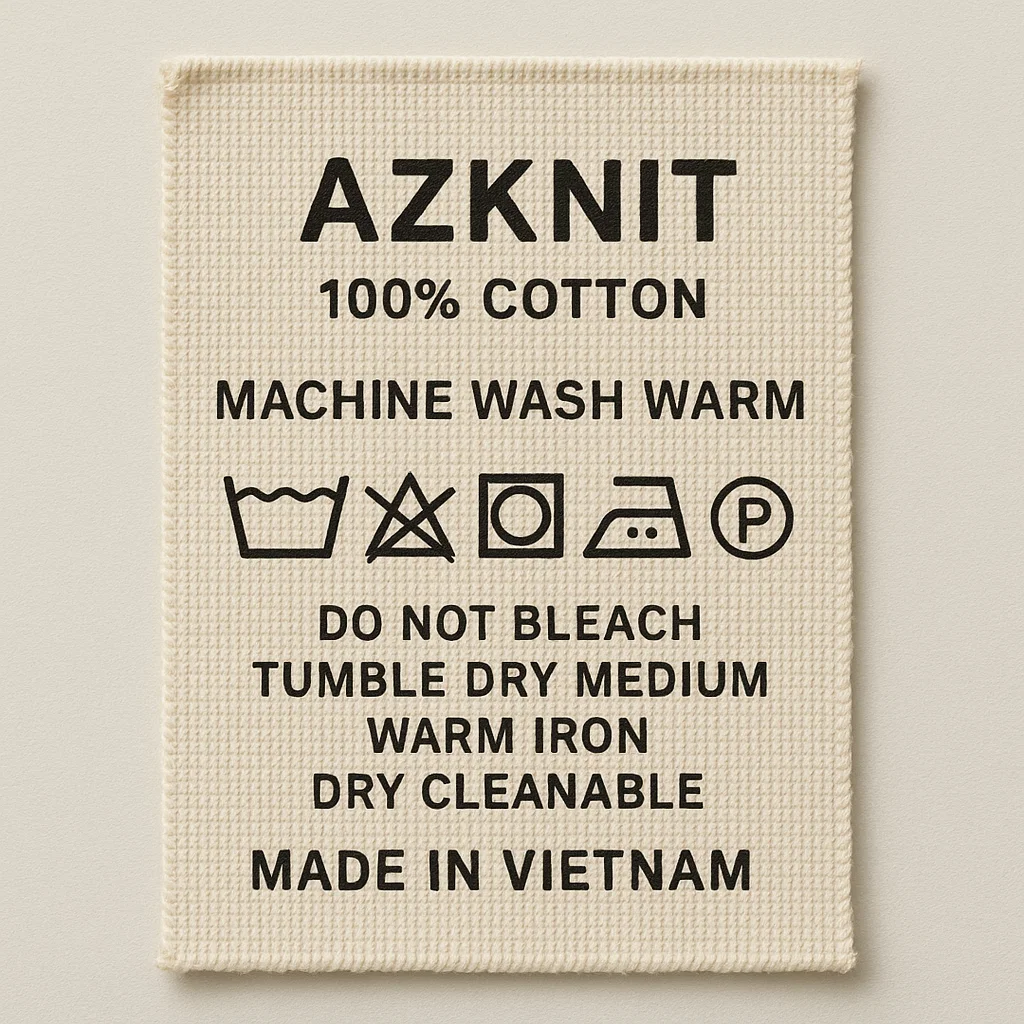
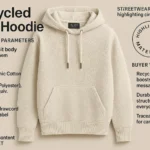
The phrase “100% cotton hoodie” is one of the most misused descriptors in apparel marketing. As someone who has spent years reviewing mill sheets and approving lab dips, I can tell you that what a label says and what a garment physically is are often two different things.
For the purist, the search for a truly all-cotton hoodie is often a frustrating exercise in reading fine print. Brands often conflate the fiber content of the face yarn (what you touch on the outside) with the total garment composition. They rely on regulatory loopholes that allow them to ignore trims, stitching, and secondary fabrics.
To understand what you are actually buying, you have to look past the marketing copy and understand the garment at the yarn and knitting level.
1. Defining the “100% Cotton” Standard
To a materials editor, “100% cotton” is a technical specification, not just a vibe. However, there are three distinct levels of “purity” in the market, and recognizing the difference is critical.
The “Body Only” Standard
This is the most common category. The brand claims the hoodie is 100% cotton, but they are referring exclusively to the main body panel fabric (the chest, back, and sleeves). The ribbing at the cuffs and hem almost certainly contains 3–5% elastane (Spandex/Lycra) for recovery. The drawcord might be a poly-blend, and the neck tape (the strip covering the seam at the back of the neck) is likely polyester. Legally, they can often still label the garment “100% Cotton” on the main hangtag, provided the care label specifies “Exclusive of Trims.”
The “Face Side” Misdirection
This is deceptive but common in lower-tier fast fashion. A fabric might be marketed as “Cotton Fleece,” but it is actually a distinct knit construction where the face yarn (the outside) is cotton, but the loop yarn (the inside that gets brushed) is polyester. This is technically a CVC (Chief Value Cotton) blend, often resulting in a 60/40 or 80/20 split. If a brand screams “Cotton Feel” rather than “100% Cotton,” you are likely looking at this hybrid.
The True All-Cotton Construction
This is the rarest tier. A genuine 100% cotton hoodie means:
-
Body Fabric: 100% cotton yarn.
-
Ribbing: 100% cotton rib knit (relying on mechanical stretch rather than chemical elasticity).
-
Thread: Cotton (or cotton-wrapped) thread, though poly-core thread is often forgiven for durability.
-
Trims: Cotton drawcords and canvas neck tape.
2. Types of 100% Cotton Constructions
If you have verified that the fiber is indeed all cotton, the next variable is the knit structure. Cotton behaves radically differently depending on how the loops are formed and finished.
French Terry (Loopback)
This is the gold standard for high-end cotton hoodies. If you turn the fabric inside out, you will see distinct loops of yarn, resembling a towel.
-
Hand Feel: Dry, textured inside; smooth outside.
-
Warmth: Moderate. The loops trap air, but it breathes exceptionally well.
-
Durability: High. Because the loops aren’t broken (brushed), the fabric maintains its structural integrity longer.
-
Shrinkage: Moderate. The loops have room to tighten, so pre-shrinking at the factory level is essential.
Brushed Fleece
Here, the mill takes a loopback fabric and runs it through mechanical wire brushes. This tears the loops apart, creating a fuzzy, chaotic napping.
-
Hand Feel: Soft, plush, and cozy against the skin.
-
Warmth: High. The destroyed fibers create more loft, trapping more body heat.
-
Durability: Lower than terry. The brushing process weakens the yarns. 100% cotton fleece will eventually mat down and lose its fluff after repeated washing, unlike poly-blends which stay fluffy forever.
Heavyweight Jersey
Imagine a t-shirt fabric, but knitted with much coarser yarn and a tighter gauge to reach a high weight (300+ GSM).
-
Hand Feel: Dense, rugged, and uniform on both sides. No loops, no fuzz.
-
Durability: Extreme. This is built like armor.
-
Drape: Stiff. It tends to sit away from the body rather than draping over it.
Organic vs. Conventional
From a tactile perspective, organic cotton is not inherently softer than conventional cotton. The “softness” usually comes from the finishing agents (softeners) applied at the mill. However, organic cotton (GOTS certified) ensures the absence of toxic pesticides and usually implies a longer staple length (fiber length), which results in a smoother yarn that pills less over time.1
3. Why Most Hoodies Are NOT 100% Cotton
If cotton is so comfortable, why is the market dominated by 80/20 (Cotton/Poly) blends? It rarely comes down to just “cheapness.” There are valid manufacturing and performance reasons why brands dilute cotton.
1. The “Bagging Out” Problem
Cotton is a fiber with low elasticity and poor memory.2 If you push up the sleeves of a 100% cotton hoodie, the cuffs will eventually stretch out and hang loose. Synthetic elastane is added to ribbing to provide the “snap back” (recovery) that modern consumers expect. A 100% cotton rib relies entirely on the density of the knit for structure; once that mechanical structure relaxes, it stays relaxed until washed and dried.
2. Loft and Weight
Polyester is lighter and stronger than cotton. By adding polyester to the backing (the inside fuzz), manufacturers can create a hoodie that feels thick and puffy but remains lightweight. A 100% cotton hoodie of the same thickness would be significantly heavier and denser.
3. Color Fastness
Cotton is a natural fiber that bleeds.3 It loses dye molecules during washing (crocking). Polyester holds dye relentlessly. Blends are often used to ensure that a black hoodie stays jet black after 20 washes, whereas a 100% cotton hoodie will develop a vintage, charcoal patina.
4. Shrinkage Stabilization
Cotton fibers swell when wet and contract when dried.4 A pure cotton garment can shrink 3–8% in length and width depending on how it was finished. Polyester stabilizes the matrix, preventing the garment from twisting (torque) or shrinking significantly.
4. How to Identify a Real 100% Cotton Hoodie
You are in a store or looking at a sample. How do you confirm authenticity without a lab test?
The “Cold Touch” Test
Place your hand on the exterior fabric. 100% cotton feels cool to the touch initially and warms up slowly. Poly-blends often feel slightly clammy or insulate immediately.
The “Crunch” Test
Scrunch the fabric in your fist and release. 100% cotton makes a soft, distinctive “crunch” or “rustle” sound and will hold wrinkles slightly. Poly-blends are silent and spring back open immediately.
Check the Ribbing
Pull the cuff horizontally.
The Pilling Check (For Used/Vintage Items)
Look at the high-friction areas (underarms).
-
Tight, hard little balls: These are “pills” anchored by strong polyester fibers holding the broken cotton fibers.
-
Loose fuzz that pulls off easily: This is characteristic of 100% cotton. Cotton fibers break and fall away; they don’t hold on to form hard pills as aggressively.
Weight vs. Thickness
If a hoodie looks incredibly thick and puffy but feels surprisingly light when you pick it up, it is almost certainly a poly-blend. Real heavyweight cotton is dense and heavy in the hand.5
5. Pros and Cons: An Honest Analysis
Choosing 100% cotton is a trade-off. You are prioritizing feel and aging over stability.
| Feature |
100% Cotton Hoodie |
Cotton/Poly Blend |
| Breathability |
Excellent. Air passes through fibers. |
Poor. Traps heat and moisture. |
| Odor Control |
Good. Does not retain body oils/smell. |
Poor. Synthetics hold odor bacteria. |
| Aging |
High. Fades and softens beautifully. |
Low. Stays looking “new” but feels plasticky. |
| Drying Time |
Slow. Can take a full cycle to dry. |
Fast. Hydrophobic fibers shed water. |
| Shape Retention |
Low. Elbows and cuffs may bag out. |
High. Maintains silhouette all day. |
| Pilling |
Low/Soft. Pills fall off naturally. |
High. Hard pills form over time. |
Note on Shrinkage: If you buy a 100% cotton hoodie, assume it will shrink. Even “pre-shrunk” cotton will move. Wash it cold and hang dry, or buy a size up if you plan to use the dryer.
6. Use-Case Guidance
Who is the 100% cotton hoodie actually for?
The “Work from Home” Professional
If you are sitting at a desk for 8 hours, breathability is paramount. Poly-blends can create a micro-climate against the skin that leads to overheating. 100% cotton regulates temperature naturally.
The Sensitive Skin / Allergy Sufferer
For those with eczema or contact dermatitis, polyester and the chemical finishes often used on blends can be irritants.6 An un-dyed or natural-dye 100% organic cotton hoodie is the safest apparel choice available.
The Sustainability Advocate
Every time you wash a synthetic garment, it sheds microplastics into the water system.7 A 100% cotton hoodie sheds biodegradable cellulose. Furthermore, at the end of its life, a pure cotton hoodie is compostable (minus the zipper/thread); a blend is landfill-bound.
Who Should AVOID It?
-
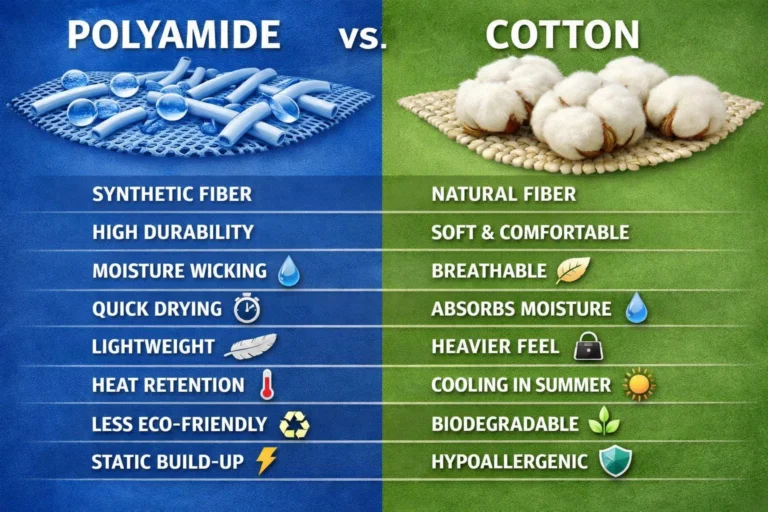
Athletes: Cotton absorbs 27 times its weight in water. If you sweat in a cotton hoodie, it stays wet, becomes heavy, and can cause chilling.
-
Travelers: It is heavy to pack and impossible to dry in a hotel room sink overnight.
7. Closing Insight
A 100% cotton hoodie is not objectively “better” in every metric—it is simply more honest. It doesn’t hide its wear patterns; it doesn’t trap your body heat in a plastic layer; and it doesn’t retain odors.
The shift toward 100% cotton in premium streetwear isn’t just a trend; it’s a return to garments that age with the wearer rather than deteriorating on them. When you choose pure cotton, you are accepting that the cuffs might get a little loose and the black dye might fade to charcoal—but in exchange, you get a garment that feels like a natural extension of yourself, not a synthetic shell.
If you are ready to make the switch, start by checking the ribbing composition on the care label. It’s the small detail that reveals whether a brand is truly committed to the material or just marketing the concept.