1. Executive Summary
Tommy Hilfiger suits are generally considered “good” within the context of entry-level, mass-market tailoring, offering a reliable balance of modern aesthetics and accessible pricing. They are best suited for young professionals, students, or occasional wearers who prioritize a recognizable brand name and a modern fit over traditional sartorial craftsmanship. While they excel in style consistency and availability, they are limited by fused (glued) construction and the frequent use of synthetic blends, making them less ideal for enthusiasts seeking long-term durability or high-level garment breathability.
2. Brand Positioning and Suit Philosophy
Tommy Hilfiger is a pillar of “Classic American Cool,” a brand DNA built on preppy, varsity-inspired sportswear rather than the heritage of Savile Row or Milanese tailoring.1 Within the broader product mix, suits function as a lifestyle extension, allowing the brand to capture the customer’s needs for “graduating” into formal environments like weddings, graduations, and entry-level corporate roles.
Unlike heritage tailoring houses where the suit is the primary engineering focus, Tommy Hilfiger suits are often produced through licensing agreements (such as with Peerless Clothing in North America).2 This means the brand provides the aesthetic direction—lapel widths, button placements, and fabric patterns—while the manufacturing is handled by large-scale contractors. Consequently, the philosophy is one of “accessible aspirationalism”: providing a garment that looks expensive in a photograph or from a distance, optimized for a retail environment rather than a bespoke atelier.
3. Fabric Quality and Material Choices
The fabric selection in Tommy Hilfiger’s tailoring line reflects its mass-market positioning. Most of their suits fall into two categories: 100% wool or wool-synthetic blends.
-
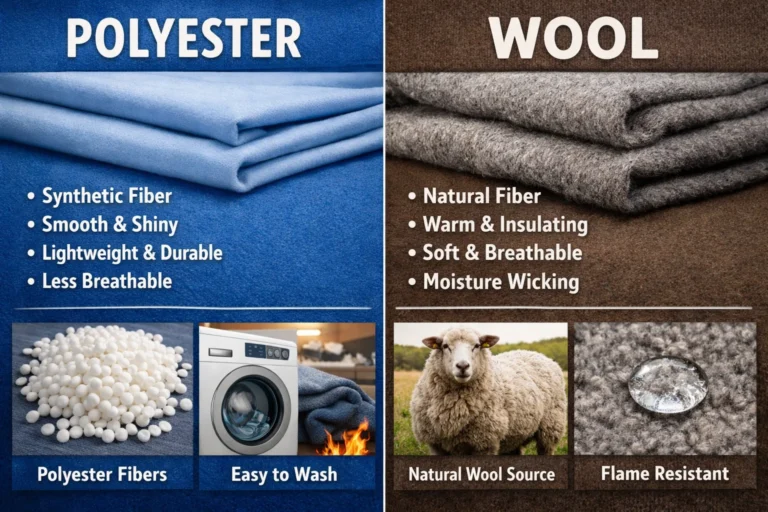
Wool Blends: At the entry-level price point (often found in department stores), fabrics frequently consist of wool mixed with polyester and elastane (spandex). The inclusion of polyester increases durability and reduces wrinkling, while elastane provides “mechanical stretch,” which appeals to a younger demographic accustomed to the comfort of knitwear. However, these blends suffer from reduced breathability and can develop a “synthetic shine” over time with repeated dry cleaning.
-
100% Wool: Mid-tier Hilfiger suits typically utilize “Super” wools, often in the Super 100s to 110s range. While these are respectable, they are usually sourced from high-volume mills rather than prestigious Italian or British houses. These fabrics offer better hand-feel and drape than blends but are still optimized for cost-efficiency.
-
Seasonal Weights: The brand typically sticks to “all-season” weights (approx. 250–280 GSM), which maximizes retail shelf life but may be insufficiently warm for true winter or too heavy for high-humidity summer.
4. Construction and Tailoring Methods
From a technical manufacturing standpoint, construction is where the distinction between “designer fashion” and “fine tailoring” becomes most apparent.
Fused Construction
The overwhelming majority of Tommy Hilfiger suits utilize fused construction. In this method, a secondary layer of interlining is glued to the outer wool fabric to provide shape and structure. While modern fusing technology has improved significantly, it remains inherently stiffer than a floating canvas. Over time, or through poor dry cleaning, the glue can degrade, leading to “bubbling”—a permanent deformity where the fabric separates from the lining.
Shoulder Structure and Padding
Hilfiger suits typically feature a structured, “American” shoulder with significant padding. This design is intentional; it creates an V-shaped silhouette even for wearers with less-developed physiques. However, for a seasoned suit buyer, this can feel restrictive and less “natural” than the soft, unconstructed shoulders found in Neapolitan tailoring.
Internal Finishing
The linings are almost exclusively polyester or acetate. While durable, these materials do not wick moisture as effectively as Bemberg (cupro), which is the standard for high-end tailoring. The internal seams are usually machine-finished, prioritizing speed and consistency over the hand-stitched details that allow a garment to move with the body.
5. Fit, Silhouette, and Wearability
The primary strength of Tommy Hilfiger lies in its mastery of the “Modern Fit.” The brand offers three main silhouettes:
-
Slim Fit: Characterized by high armholes, a tapered waist, and narrow lapels. This is the brand’s top performer, catering to the aesthetic demands of the current market.
-
Modern Fit: A middle ground that offers more room in the chest and trousers while maintaining a clean line.
-
Classic Fit: A more traditional, fuller cut primarily sold in North American department stores.
Wearability is high for short durations. The standardized sizing means that a customer who fits a 40R in a Hilfiger shirt is highly likely to find a 40R jacket that requires minimal alterations. This “plug-and-play” aspect is a significant value driver for the non-enthusiast consumer.
6. Durability and Long-Term Performance
In terms of longevity, Tommy Hilfiger suits are designed for a lifecycle of approximately 2 to 4 years of occasional wear (once or twice a week).
-
Fabric Wear: The high-friction areas—the crotch of the trousers and the elbows—are prone to thinning more quickly in the lower-tier wool/poly blends.
-
Shape Retention: Because the structure is glued rather than sewn, the jacket may lose its “roll” in the lapel after a few years, becoming flat and lifeless.
-
Buttons and Trims: Buttons are typically plastic (resin) rather than horn or mother-of-pearl. While they are functional and durable, they lack the aesthetic depth of natural materials and may crack if handled roughly by commercial laundry presses.
7. Price-to-Value Assessment
To evaluate value, one must distinguish between the MSRP (Manufacturer’s Suggested Retail Price) and the Market Price.
-
At Full MSRP ($500 – $700): The value proposition is relatively weak. At this price point, consumers are paying a significant premium for the Tommy Hilfiger “flag” logo and marketing. In this range, specialized “Direct-to-Consumer” tailoring brands often offer half-canvas construction and better fabrics.
-
At Discount/Outlet Prices ($200 – $350): The value proposition is excellent. At this tier, it is difficult to find a better-fitting, more stylish suit that doesn’t require extensive bespoke tailoring. For a “first suit” or a workhorse garment for a junior associate, the price-to-performance ratio is highly competitive.
8. Comparison With Key Competitor Categories
| Feature |
Tommy Hilfiger |
Entry-Level Premium (e.g., SuitSupply) |
Department Store (House Brands) |
| Construction |
Fused |
Half-Canvas |
Fused |
| Fabric |
Wool/Poly or Basic Wool |
S110s – S150s Italian Wool |
Mostly Synthetic Blends |
| Fit Style |
Modern/Slim American |
Slim European |
Boxy/Classic |
| Brand Identity |
High (Global Lifestyle) |
Moderate (Specialist) |
Low (Generic) |
| Price Point |
Mid |
Mid-High |
Low-Mid |
While Tommy Hilfiger dominates in brand recognition, it often lags behind specialists like SuitSupply or Spier & Mackay in terms of technical construction (canvas vs. fuse). However, it consistently outperforms generic department store brands in terms of silhouette and “shelf appeal.”
9. Common Misconceptions About Branded Suits
A frequent error among consumers is the “Designer Fallacy”—the belief that a famous fashion logo automatically correlates with superior tailoring expertise.
-
Tailoring Expertise: As noted, Hilfiger is a sportswear brand. Their suits are a product of successful supply chain management and brand licensing, not a lineage of master tailors.
-
Price vs. Quality: In the $600 range, a Hilfiger suit is often “less suit” technically than a $400 suit from a tailoring specialist. The extra $200 pays for the global advertising campaigns and the retail real estate the brand occupies.
-
Consistency: Not all Hilfiger suits are equal. Suits found in premium boutiques are often constructed differently than those manufactured specifically for “off-price” outlet malls.
10. Who Should and Should Not Buy Tommy Hilfiger Suits
The Ideal Buyer
-
The “One Suit” Man: Someone who needs a suit for two weddings and one funeral a year. The modern fit ensures they look current without needing to research tailoring.
-
The Entry-Level Professional: Those who need a recognizable brand for social proof in a corporate environment but are working with a limited initial wardrobe budget.
-
The “Difficult Fit” with a Standard Frame: Men who find that “Modern Fit” off-the-rack sizing fits them perfectly without the cost of a tailor.
Who Should Look Elsewhere
-
The Sartorial Enthusiast: Anyone who values a “lapel roll,” hand-finished buttonholes, or the longevity of a half-canvas chest piece.
-
High-Heat Environments: Professionals in tropical climates will find the polyester linings and fused interlinings too restrictive and hot.
-
The Investment Shopper: If the goal is a suit that will last ten years and mold to the body, a fused Tommy Hilfiger garment will likely fail to meet expectations.
Conclusion
Tommy Hilfiger suits represent a successful execution of “commercial tailoring.” They are not masterpieces of the craft, nor are they intended to be. Instead, they are highly engineered retail products designed to provide a specific aesthetic—the “American Dream” look—to a wide audience at a predictable price point. As long as the buyer understands they are purchasing a fused, fashion-forward garment rather than a piece of heirloom tailoring, the brand provides a reliable and stylish solution for modern formal needs.
Would you like me to conduct a similar deep-dive analysis on a specific competitor brand, such as SuitSupply or Hugo Boss, to compare their construction methods?