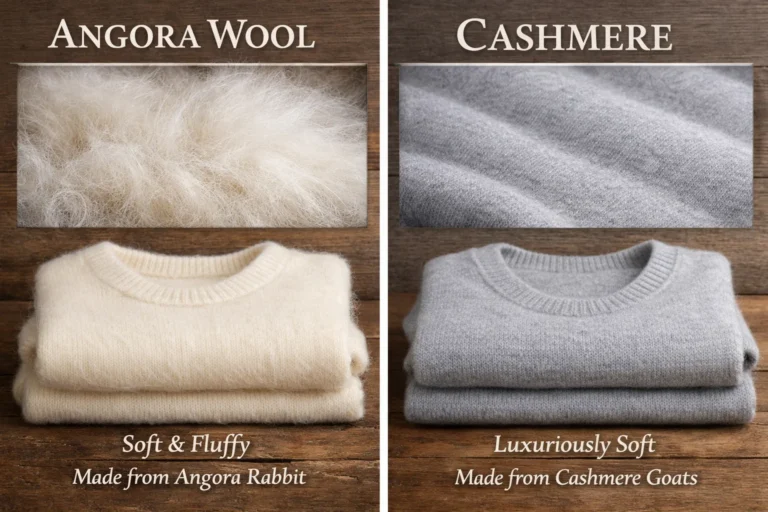
Cashmere is obtained from the soft undercoat of cashmere goats, through a careful, multi-step process that focuses on collecting fine fibers without harming the animal. The method of collection and processing is what gives cashmere its softness, warmth, and high value.
Cashmere goats develop two layers of hair during cold seasons:
Only the undercoat fibers are used to make cashmere.
The process works as follows:
First, seasonal fiber growth
Cashmere goats naturally grow their fine undercoat in winter. As temperatures rise in spring, the goats begin to shed this layer naturally.
Second, fiber collection (combing or shearing)
During spring molting, the undercoat is collected in one of two ways:
-
Hand combing (preferred): The goat is gently combed to remove loose undercoat fibers. This produces the highest-quality cashmere because it minimizes coarse hair contamination.
-
Shearing (less precise): The goat is shorn, and the usable cashmere must later be separated from coarse guard hairs.
Hand-combed cashmere is softer, finer, and more expensive.
Third, sorting and cleaning
After collection, the raw fiber is:
-
Sorted by hand to remove coarse hairs
-
Cleaned to remove dirt, grease, and debris
At this stage, a large percentage of the raw material is discarded. Only a small portion becomes usable cashmere, which contributes to its high cost.
Fourth, dehairing
The fibers go through a mechanical dehairing process to separate the fine undercoat from remaining coarse hairs. This step is critical for achieving cashmere’s signature softness.
Fifth, spinning and yarn production
The purified fibers are then:
Sixth, knitting or weaving
The finished yarn is used to produce sweaters, scarves, blankets, and other textiles through knitting or weaving processes.
Key facts about cashmere production:
-
One goat yields only about 150–200 grams of usable cashmere per year
-
High-quality cashmere comes from fibers that are long, fine, and uniform
-
Major sourcing regions include Mongolia, China, and parts of Central Asia
In summary, cashmere is obtained by collecting, cleaning, and refining the naturally shed undercoat of cashmere goats, through a labor-intensive process that prioritizes fiber quality. This limited yield and careful handling are the main reasons cashmere is prized for its warmth, softness, and luxury status.
Azknit provides oem/odm service for knitwear. Help to create your own brands knitwear series like sweater, hoodie, cardigan, dresses and tank tops.
Azknit has been working with more than 30+ worldwide brands and finished more than 100 samples each months.
Feel free to contact for your own design quote.