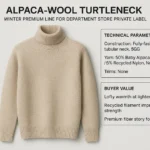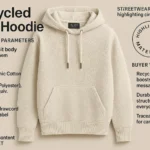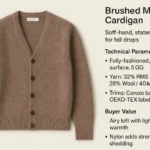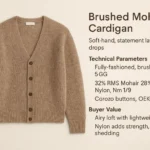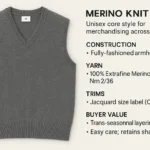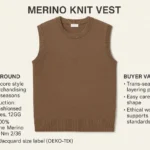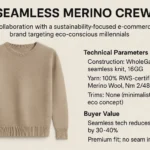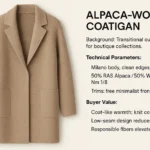

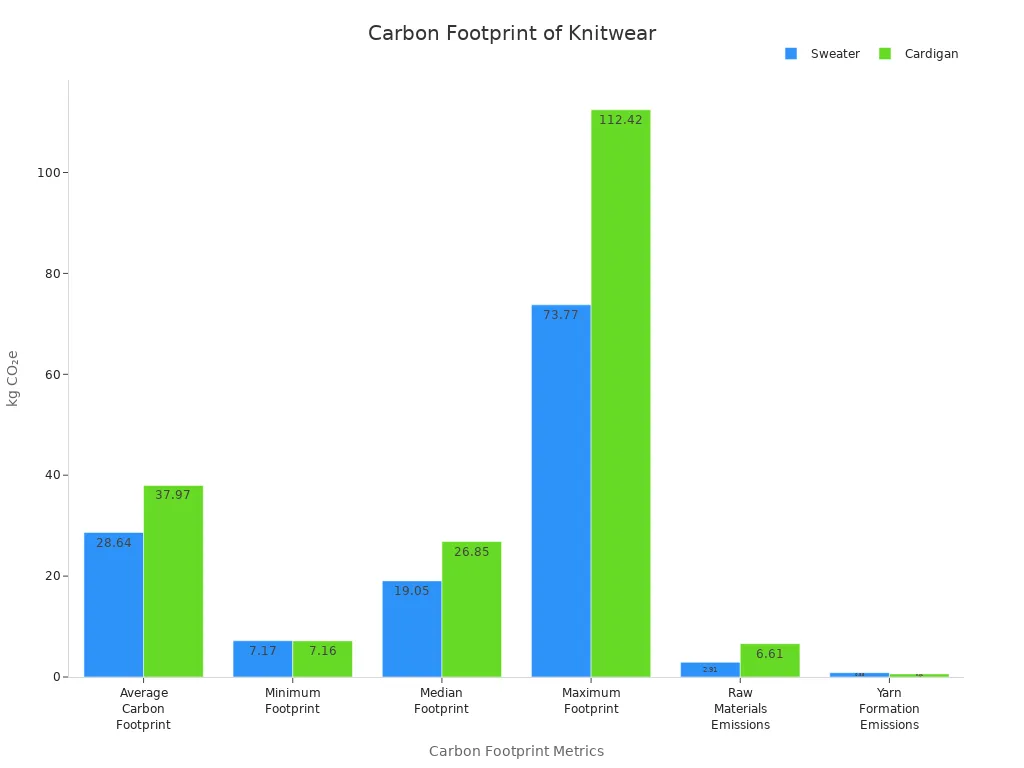
You may ask how your sweater or cardigan affects the earth, particularly in terms of the carbon footprint of knitwear manufacturing. Studies say making a sweater uses 28.64 kg CO₂e, while making a cardigan uses 37.97 kg CO₂e. The chart below shows these numbers:
Experts find these numbers by looking at emissions related to the carbon footprint of knitwear manufacturing. They check raw materials, production, transport, and disposal. You help by picking products with less impact. You also help by supporting sustainability. Knowing these facts helps you choose to protect the planet.
Key Takeaways
A sweater makes about 28.64 kg CO₂e. A cardigan makes about 37.97 kg CO₂e.
Picking knitwear made from organic cotton or recycled stuff can lower your carbon footprint a lot.
Washing knitwear in cold water and letting it air-dry can save up to 20% of energy and water.
The fiber type matters. Wool has a bigger carbon footprint than cotton. Synthetic fibers can also be bad.
Dyeing and finishing steps cause a lot of pollution. Choose brands that use low-impact dyes.
Packaging and shipping add to the carbon footprint. Buy from brands that use less or recycled packaging.
Recycling or giving away old knitwear instead of tossing it helps cut down on landfill waste and pollution.
Every choice you make, from what you buy to how you care for clothes, can help protect the planet.
Carbon Footprint of Knitwear Manufacturing
Average Emissions per Garment
Sweater and Cardigan Data
You may wonder how much carbon comes from one sweater or cardigan. Studies say a sweater makes about 28.64 kg CO₂e. A sweater usually weighs around 478.83 grams. Cardigans have a carbon footprint of 37.97 kg CO₂e during their life. These numbers show how each item you buy affects the earth.
Range and Median Values
The carbon footprint of knitwear manufacturing can be very different. Here are some important numbers:
Sweaters can make as little as 7.17 kg CO₂e or as much as 73.77 kg CO₂e. This is from a study of over 123,000 sweaters.
Cardigans have a bigger range, from 7.16 kg CO₂e up to 112.42 kg CO₂e.
The median for cardigans is 26.85 kg CO₂e. This means half of cardigans are below this number, and half are above.
These numbers show that not all knitwear is the same. Your choices can help lower your impact.
Calculation Methods
You might ask how experts get these numbers. They use different ways to measure the carbon footprint of knitwear manufacturing:
Energy use: This checks the electricity and fuel for spinning, knitting, and dyeing.
Raw material production: This counts emissions from growing cotton, raising sheep for wool, or making synthetic fibers.
Water use: This includes energy for treating and heating water, especially for dyeing and finishing.
Waste management: This tracks emissions from throwing away or burning textile waste.
Each step adds to the total carbon footprint. If you know these steps, you can see where most emissions come from.
Influencing Factors
Many things can change the carbon footprint of knitwear manufacturing. The fiber type is very important. Here is a table to help you compare:
Fiber Type | Carbon Footprint Contribution (CO₂e) |
|---|---|
Cotton | Least contribution |
Wool | Most contribution |
Organically produced cotton | Less than half of conventional cotton |
Synthetics | Higher than plant-based fibers |
You should also think about what happens after you buy your knitwear. About 80% of a garment’s carbon footprint comes from washing it. Heating water for washing is 90% of that footprint. If you wash sweaters by hand in cold water, you can lower emissions.
Tip: Pick knitwear made from organic cotton or wash your clothes in cold water to help the planet.
Production Stage Breakdown
Raw Materials
Farming and Extraction
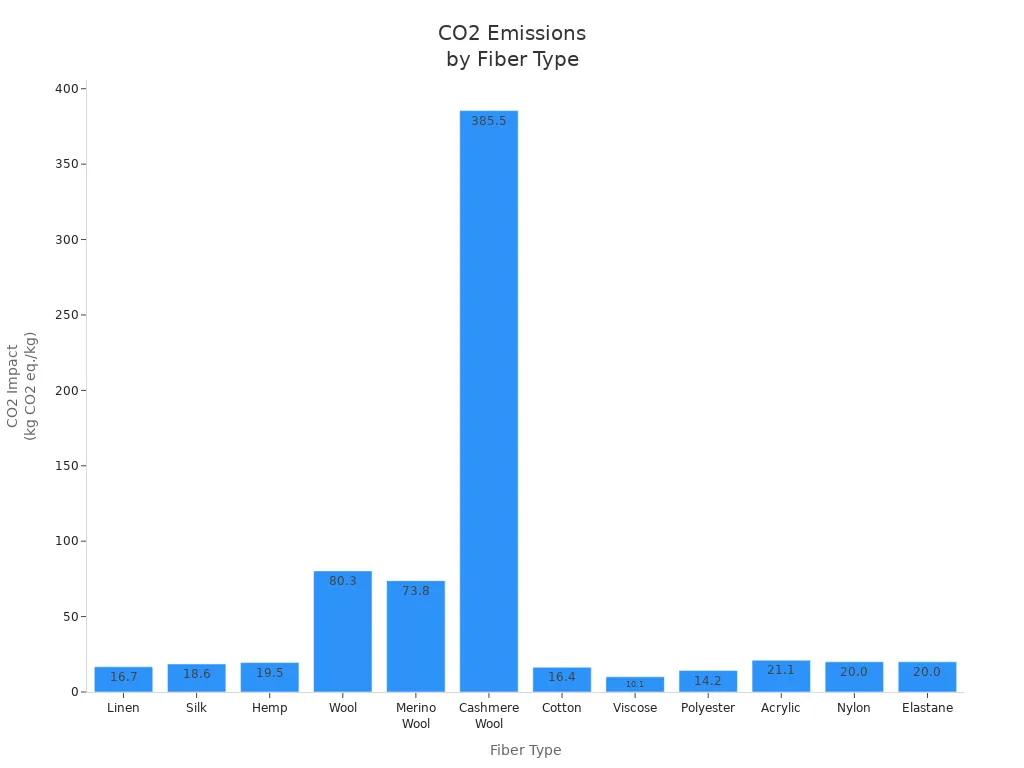
Knitwear starts with raw materials. The fiber you pick matters a lot. Some fibers need more water and energy. Others need less. Look at this table to see how much carbon each fiber makes:
Fiber Type | |
|---|---|
Linen | 16.7 |
Silk | 18.6 |
Hemp | 19.5 |
Wool | 80.3 |
Merino Wool | 73.8 |
Cashmere Wool | 385.5 |
Cotton | 16.4 |
Viscose | 10.1 |
Polyester | 14.2 |
Acrylic | 21.1 |
Nylon | 20.0 |
Elastane | 20.0 |
Wool and cashmere make much more carbon than cotton or polyester. Organic cotton is special because it uses less water and energy. Here are some facts about picking raw materials:
Organic cotton uses 91% less water and 62% less energy than regular cotton.
Polyester makes 9.5 kg of CO2 for every kilogram of fabric.
Recycled polyester uses 59% less energy than new polyester. It also keeps waste out of landfills.
Organic cotton can cut greenhouse gases by 46% compared to regular cotton.
Transport
After farming or getting fibers, they go to factories. Trucks, ships, and trains move these fibers. Transport adds to the carbon footprint. But it is usually less than farming or extraction. You can help by buying knitwear made near you.
Yarn Formation
Spinning Energy
Factories turn fibers into yarn. Machines do this job. They need electricity to work. The fiber type changes how much energy is needed. Here is a table to compare:
Fiber Type | CO2-e Contribution |
|---|---|
Cotton | Lowest |
Wool | Highest |
Synthetic Fibers | High |
Wool needs the most energy to spin into yarn. Cotton uses the least energy. Synthetic fibers like polyester use a lot, but less than wool. The energy used here adds to the carbon footprint.
Knitting and Assembly
Machine Use
Yarn is knitted into fabric by machines. These machines use electricity. How much energy they use depends on the machine and time. You can help by picking brands that use clean energy in their factories.
Facility Emissions
Factories also make emissions from other things. These include heating, lighting, and running other equipment. Microplastic shedding is another problem. When machines knit or finish fabric, tiny fibers break off. These fibers can go into the air or water. Here are some main sources of emissions during knitting and assembly:
Microplastic shedding happens during dry processes like knitting.
Knitting machines break fibers off the yarn.
Surface treatments like brushing or sanding make more loose fibers.
Note: Microplastic pollution is a big problem. You can help by washing knitwear less often and using a laundry bag that catches fibers.
When you know about each stage, you see how your choices matter. Picking better materials and cleaner factories can lower the impact of your knitwear.
Dyeing and Finishing
Chemicals and Water
Factories use lots of water and chemicals to dye and finish knitwear. Water mixes with dyes and chemicals to set colors and make fabric soft. The amount used depends on the process and machines. Look at the table to see how much water and chemicals each step needs:
Process | Water Consumption (L/kg) | Chemicals Involved |
|---|---|---|
Cotton Cultivation | Up to 20,000 | N/A |
Dyeing | 35 – 215 | Dyes, salts, chemicals |
Fabric Finishing | 60 – 314 | Dyes, chemicals, salts |
Old Technology | Up to 645 | High chemical oxygen demand (COD), dyes |
Older machines use more water and chemicals. Newer machines use less, but dyeing and finishing still need a lot. The textile industry uses about 93 billion cubic meters of water each year. Making one cotton T-shirt can use over 2,600 liters of water. You help by picking brands that use less water and safer chemicals.
Tip: Choose knitwear with “low-impact dye” or “water-saving process” labels. These use fewer chemicals and less water.
Wastewater
After dyeing and finishing, factories have dirty water left over. This water has dyes, salts, and other harmful stuff. If factories do not clean this water, it can hurt rivers and soil. Dyeing and finishing can use up to 125 liters of water for every kilogram of cotton fiber. Wastewater often has chemicals that do not break down and can harm nature.
See the table below for the impact:
Aspect | Value |
|---|---|
Carbon Footprint (per ton of dyed cotton) | |
Energy Footprint (per ton of dyed cotton) | 3,405.30 kg oil eq |
Freshwater Ecotoxicity Footprint | 2.01 × 10⁵ PAF·m³·d |
Contribution of Dyeing Phase to Environmental Impacts | 56.3%–85.6% |
Dyeing and finishing can be more than half of knitwear’s environmental impact. If factories do not clean wastewater, it makes the carbon footprint worse. You help by picking brands that clean their water and use safe dyes.
Packaging and Shipping
Packaging Impact
When you buy knitwear, it comes in packaging. Factories use boxes, plastic bags, and tags to protect products. Packaging adds to the carbon footprint, especially if it is plastic or not recycled. You help by picking brands that use recycled or less packaging.
Recycled packaging uses less energy.
Minimal packaging makes less trash.
Biodegradable packaging breaks down faster.
Note: You help the earth by reusing or recycling packaging when you can.
Distribution Emissions
Shipping knitwear from factories to stores and homes makes more pollution. Factories far away ship products long distances. Materials travel to factories, and finished knitwear travels again to you. Fast fashion means more trips and more pollution.
Emission Source | Contribution to Carbon Footprint |
|---|---|
Upstream Transportation and Distribution |
You help by buying local products or brands that ship smart. Fewer shipping steps mean less pollution. Every choice you make helps lower knitwear’s carbon footprint.
Material Impact Comparison
Wool, Cotton, Acrylic
Emissions per Kilogram
You might ask how much pollution comes from each fiber. Wool, cotton, and acrylic all affect the earth in different ways. The table below shows how much carbon each fiber makes for every kilogram:
Fiber | Carbon Emissions (kg CO₂ eq per kg) |
|---|---|
Wool | 80.3 |
Cotton | 5.9 |
Acrylic | 11.53 |
Wool makes the most carbon. Cotton makes the least. Acrylic is in the middle. If you pick a wool sweater, you add more carbon to the air than if you pick cotton or acrylic.
Land and Water Use
You should also think about how much land and water each fiber needs. Wool needs a lot more land than cotton. Wool uses 367 times more land than cotton. Making a wool sweater in Australia makes about 27 times more greenhouse gases than a cotton sweater. Cotton needs lots of water to grow. Farmers use chemicals that can get into rivers and lakes. Acrylic does not need land, but it comes from oil and uses energy to make.
Wool uses the most land and makes the most greenhouse gases.
Cotton needs lots of water and can pollute water.
Acrylic uses oil and energy but does not need land.
Tip: To help the earth, pick cotton that uses less water or wool from farms that care for nature.
Blends and Recycled Fibers
Wool-Polyester Blends
Many sweaters use a mix of fibers, like wool and polyester. Mixing fibers makes clothes stronger and cheaper. But it is hard to recycle blended fabrics. Factories must use chemicals to pull the fibers apart. This costs a lot and does not happen often. Most blended fibers become waste or are reused for things that are not as good. This means blends are not as good for the earth as single-fiber clothes.
Recycled Materials
You can help the earth by picking knitwear made from recycled fibers. Using recycled fibers lowers the carbon footprint. For example, if you add 20% recycled polyester to a sweater, you can cut its carbon footprint by 4.5%. If all new polyester was recycled, the savings could be over 25%. Recycled fibers also save water and energy. They mean we do not need as much new cotton or polyester, which helps nature and animals.
Note: When you pick recycled knitwear, you help make cleaner clothes and save resources.
Recycled fibers make knitwear better for the earth. You help cut pollution and save energy when you pick recycled instead of new materials.
Carbon Footprint of a Sweater
Lifecycle Emissions
Every part of making a sweater adds pollution. Making yarn, wearing, and washing all matter. A sweater makes about 13.25 kg CO₂e. Some sweaters make only 8.5 kg CO₂e. Others can make up to 18 kg CO₂e. Most pollution comes from growing cotton or wool. Making fabric and shipping also add a lot.
Here is a table that compares recycled wool blend sweaters and pure wool sweaters:
Impact Category | Recycled Wool Blend Sweater | Virgin Pure Wool Sweater |
|---|---|---|
GHG Emissions (kg CO₂-e) | 0.05 | Higher |
Fossil Energy Demand (MJ) | 0.63 | Higher |
Water Stress (L H₂O-e) | 0.58 | Higher |
Freshwater Consumption (L) | 0.95 | Higher |
Manufacturing Contribution (%) | 54% | Higher |
Use Phase Contribution (%) | 43% | Higher |
Fiber Production Contribution (%) | ≤4% | Higher |
End of Life Contribution (%) | ≤4% | Higher |
Sweaters with recycled wool use less water and energy. Picking recycled materials helps lower pollution.
Use Phase (Washing, Drying)
How you wash your sweater changes its impact. Washing and drying use water and power. Washing a lot uses more water and energy. Good washing habits can save up to 20%. Bad washing can use 72% more energy and 87% more water. Drying does not add as much, but bad habits use 24% more energy. You help by washing less and air-drying.
Tip: Wash your sweater only when it is dirty. Let it dry in the air. This saves water and energy.
End-of-Life (Recycling, Disposal)
What you do with old sweaters matters. Throwing them away makes landfills pollute a lot. Landfills make 8,310 kg CO₂e for every 1,000 kg of waste. Recycling uses less energy. Chemical recycling makes only 218 kg CO₂e for natural sweaters. Mechanical recycling wastes 20% of the material but still helps.
End-of-Life Option | CO₂ Emissions (kg CO₂eq per 1000 kg textile waste) |
|---|---|
Landfilling | 8310 |
Chemical Recycling | 218 (natural apparel) / 34.8 (synthetic apparel) |
Mechanical Recycling | Less carbon-intensive, but with 20% material wastage |
You help by recycling or donating sweaters instead of throwing them away.
Comparison to Other Knitwear
Other knitwear also affects the earth. Wool sweaters pollute a lot because sheep make methane. Cashmere sweaters pollute even more, with 385.5 kg CO₂e for every kilogram. Alpaca sweaters are better for the planet. Alpaca fiber makes only 0.449 kg CO₂e per wear. Most pollution comes from making the fiber.
Fiber Type | Carbon Footprint (kg CO₂e per wear) | Major Emission Sources |
|---|---|---|
Alpaca | 0.449 | Fiber production (70%), Distribution (14.45%) |
Wool | Fiber procurement (over 50% emissions) | |
Cashmere | 385.5 kg CO₂e per kg | Fiber production impacts |
Picking alpaca or recycled fibers helps the earth. These choices lower pollution and protect nature.
Knitwear vs. Other Textiles
Emissions Comparison Table
You may wonder how knitwear compares to other clothes. The table below shows the average carbon footprint for each textile. It tells you how much carbon dioxide (CO₂e) each material makes for every kilogram.
Textile Type | Average Carbon Emissions (kg CO₂e per kg) |
|---|---|
80.3 | |
Cotton Knitwear | 5.9 |
Acrylic Knitwear | 11.5 |
Polyester (Woven) | 9.5 |
Cotton (Woven) | 6.7 |
Viscose (Woven) | 10.1 |
Linen (Woven) | 16.7 |
Silk (Woven) | 18.6 |
Wool knitwear makes much more carbon than cotton or acrylic. Woven polyester and viscose make less carbon than wool. But they make more than cotton. Cotton knitwear and woven cotton have the lowest emissions.
Note: These numbers can change if factories use different energy or methods.
Key Differences
Your choices matter when you pick clothes. Knitwear is different from other textiles in many ways:
Material Source: Knitwear uses natural fibers like wool or cotton. Other textiles, like polyester or viscose, come from oil or wood pulp.
Production Process: Factories use less energy to knit cotton. Making wool or synthetic fibers needs more energy. Woven textiles often need more steps and energy.
Sustainability: Sustainable knitwear uses organic and recycled fibers. These choices use fewer chemicals and less water. Picking these helps the planet.
Waste and Recycling: Knitwear with one fiber is easier to recycle. Blended fabrics are harder to recycle and often become waste.
Circular Economy: Choosing knitwear with recycled or organic fibers helps the circular economy. This means less waste and fewer emissions.
🌱 Tip: Pick knitwear made from organic or recycled materials. These choices use fewer resources and help cut pollution.
Sustainable knitwear makes less carbon than regular textiles. Using organic and recycled fibers saves water, energy, and land. You also help better farming and cleaner factories. When you pick knitwear made this way, you help make less waste and protect nature.
You can help the earth with every sweater or cardigan you buy. Make smart choices, and you help build a cleaner world.
Reducing Knitwear’s Carbon Footprint

Major Emission Sources
You can help lower knitwear’s carbon footprint by knowing where most pollution comes from. Factories pollute the most during these steps: Making raw materials like wool or cotton uses lots of energy. Spinning and knitting also need power. Dyeing and finishing use water and chemicals. Packaging and shipping add more pollution. Factories also make waste and use a lot of electricity. When you know these main problems, you can make better choices for the planet.
Reduction Strategies
You can help cut emissions by using smart ideas. Both brands and shoppers have a part to play. Here is a table with ways to lower pollution:
Strategy | Description |
|---|---|
Waste Reduction | Tries to make less waste during production to help the earth. |
Energy Efficiency | Uses less energy in factories to lower carbon emissions. |
Environmentally Friendly Techniques | Uses safer ways to make knitwear that are better for nature. |
Material Choices
You can pick materials that are better for the earth. Choose organic cotton, recycled polyester, or alpaca fibers. These use less water and energy. Wool and cashmere make more pollution, so try recycled wool or blends. When you buy knitwear made from recycled or organic fibers, you help the planet.
Tip: Look for tags that say “organic,” “recycled,” or “responsibly sourced.” These choices help nature.
Process Improvements
Factories can use new machines and better ways to save energy. They can recycle water and use safer dyes. Brands can work together to share good ideas and improve how they make things. Here are some ways factories can help: Use solar or wind power. Upgrade machines to use less electricity. Clean and reuse water for dyeing. Recycle scraps to make less waste. Working together and trying new things helps make knitwear greener.
Consumer Actions
You can help by making smart choices every day. Wash sweaters in cold water and let them air-dry. Buy fewer clothes and pick good quality. Donate or recycle old knitwear instead of throwing it away. You can also support brands that care about the earth.
Here are steps you can take: 1. Take care of your clothes in a green way. 2. Pick knitwear made with eco-friendly materials. 3. Support companies that use clean energy and make less waste.
🌱 Small changes in what you do can help the planet a lot.
You are important in making knitwear better for the earth. Every choice you make helps create a cleaner and greener future.
Wool and cashmere make the most carbon in knitwear. Dyeing and finishing use lots of water and chemicals. You can help by picking eco-friendly materials. You can also support yarn producers who care about the earth. Brands help by using clean energy and safe dyes. They can also reuse water in their factories. You help more when you wash clothes in cold water. Air drying saves energy too. Fixing, recycling, or giving away old clothes helps the planet.
Pick eco-friendly materials
Support yarn producers who are ethical
Wash clothes in cold water and air dry
Fix, resell, or recycle your knitwear
FAQ
What does “carbon footprint” mean for knitwear?
The carbon footprint is the total greenhouse gases made. It comes from making, using, and throwing away a sweater or cardigan. Every step adds to the carbon footprint.
Why does wool have a higher carbon footprint than cotton?
Sheep make methane, which is a strong greenhouse gas. Wool needs more land and energy to produce. Cotton uses less land and makes fewer emissions.
How can you lower the carbon footprint of your knitwear?
Wash your clothes in cold water. Let them air dry. Buy knitwear made from recycled or organic fibers. Donate or recycle old sweaters to help the earth.
Does recycled knitwear help the environment?
Recycled knitwear uses less energy and water. It keeps waste out of landfills. Picking recycled materials helps the planet.
Is packaging a big part of knitwear’s carbon footprint?
Packaging adds to the carbon footprint, especially if it is plastic. You can choose brands with recycled or less packaging. This helps reduce waste.
What is the best material for eco-friendly knitwear?
Organic cotton and recycled fibers have the lowest impact. Alpaca fiber makes less pollution than wool or cashmere.