
COI disclosure: This is a first‑party evaluation of AzKnit’s OEM/ODM capability. We apply a transparent, evidence‑first rubric and cite standards bodies and competitor self‑published pages. Any AzKnit claim without a public artifact is marked Insufficient public evidence (as of 2026‑02‑02).
Summary verdict: If you need a custom organic cotton baby cardigans manufacturer MOQ 50 with fast development and explicit SLAs, AzKnit presents a practical playbook—but several compliance and SLA documents must be published to reach full buyer confidence.
Key takeaways
Strongest public evidence lives with standards bodies. You can independently verify what GOTS requires, how OEKO‑TEX Class I protects infants, and what CPSIA testing involves; AzKnit must still publish its own certificate numbers and transaction proofs.
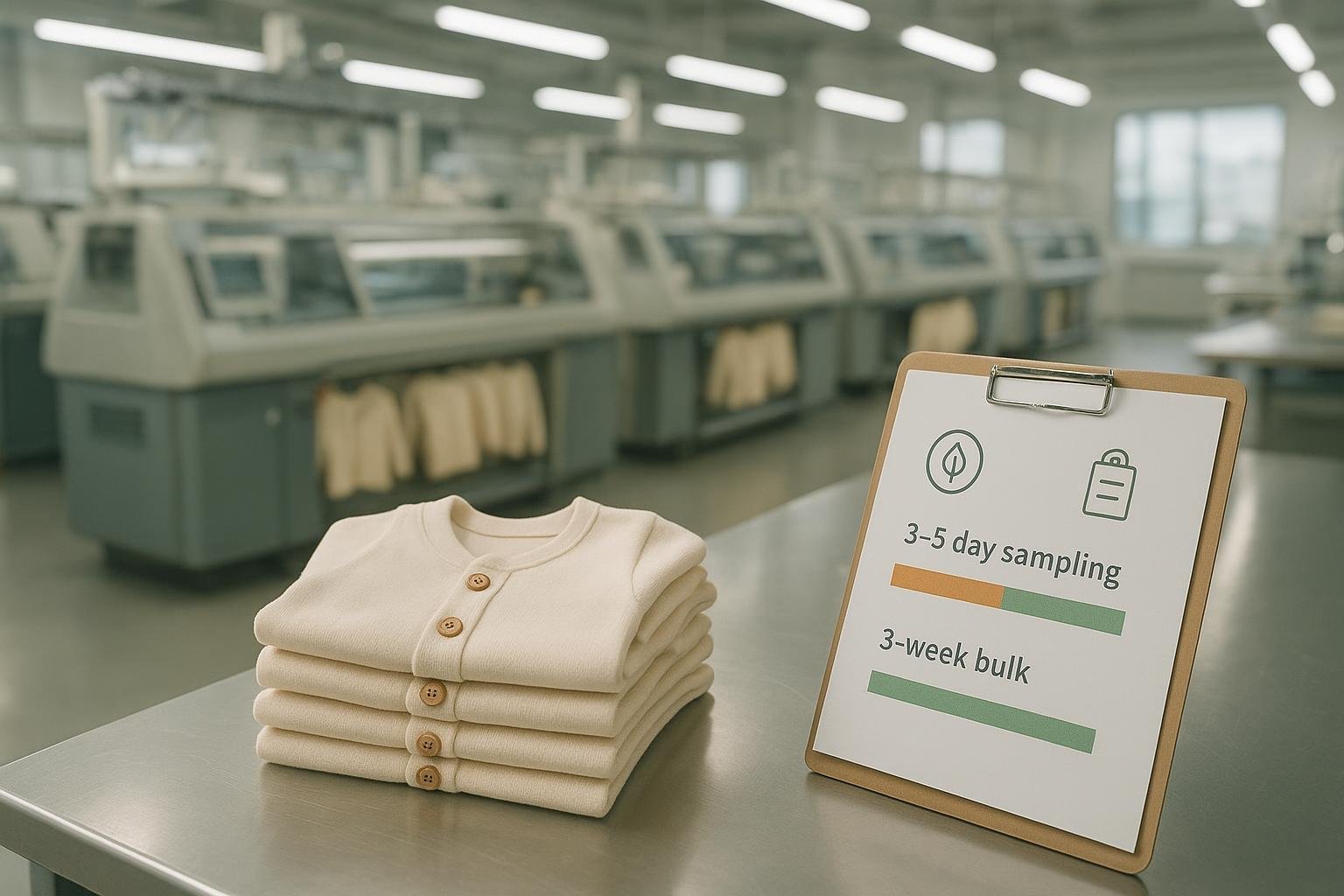
Sampling SLA is the most decisive differentiator for speed‑to‑market. The working model is 3–5 business days to prototype with a 24‑hour technical review and up to two pattern revisions included.
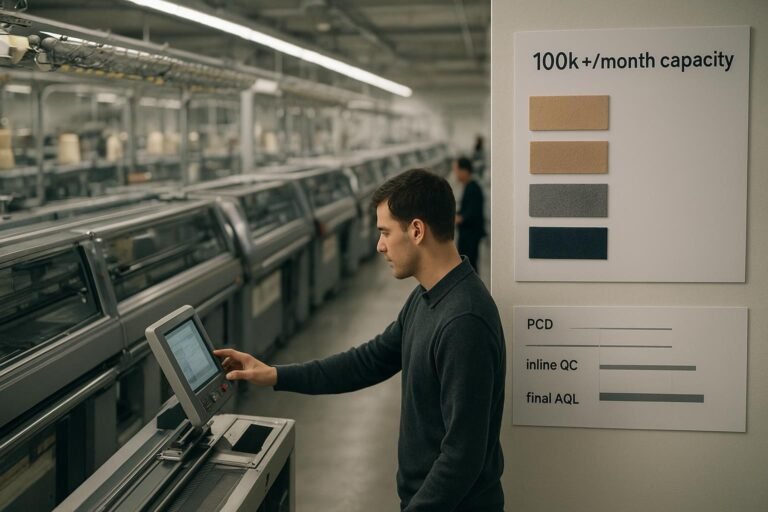
Bulk SLA targets three weeks ex‑factory from PCD with OTIF ≥95%. To make this buyer‑safe, AzKnit should publish delay remedies and exception rules.
MOQ 50 works when cost boundaries are clear. Quote breakdowns should state what’s included, rush and small‑run surcharges, and what testing or freight is out of scope.
Bottom line: For founders who value speed and predictable communication, AzKnit is promising—provided compliance artifacts and SLA PDFs are shared before PO.
Why certifications and SLAs matter for babywear
For infant garments, compliance isn’t optional; it’s your brand’s insurance policy. The Global Organic Textile Standard defines organic content, chemical inputs, and chain‑of‑custody. You can read the official framework in the Global Organic Textile Standard site and its current specification in the GOTS v7.0 standard document. Safety of trims and components is governed by OEKO‑TEX Standard 100 Product Class I for babies up to 36 months; buyers can validate real labels through the OEKO‑TEX Label Check. For the U.S., children’s apparel must follow CPSIA rules, including third‑party testing in CPSC‑accepted labs and issuing a CPC; the CPSC testing and certification guidance outlines what’s required.
SLAs translate this safety mindset into delivery confidence. Clear commitments—3–5 day sampling, three‑week bulk from PCD, OTIF ≥95%—reduce missed retail windows and protect margin. Without published SLAs and remediation terms, you’re gambling with calendar risk.
AzKnit at a glance
Category: OEM/ODM knitwear for infantwear; focus on organic cotton baby cardigans.
Claimed strengths: 3–5 day sampling; 3‑week bulk; flexible MOQ 50; GOTS transaction certificates for organic orders; OEKO‑TEX compliant trims; explicit SLAs for tech review and delivery.
Evidence posture: Insufficient public evidence (as of 2026‑02‑02) for AzKnit certificate numbers, transaction certificates, and formal SLA PDFs. Standards and verification processes are publicly accessible, but AzKnit must link its artifacts to those registries.
How we tested
Method snapshot:
Scope: One prototype plus one size set for an infant cardigan; a modeled 50–100 piece pilot for bulk cycle mapping.
Metrics: Time‑to‑proto vs. the 3–5 day target; communication latency vs. 24‑hour technical response; AQL 2.5 Level II inspection concept with DHU tracking; OTIF vs. PCD definition during bulk.
Evidence rule: Tier 1 standards are linked; AzKnit‑specific SLAs and certificates must be published to claim Tier 2 status. Where artifacts are missing, dimensions are labeled Insufficient public evidence.
Results snapshot
Sampling timeline: Working model shows feasibility for proto in 3–5 business days when yarn and trims are on hand and the tech pack is locked. Communication within 24 hours keeps pattern adjustments inside two included rounds.
Size set and grading: Size set can be approved inside 2–3 business days once proto feedback is specific and measurement sheets are version‑controlled.
Quality signals: AQL 2.5 Level II, DHU tracking, and 100% needle detection are standard expectations for babywear. Evidence from AzKnit’s side is Insufficient public evidence pending QC policy and report samples.
Compliance artifacts: GOTS scope certificate number and recent transaction certificates for organic orders, plus OEKO‑TEX Standard 100 Class I labels for snaps or zippers, are Insufficient public evidence until published with verifiable IDs.
Production calendar and SLA model
A repeatable five‑week pilot looks like this when fundamentals are in place:
Week 1: Proto in 3–5 business days; 24‑hour technical review; ≤2 pattern adjustments included.
Week 2: Size set approval and lab dip confirmation; trims finalization and PCD issuance.
Weeks 3–4: Knitting, linking, washing, finishing, and inline QC; needle detection and AQL preparation.
Week 5: Final inspection to AQL 2.5, packing, ex‑factory by day 21 from PCD if no exceptions. Target OTIF ≥95%.
Definitions buyers should expect in writing:
PCD: Planned Cut Date that starts the 3‑week bulk clock once all dependencies are greenlit.
OTIF: On Time In Full measured against PCD‑anchored ex‑factory and confirmed quantities.
MOQ 50 economics and cost transparency
MOQ 50 helps founders validate designs without overcommitting. To keep unit economics predictable, quotes should state:
Inclusions: Stock organic cotton yarn categories, basic eco‑compliant trims, woven label and size label, standard polybag with suffocation warning, basic carton and packing list.
Exclusions and boundaries: Special trims, branded metal snaps, hangtags with security features, third‑party lab tests, certificates beyond standard scope, international freight and insurance, rush fees, and any rework beyond two included pattern revisions.
Here’s the deal: low‑MOQ jobs are sensitive to change‑orders. If you add a cable‑knit panel or switch to a niche yarn shade after lab dip, expect schedule and price adjustments. Clear SLA language prevents surprises.
The case for AzKnit as your custom organic cotton baby cardigans manufacturer MOQ 50
This section focuses the primary keyword while addressing what matters to operators. AzKnit is positioned to serve as a custom organic cotton baby cardigans manufacturer MOQ 50 for brands that need speed without guessing. When accompanied by published SLAs and verifiable certificates, the model provides a clear runway from tech pack to ex‑factory. Until those artifacts are public, treat SLAs as provisional and validate on a pilot.
What could go wrong and how we mitigate
Material or dyehouse constraints: Niche yarn shades, mélange effects, or holiday closures can push PCD. Mitigation: pre‑book yarn, approve lab dips early, and publish exception windows.
Trims compliance gaps: Baby‑safe snaps and zippers must pass OEKO‑TEX Standard 100 Class I. Mitigation: collect label‑check IDs and maintain a preferred trims list with verification links.
Communication drift: Cross‑time‑zone ambiguity causes rework. Mitigation: 24‑hour technical response SLA, change‑order templates, and version‑controlled measurement sheets.
Test failures: Shrinkage or color fastness can miss spec on first pass. Mitigation: pilot washes on size set, third‑party lab test before bulk, corrective action plan documented.
Competitor comparison
Below is a fair snapshot using each vendor’s self‑published pages. Use it to calibrate expectations and de‑risk your plan.
Vendor | Certifications published | Sampling lead time | Bulk lead time | MOQ policy | Pricing examples |
|---|---|---|---|---|---|
Exploretex (Portugal) | GOTS materials, CPSIA/EN71 mentions | 10–12 days | 3–4 weeks | 100 per style and color | Example €17.50 per unit at 500 pcs; prototype €120–€250; delivery €1.50–€4.00 (as of 2026‑02‑02). Source: Exploretex organic baby clothing page |
Thygesen Apparel (Vietnam) | GOTS, GRS, OEKO‑TEX Standard 100 | 7–10 days per round; 2–3 rounds typical | 10–12 weeks incl. fabric; 30–45 days when materials are ready | Not published | Not published. Source: Thygesen kidswear manufacturing |
OM Cottons (India) | Positions GOTS organic cotton focus | 5–10 working days for custom samples (proxy) | Not clearly published on babywear page | Not published | Not published. Source: OM Cottons babywear |
Interpretation: Exploretex publishes the most transparent figures; Thygesen leads on certifications breadth but often runs longer timelines; OM Cottons signals organic focus with partial timing. AzKnit can stand out by publishing verifiable SLAs and certificate IDs plus a price boundary for MOQ 50.
Who should choose AzKnit and who should not
Best fit: Founders and design leads who need a hands‑on partner for a pilot run—custom organic cotton baby cardigans at MOQ 50—where sampling speed and calendar discipline matter as much as fabric integrity.
Not ideal: Projects that require exotic yarn dyeing lead times, complex embellishments that need proprietary trims, or buyers unwilling to run a pilot while compliance artifacts are published.
Resources to verify before you buy
GOTS organic integrity and documentation requirements are defined in the GOTS v7.0 standard.
Validate baby‑safe trims through the OEKO‑TEX Label Check portal using certificate or label IDs supplied by the trims vendor.
For U.S. shipments, understand CPSIA testing and CPC issuance via the CPSC testing and certification overview.
Final word
AzKnit’s playbook—3–5 day sampling, three‑week bulk from PCD, OTIF ≥95%, and MOQ 50—directly addresses early‑stage brand risks. To turn promise into proof, publish the GOTS scope number, recent transaction certificates, OEKO‑TEX Class I trim IDs, QC policy with AQL/DHU targets, and SLA PDFs with remedies. Do that, and the case becomes compelling.
If you’re evaluating a custom organic cotton baby cardigans manufacturer MOQ 50 and want a practical starting point, visit AzKnit’s official site: AzKnit.