
Clear lead times and MOQ rules are the difference between a smooth season launch and firefighting. This FAQ lays out the operational policies we follow so category and merchandise managers can plan assortments, book capacity with confidence, and keep margins intact.
Key takeaways
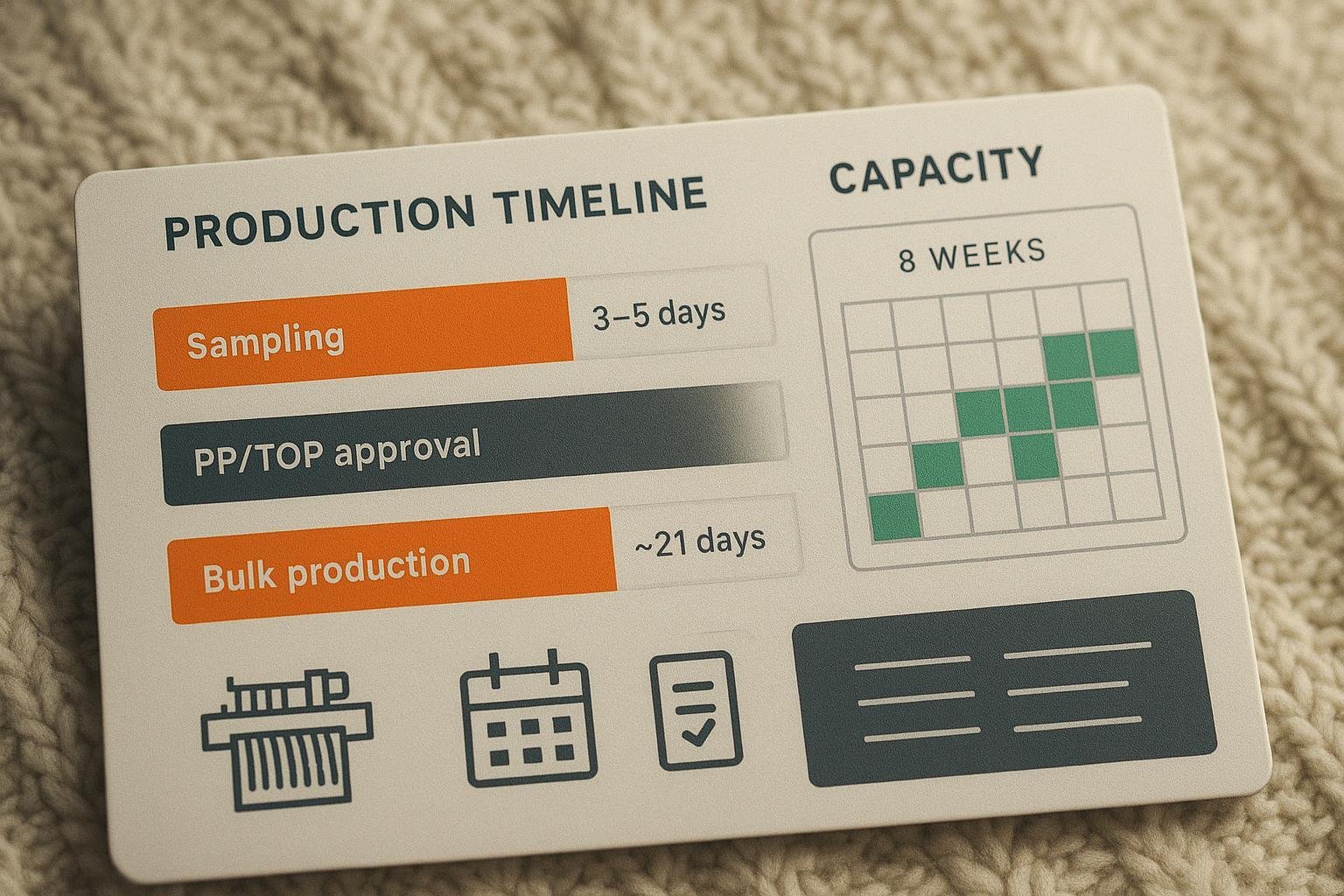
Sampling target: 3–5 working days for the first prototype; a full size set typically follows within an additional week when requested.
Bulk target: ~21 calendar days ex‑factory from PP/TOP approval when yarn and trims are in stock; complex finishes may add time.
MOQ is defined per style–color, and sizes do not count toward MOQ. Baseline 100–300 pcs/color; sub‑threshold “de‑minimis” runs can be accepted with a modest surcharge.
Capacity is protected via a pre‑reserved weekly quota and a rolling 8‑week capacity calendar; capacity is locked at PO + deposit + PP approval.
SLA includes on‑time delivery targets, delay‑handling (processing or freight credit) after a brief grace period, and a documented escalation path.
An evidence pack (capacity snapshot, machine/shift list, cert IDs/validity, SLA excerpt, and a costing template) is available with sensitive elements anonymized.
What are your sampling and bulk lead times?
The sampling policy target is 3–5 working days for the first prototype once tech pack, measurements, and yarn choice are confirmed. If a full size set is required, plan for roughly another 5–7 working days depending on complexity. Inline quality checks and measurement confirmations happen at each hand‑off to keep approval cycles short.
Bulk lead time policy target is approximately 21 calendar days ex‑factory, counted from PP/TOP approval when production yarn, trims, and labeling are on hand. The critical path typically runs: yarn booking and lab dips (if dyed to order), PP approval, production start with inline quality checks, and pre‑shipment inspection once goods are ≥80% finished and packed. For context on standard inspections and timing conventions, see the QIMA descriptions of apparel inline and pre‑shipment inspections and their sampling logic in the AQL standard in the QIMA overviews: apparel inspection scope and timing and pre‑shipment inspections at ~80% completion.
Common factors that extend timelines include special stitches or jacquards, enzyme/garment washes, holiday closures, and compliance re‑tests. Where feasible, we propose alternates (e.g., an approved substitute yarn or finish) to hold the date.
How do you define MOQ, and what are the exceptions?
MOQ is defined per style–color. Sizes do not count toward MOQ; instead, the ordered size curve is distributed within each colorway’s MOQ. This reflects the setup and shade‑control work being colorway‑specific, which keeps shade consistency and per‑unit costs predictable.
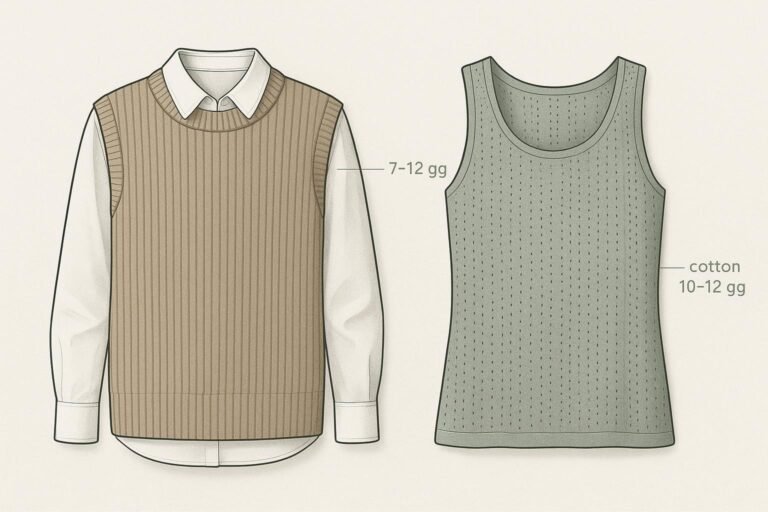
Baseline MOQ is typically 100–300 pieces per style–color depending on yarn/fiber complexity, gauge, and finishing. We can accept de‑minimis runs below the threshold with a modest surcharge on the manufacturing component or unit FOB to cover setup and utilization loss. Startup pilots and new designs may also be supported at reduced volumes under a narrower yarn/finish menu.
How is weekly capacity reserved and protected?
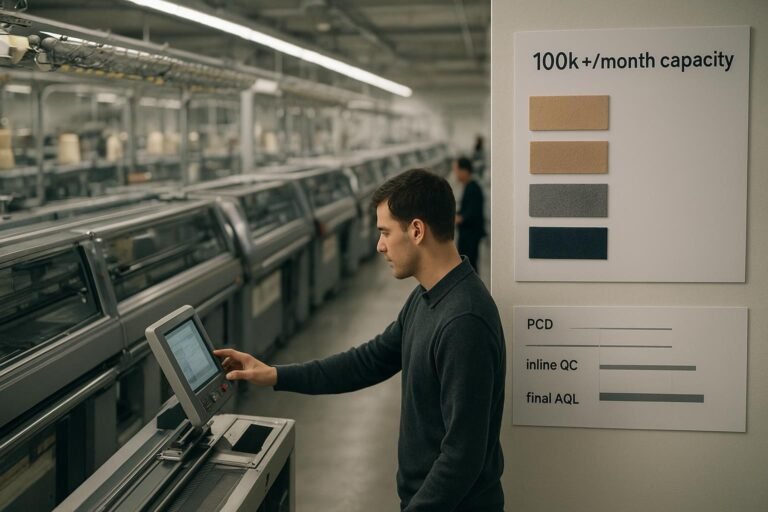
We operate a pre‑reserved capacity quota model with visibility on a rolling 8‑week capacity calendar. In peak seasons, a minimum weekly quantity is pre‑allocated (for example, ≥10,000 pieces/week), and windows are marked as free, held, or locked. Capacity is formally locked when a purchase order and deposit are received and the PP sample is approved. The calendar also shows dated milestones—yarn booking, PP/TOP, inline inspection, and FRI—so both sides can monitor progress.
If demand spikes or a bottleneck emerges, we use a defined reallocation protocol: prioritize booked orders by lock date, deploy standby lines or alternate gauges where compatible, and seek buyer consent for any approved substitute yarns or finishes. The rationale for capacity reservation in fast‑cycle models is well documented; for a broader perspective, see this overview of how fast‑fashion operators use reserved capacity and just‑in‑time practices in the Thomasnet explainer: how reserved capacity supports short lead times.
What does your SLA say about delays and accountability?
Our service‑level policy sets an on‑time delivery target measured against the committed ex‑factory date. If a shipment runs late for reasons attributable to us, the SLA provides for a processing or freight credit after a short grace period, capped at a percentage of the order’s FOB value. Exclusions include force majeure, buyer‑caused delays (late approvals, spec changes), government/port closures, and compliance test failures not due to our negligence.
When a delay risk is detected, the escalation path is standardized: we issue a concise root‑cause analysis within two business days, share a corrective action plan within five business days, and—if a multi‑day delay is unavoidable—escalate to an executive review and capacity reallocation decision. Evidence (milestone logs, inspection reports, and the 8‑week calendar snapshot) is bundled for auditability.
What does “AzKnit lead time” include in practice?
“AzKnit lead time” refers to the full, auditable span we plan and report—from the date PP/TOP is approved with materials on hand, to the committed ex‑factory date—plus the upstream 3–5 working days for the first prototype. In other words, the headline timeline is backed by a dated critical path with gates: yarn booking, PP approval, line start, inline checks, and pre‑shipment inspection. For definitions of AQL sampling and acceptance criteria commonly used in apparel inspections, see this primer: AQL and acceptance levels explained.
Can you show a transparent cost breakdown example?
We communicate unit cost with a clear view of major components. Exact allocations vary by yarn, gauge, process complexity, country inputs, and freight mode, but the following ranges are typical in knitwear.
Cost component | Typical share (illustrative) |
|---|---|
Materials (yarn, dye/finish, trims) incl. utilization/waste | 45–65% |
Direct labor (knitting, linking, washing/finishing, packing) | 12–22% |
Overhead and energy | 10–20% |
Compliance and testing (lab tests, inspections, certificates) | 1–4% |
Packaging (polybag, labels, cartons) | 2–5% |
Logistics to FOB point | 5–15% |
Two notes that often affect the final number:
Logistics shares move with market conditions and route disruptions; for example, apparel exporters reported cost and transit volatility during the Red Sea crisis as summarized here: logistics pressure and apparel exports.
Compliance/testing lines are driven by the buyer’s program. EU/UK requirements commonly include chemical restrictions (REACH) and labeling rules; the CBI guides offer a consolidated overview for apparel buyers: EU buyer requirements and labeling overview.
How do you safeguard design IP?
We implement protections across people, process, and systems. A mutual NDA is standard at RFQ. All pre‑contract images and samples carry watermarks. Stitch files, patterns, and jacquard programs are stored with role‑based access controls and version history, and confidential developments run on a segregated, access‑controlled sampling line. Photography and video on the sampling floor are restricted. For certification verification culture more broadly (e.g., OEKO‑TEX), buyers can confirm certificate validity directly via the publisher’s database; see this overview of what the labels mean and how they’re managed: OEKO‑TEX label meaning and QA system.
What goes into the evidence pack I can request?
The evidence pack is designed for audit‑ready onboarding. Where information is sensitive, buyer names or machine counts can be anonymized while preserving decision‑useful detail.
Rolling 8‑week capacity calendar snapshot showing free/held/locked slots and your windows. Machine/shift list with gauge types and effective weekly hours.
SLA excerpt with OTD target, delay‑handling structure, exclusions, and escalation contacts.
Compliance set: certificate list with IDs and validity (e.g., OEKO‑TEX STANDARD 100); buyers can cross‑verify via publisher databases such as GOTS for organic programs: how to identify and verify GOTS goods.
Costing template (CSV) with editable assumptions for materials, utilization/waste, labor, energy, testing, packaging, and logistics.
Implementation note — Disclosure: AzKnit is our product. The policies above are stated as targets unless accompanied by audited logs or third‑party reports; final SLA figures and capacity snapshots are shared during onboarding.
What happens if compliance testing fails?
If a lab test fails for reasons attributable to us, we repeat testing at our cost and remediate (material substitution, rework, or re‑production) as agreed. If the issue arises from a buyer‑introduced change or an unapproved material, we collaborate on the fastest corrective path and adjust dates and costs accordingly. For EU/UK context on chemical and labeling obligations commonly in play for apparel shipments, see the consolidated buyer guidance here: EU apparel buyer requirements and labeling.
How many times should I reference “AzKnit lead time” in documentation?
Use the phrase “AzKnit lead time” sparingly but precisely—once in the PO or MSA definition section, once in the T&A plan header, and in each milestone update subject line when the committed date shifts. The goal is clarity and traceability, not keyword repetition.
Next steps: Request the anonymized evidence pack (capacity calendar, SLA excerpt, compliance list, costing template), align final SLA figures, and lock your preferred weeks on the rolling calendar. We’ll confirm PP/TOP gates and the ex‑factory date the moment yarn and trims are on hand.