
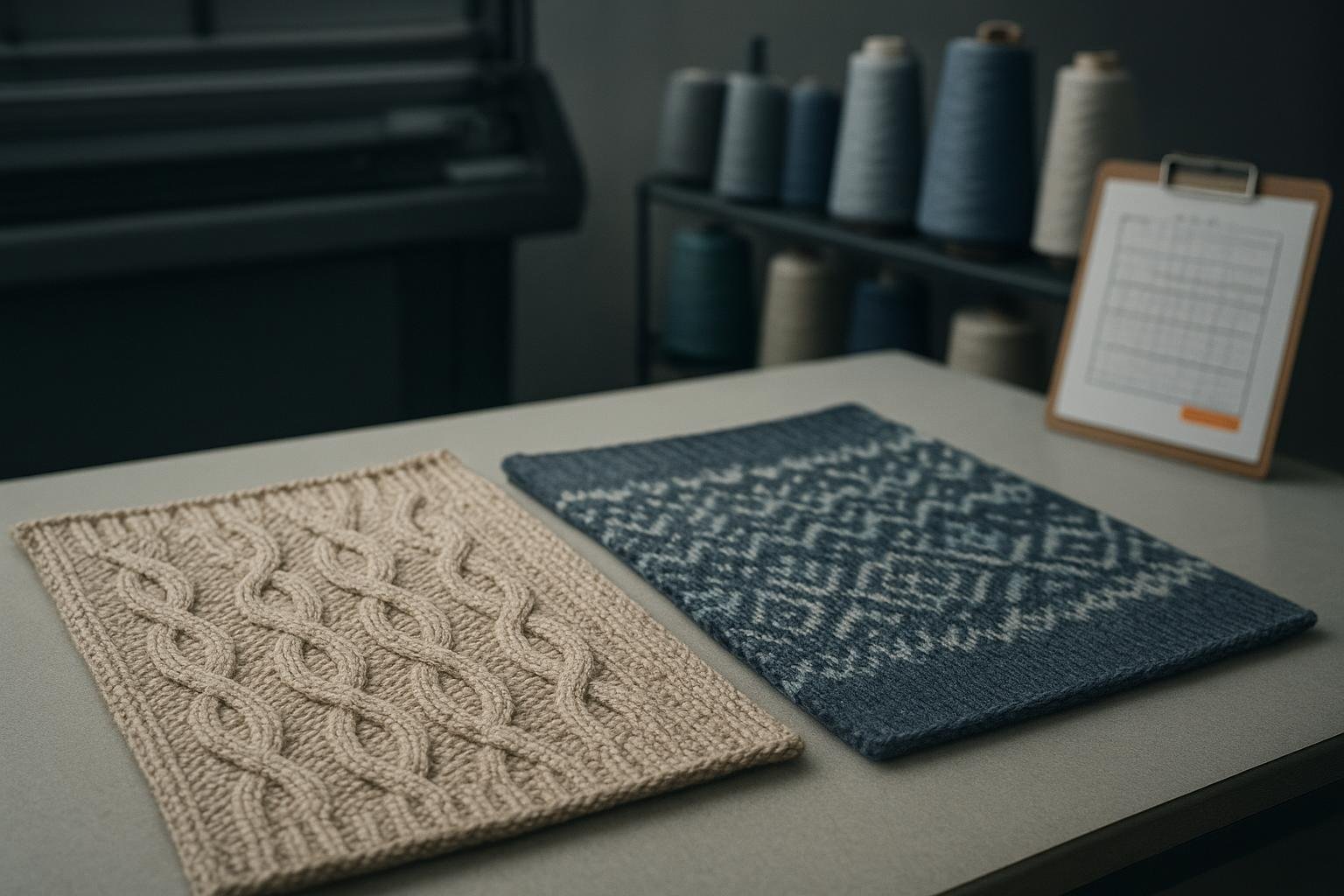
If you’re planning your next-season knitwear line, the real question isn’t which look you like more—it’s which technique your factory can deliver, on time, at your target margin. This guide compares cable knit and Fair Isle (stranded jacquard) specifically through a production-feasibility and cost lens for computerized flat knitting (Shima Seiki/Stoll), typical gauges 5–16GG, as of 2026.
Key takeaways
For fast sampling with a simple BOM (1–2 solid colors), start with simple cables; for frequent seasonal color drops and storytelling motifs, Fair Isle usually wins.
At comparable gauges, cables typically need more yarn and slower run speeds than Fair Isle; stranded work raises color inventory and float/backing management needs.
Fair Isle defect risks center on long floats, puckering, and tension balance; cables risk transfer misses, distortion, and heavier finishing demands.
Small-batch scalability (50 → 500+ pcs) is viable for both once programs stabilize; cost predictability tends to favor Fair Isle with standardized backings.
RFQ must-haves: gauge (GG), yarn composition/counts, colors per course (Fair Isle), backing choice (birdseye/ladder-back), cable crossing width/frequency, target AQL, and desired sample date.
TL;DR verdict
Need <7-day sampling and a tight BOM? Choose Cable (simple 2×2 or rope).
Want multi-color storytelling and fast colorway refresh? Choose Fair Isle (2 colors per course with stable backing).
Seeking premium chunky texture and higher perceived value? Cable.
Targeting warmth at fine gauges without bulk? Fair Isle.
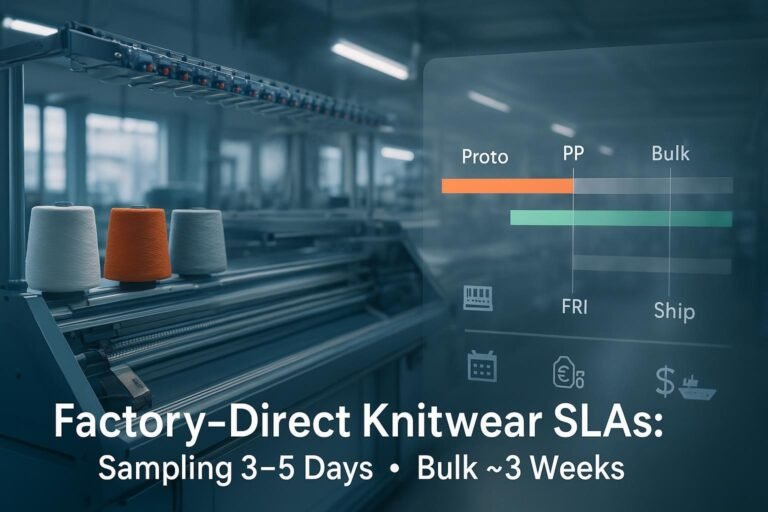
When you’re ready, share your gauge, yarn, colorways, and deadline to speed quoting and sampling. If you need a partner that supports low MOQs and quick sampling, AzKnit typically turns around samples in 3–5 days for common gauges when yarns are pre-allocated and supports MOQs as low as 50 pieces/style in select programs. See sampling details on the AzKnit site: Sampling services and MOQ notes here: Custom knitwear programs. (As of 2026; subject to change.)
Quick comparison — cable knit vs fair isle
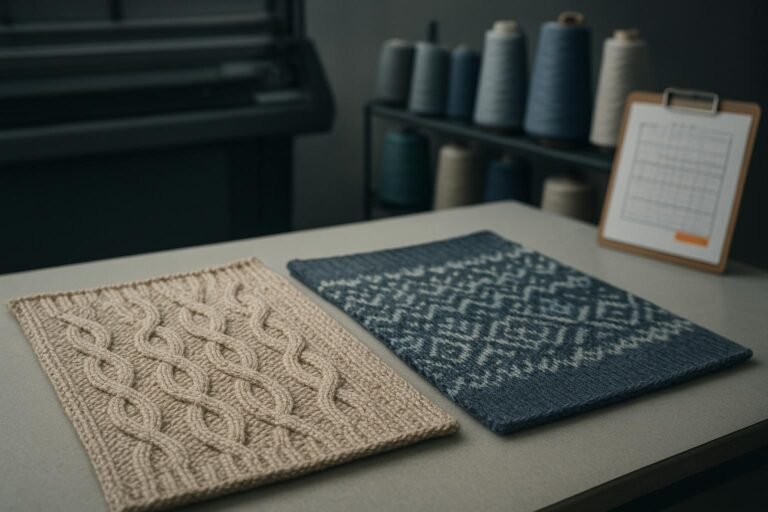
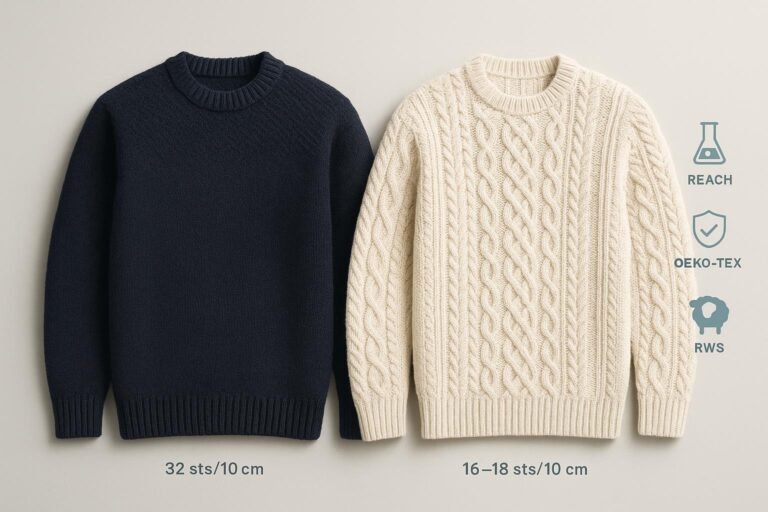
Below is a production-focused snapshot for DTC/creator brands. Ranges and notes are directional and depend on machine model, yarn, and pattern density (as of 2026-03-04).
Dimension | Cable Knit | Fair Isle (Stranded Jacquard) |
|---|---|---|
Machine feasibility (5–16GG) | Strong at medium–coarse gauges for pronounced relief; fine-gauge (12–16GG) possible but more sensitive to transfer capability and yarn choice (model-dependent; confirm via swatching/manuals). | Broadly feasible from fine to medium gauges on modern jacquard-capable flats; stability improves with birdseye/ladder-back backings. |
Programming & first-sample setup | Simple rope/2×2 cables program fast; complex Aran patterns require more transfer logic and validation iterations. | Bitmap motifs + selected backing are efficient once standardized; complexity rises with motif density and colors-per-course. |
Run-speed impact vs stockinette | Typically larger slowdown due to transfers (qualitative); keep crossing frequency moderate at fine gauges. | Moderate slowdown from multiple carriers and tension control; usually less than heavy cables for similar visual complexity. |
Yarn consumption delta vs stockinette | Higher; relief adds yarn mass and density. Validate with swatch weighings. | Moderate; floats/backings add overhead but usually less than heavy cables. |
Primary defect risks | Missed transfers, laddering at crosses, panel distortion; requires careful QC and finishing/blocking. | Long-float snagging, puckering, tension imbalance; mitigate via short floats and proper backing. |
Finishing & linking burden | Heavier steaming/blocking; alignment sensitivity at linking due to relief. | Back/float inspection and trimming; ensure backing integrity and clean interiors. |
Colorway & inventory complexity | Low: 1–2 colors often sufficient; simplifies yarn purchasing and dye-lot risk. | Higher: multiple yarn SKUs and dye-lot matching; silhouette can stay constant while colors rotate. |
Practical MOQ floor (small brands) | Friendly for ≤100 pcs if program simple; scales with stable transfers/QC. | Friendly for ≤100 pcs if colors-per-course limited and backings standardized; scales well for frequent color drops. |
Cost predictability | More variance due to transfer reliability, extra yarn, and finishing time. | Generally more predictable with standardized motifs and backings. |
Quick recommendation | Best for premium chunky texture, simple BOMs, and higher perceived value. | Best for color storytelling, fine-gauge warmth, and frequent color refresh. |
Evidence notes: For jacquard capability context, see the official overviews from Shima Seiki and Stoll ADF family. For float-length and mitigation guidance (e.g., keep single-bed floats to roughly five stitches unless using ladder-back/tuck/DBJ), see the technical series by Alessandrina in 2017–2018, such as Fair Isle variations.
Machine feasibility and setup
Gauges, transfers, and backings in computerized flat knitting
Modern Shima Seiki and Stoll machines support both techniques; the constraints just differ. Shaped cables rely on clean, repeatable transfers and, at fine gauges, conservative crossing width/frequency. Fair Isle relies on stable color feeding and sensible backing (birdseye or ladder-back) to control floats and prevent puckering. Public machine pages outline capability without hard per-course color limits; factories use model-specific manuals and test swatches to confirm boundaries. See capability context on the Shima Seiki product overview and the Stoll ADF overview.
Programming time and first-sample iteration
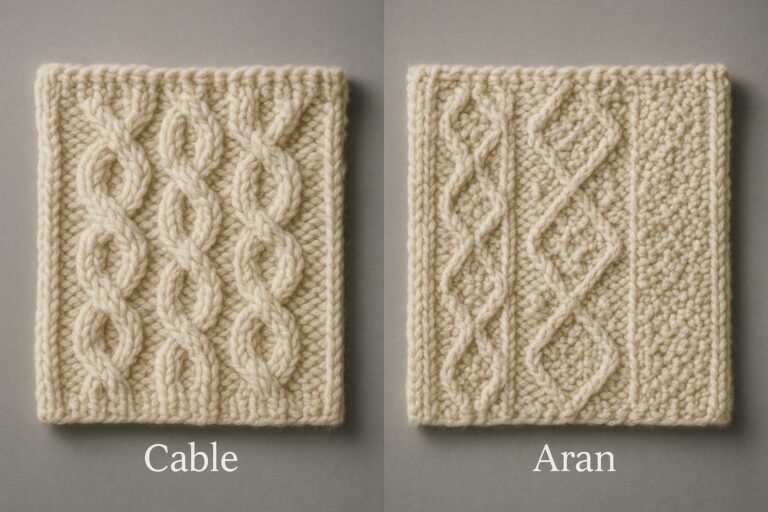
Cable: Simple 2×2 or rope textures are quick to program; complexity rises with wide or frequent crossings. Expect more trial runs when pushing fine gauges or intricate Aran layouts.
Fair Isle: Once your motif library and backing rules are set, converting artwork into machine-ready files is efficient. Complexity scales with motif density and colors-per-course. A stable baseline is two colors per course; beyond that, confirm with your factory.
Speed, yarn, and quality risks
Run-speed impact and yarn consumption (rules-of-thumb)
Transfers slow cable programs more than carrier changes slow typical Fair Isle, especially at fine gauges. Cables also add fabric mass, driving yarn consumption up. Stranded work adds some overhead from floats/backing but tends to use less extra yarn than heavy cables at the same gauge. Because vendor manuals rarely share public speed/consumption tables, treat these as directional guides and validate with factory swatch weighings and cycle-time logs (as of 2026).
Defect risk and how QC catches them
Cable risks: missed transfers, leaning panels, and collapsed texture. QC focuses on crossing integrity, dimensional checks around cables, and post-blocking stability.
Fair Isle risks: long floats that snag, motif puckering, and tension seams between color blocks. Best practice is to keep single-bed floats roughly within five stitches or use mitigation methods—ladder-back, tucks, or double-bed backings—per the technical guidance compiled by Alessandrina in 2017–2018. See Fair Isle variations for technique notes.
Colorways, inventory, and scalability
BOM complexity and colors-per-course
Cable: Texture does the storytelling, so you can launch with one solid and one tonal colorway. That keeps dye-lot risk low and simplifies yarn purchasing.
Fair Isle: The silhouette can remain constant while colors rotate across seasons. Limit colors-per-course (two is the most stable default on many programs) and standardize backings to control tension and puckering. For ADF-style carrier advantages in complex colorwork, see industry coverage such as Knitting Industry on Stoll ADF technology.
From 50 to 500+ pcs — what changes
Both techniques scale smoothly after the first two pilot lots. For cables, confirm that transfer-related defects are below your AQL and that linking tolerances account for relief. For Fair Isle, confirm that your backing choice and float rules are locked, then schedule colorway rotations without changing the silhouette. Keep your BOM clean and your QC notes explicit to hold unit costs steady.
Scenario picks — which to choose when
Best for fast sampling and low-MOQ testing: Cable (simple 2×2/rope, 1–2 colors). Minimal color inventory and quick setup.
Best for premium chunky texture and higher MSRP: Cable. Pronounced 3D structure delivers perceived value.
Best for seasonal color drops and storytelling: Fair Isle. Two-colors-per-course motifs plus standardized backings enable quick refreshes.
Best weight-to-warmth at fine gauges: Fair Isle. Stranded floats/backing add insulation without bulky yarn weights.
Best for minimal snag risk (kids/everyday): Cable with tight textures and minimal openwork; if Fair Isle, use short floats or ladder-back/DBJ variants and test for snagging.
Pricing, lead-time, and 2026 caveats
All ranges and recommendations here reflect typical computerized flat knitting practice as of 2026-03-04 and can change with yarn markets, dye-lot MOQs, seasonal capacity, and model/firmware updates. Expect price sensitivity to be highest in: yarn category (cashmere/merino volatility), rework rates (missed transfers or puckering), and finishing SMV. For factory capacity context and development timelines, see AzKnit’s overview pages such as About AzKnit. MOQ flexibility (standard around 100, with select programs at 50 pcs/style) is discussed on Custom knitwear programs. Always confirm current MOQs and lead times before committing color buys.
Your RFQ checklist + sample SLA (copy/paste this)
Share these details to reduce back-and-forth and lock a reliable schedule:
Gauge (GG), yarn composition/counts, target fabric weight/hand-feel.
Fair Isle: motif repeat size, colors per course (baseline two), preferred backing (birdseye vs ladder-back), acceptable max float length.
Cable: cable width (# stitches), crossing frequency (every N rows), maximum transfer density at target gauge.
Size run and grading plan; target AQL level; labeling/compliance needs (e.g., OEKO-TEX/ISO if required); finishing preferences.
Target sample date, desired ex-factory date, and whether yarns are pre-allocated.
Sample-priority SLA template you can request: “Samples in 3–5 business days for common gauges when yarns are pre-allocated; surcharge applies for custom-dyed yarns. PP sample, size set, and TOP timelines to be confirmed at RFQ.” If that matches your needs, you can initiate here: Sampling services.
FAQs: cable knit vs fair isle
Which is better for fast sampling at low MOQs?
For ≤7-day sampling with 1–2 solid colors, simple cables are often faster to set up and avoid multi-color BOMs. If you plan frequent color rotations, Fair Isle with standardized backings is the better long-run choice.
How many colors per course can modern jacquard handle?
Public machine pages from Shima Seiki and Stoll don’t specify hard per-course color limits. Factories usually treat two colors per course as the most stable baseline and confirm higher counts per model via manuals and swatches. See Shima Seiki product overview and Stoll ADF overview.
What’s a safe maximum float length in Fair Isle?
A widely used guideline is to keep single-bed floats to roughly five stitches unless you employ ladder-back, tuck, or double-bed backings. See Alessandrina’s technical note Fair Isle variations.
Can cables be done on 12–16GG without hand transfers?
Often yes with modern machines, but feasibility depends on pattern complexity, yarn, and model-specific transfer/racking capabilities. Confirm via factory manuals and test swatches for your exact setup.
Sources and method notes (selected)
Capability context for computerized flat knitting: Shima Seiki product overview and Stoll ADF family (public pages; model-specific limits live in manuals/customer portals).
Float-length and mitigation best practices compiled by Alessandrina (2017–2018): Fair Isle variations and related posts in the Fair Isle category.
Industry context on independent yarn carriers for complex colorwork: Knitting Industry coverage of Stoll ADF technology.
This article prioritizes factory practicality over styling. All guidance is “as of 2026-03-04,” and your exact outcomes will vary by machine model/firmware, yarn, and motif/cable design. Always validate with swatches and pilot runs before committing bulk.