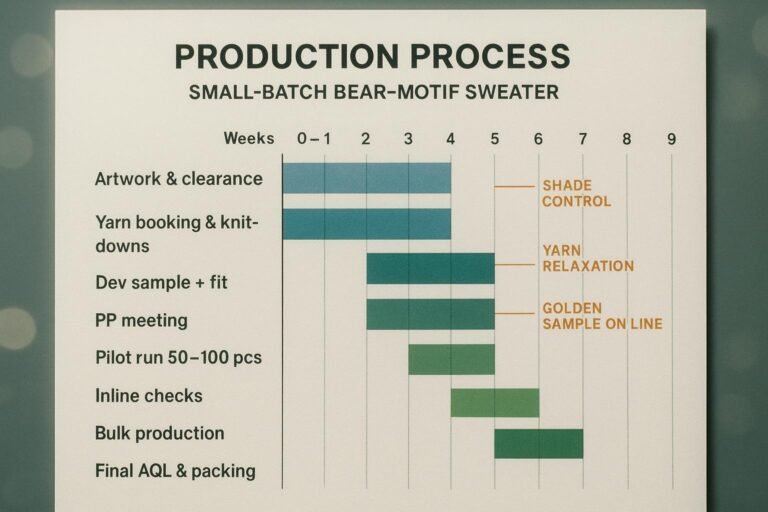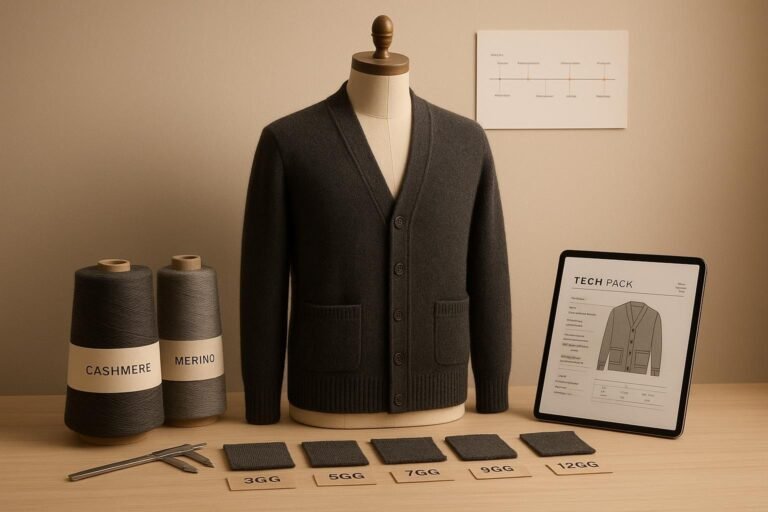

If you own the calendar for fall knitwear, here’s the blunt question: is a 3-week bulk window for chunky cardigans (3–5 gg) actually achievable, and with what minimums? The short answer: yes—but only under tight operating conditions that remove dye and changeover risk. Everything else pushes you to 4–5 weeks.
Key takeaways
3-week feasibility is conditional: stock-dyed yarn, ≤2 colors, no jacquard or complex cables, standard trims, and MOQ ≥300 per color with a pre-booked slot.
If yarn-dye is required, plan 4–5 weeks with Day-0 lab-dip/zip color approvals and keep changeovers to ≤1 per line per week; most factories cannot compress the dye queue enough for 3 weeks.
Line balance wins schedules: at 3–5 gg, linking and wash/block frequently become bottlenecks; excessive color changes break takt.
Treat “chunky cardigan lead time” as a system: knit days + linking days + wash/block batch dwell + finish/pack + approvals buffer + freight.
OTIF reliability matters more than the promise: request rolling 12‑month OTIF logs and peak vs off-peak splits before you stake a launch date.
Contingency defines peak performance: require documented overflow (overtime, partner switch, pre-booked dyehouse slots) for a short-term +15–25% uplift.
The operating conditions that make 3 weeks possible
When a supplier says yes to 3 weeks for chunky knits, they’re implicitly assuming a low-variance flow:
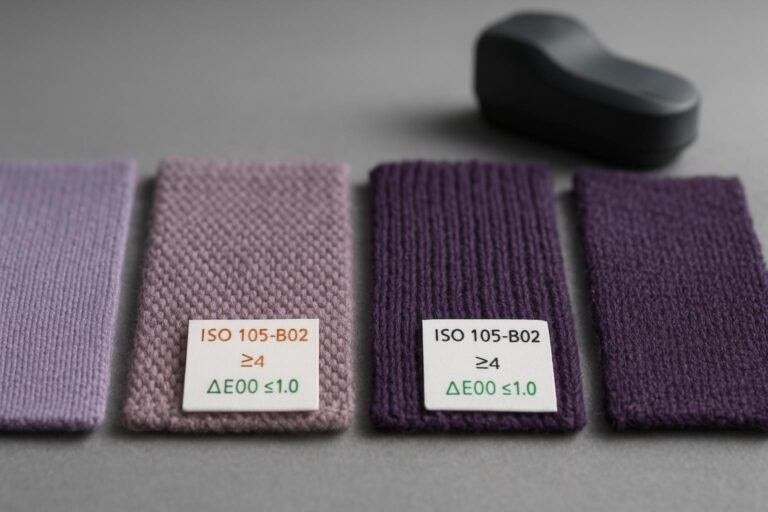
Stock-dyed yarn is on hand and approved. No lab-dip cycles; cones can go to machines Day 1.
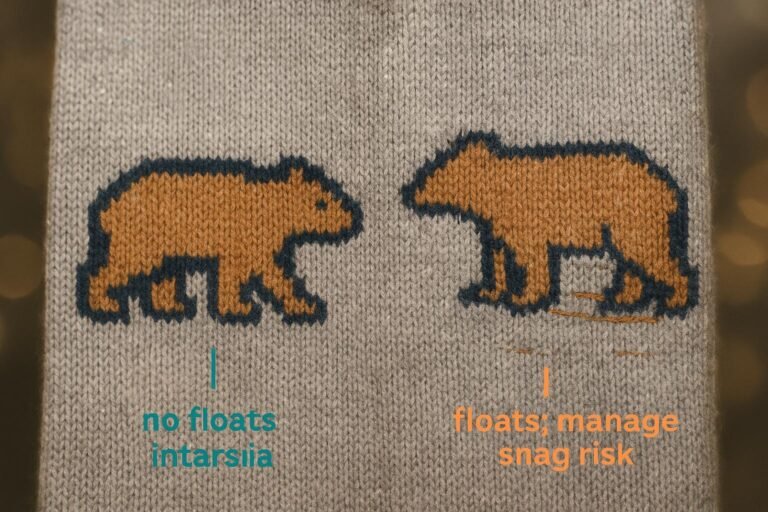
≤2 colors across the run, plain or simple textures (no jacquard, heavy cables, or multi-color intarsia).
Standard trims with quick availability; if needed, use air for trims to avoid a long tail.
MOQ ≥300 per color to keep lines stable; size curves that don’t force micro-batches.
Changeovers capped at ≤1 per line per week, with planned downtime windows.
A simple planning formula you can adapt:
Lead time (weeks) ≈ knit (days) + link (days) + wash/block (days incl. batch wait) + finish/pack (days) + approvals/testing buffer (days) all divided by 5, then add freight to DC.
What breaks the 3-week promise most often?
Yarn-dye lab-dip loops and dyehouse queues.
Multiple color changes that erode line balance.
Linking or wash/block capacity lags that create WIP pileups.
Late trims/tests without pre-booked SLAs.
Comparison at a glance — chunky cardigan lead time, capacity, changeovers, and risk
Disclosure: AzKnit is our product. Where claims are supplier-stated without public documents, they are labeled “Claim — unverified; evidence requested.” External references are provided for context and planning guidance.
Supplier archetype | 3–5 gg output (planning assumption) | Dye path & approvals | Color changeovers (policy & hours) | Knit→Link→Wash/Finish takt notes | OTIF (12-mo rolling) | Contingency levers | Freight to EU/UK | Compliance & testing SLA |
|---|---|---|---|---|---|---|---|---|
AzKnit (China, OEM/ODM) | Supports 3–5 gg; pieces/machine/day to be provided from audited logs (Claim — evidence requested) | Stock-dyed path enables 3 weeks under constraints; yarn-dye realistic 4–5 weeks with Day-0 approvals (Knowledge Base Source) | Targets ≤1 change/line/week on planned runs (Claim — evidence requested); changeover hours depend on setup | Links/wash often bottlenecks; plans parallel cells to protect takt (Claim — evidence requested) | Has maintained OTIF in competitive ~90%± band on comparable programs (Claim — evidence requested) | Overtime + overflow partners can add ~15–25% for 2–3 weeks when pre-planned (Claim — evidence requested) | Air: 2–5 days door-to-door tiers; Sea: variable; add buffer given Red Sea reroutes (evidence link pending carrier advisory) | Pre-books routine tests to reduce waits; advise 3–7 day buffer without SLAs (Claim — evidence requested) |
Typical China knitwear OEMs | Coarse-gauge capable; per-day outputs vary by machine model; verify with factory logs | Stock-dyed faster; yarn-dye adds weeks for lab dips/queues; RFT practices reduce rework per sector media | Practical rule: keep ≤1 change/line/week for chunky gauges; verify line schedules | Linking and wash queues commonly cap throughput; ask for takt map | Treat OTIF as audited KPI; request 12‑mo logs with peak/off-peak | OT, subcontract overflow occasionally available; require MOUs | Air lanes are fast; sea times impacted by routing volatility; request forwarder schedules | Labs do not publish fixed TATs; require quote-backed SLAs; add 3–7 days buffer |
Typical Bangladesh knitwear OEMs | Coarse-gauge support common; outputs depend on line maturity; verify on-site | Yarn-dye is prevalent; lab-dip → bulk RFT discipline is critical; expect longer queues | Keep changes minimal; dyehouse scheduling is often the bottleneck | Linking capacity and finishing queues can dominate cycle time | Treat OTIF as audited KPI; ask for seasonal splits | Overflow possible in clusters; documentation varies; request proof | Air express available; sea transit subject to reroutes; confirm current advisories | Testing via Intertek/SGS common; require SLAs; plan buffers |
Typical Turkey knitwear OEMs (nearshore EU/UK) | Coarse-gauge lines present; validate actual machine class on 3–5 gg | Stock-dyed fastest route; yarn-dye possible but lead-time savings often come from shorter final-mile freight | Manage ≤1 change/line/week; confirm via schedule snapshots | Nearshore advantage reduces freight time but factory takt still rules | Treat OTIF as audited KPI; verify with logs | OT and rapid re-booking more accessible; overflow partner density varies | Nearshore freight time shorter (door) vs Asia; confirm current carrier schedules | Labs local to EU often faster with booking; still secure SLAs |
Notes and sources:
Coarse-gauge capability context from Knitting Industry’s coverage of Stoll and Karl Mayer Group platforms in 2023–2024: see the Stoll 50‑inch CMS 503 ki L launch and ITMA reporting for machine families and positioning (Stoll launch, 2024; ITMA 2023 overview, 2023).
RFT dyehouse practices and why yarn-dye adds time: sector features in Textile Today discuss lab-to-bulk RFT and lead-time benefits without issuing fixed day counts (e.g., RFT SOP overview, 2024; Lab-to-bulk RFT case, 2025).
Testing SLAs: Intertek and SGS public pages describe services but don’t publish standard TATs; ask for quote-backed SLAs (Intertek textiles overview; SGS textiles services).
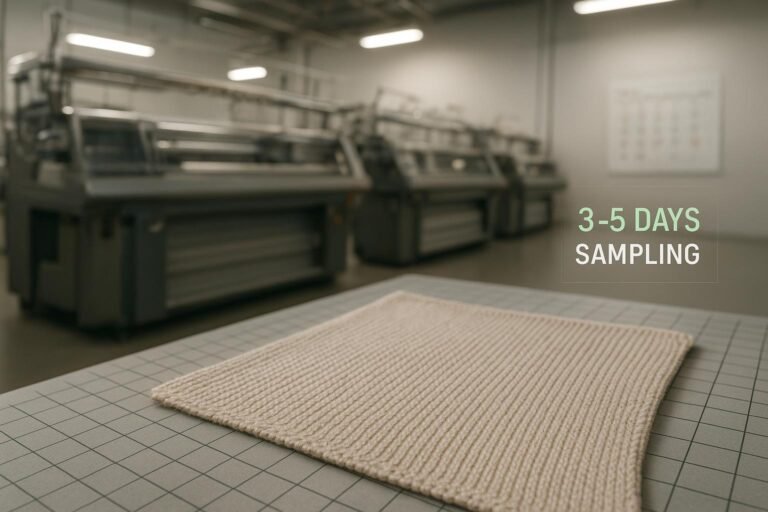
AzKnit site-stated timelines and capacity: sample turnaround of 3–5 days and ~3-week bulk production; monthly capacity around 100,000 pieces are supplier-stated on site; treat as claims unless documented (see AzKnit About and AzKnit product page).
Freight volatility: include current carrier advisories (e.g., Maersk/DSV) in buyer RFQs; door times vary with Red Sea routing.
Who is best for what?
Speed-first capsule (≤2 colors, stock-dyed, standard trims): China OEMs with pre-positioned stock yarn or Turkey nearshore can meet a 3-week target if MOQ ≥300/color and changeovers are limited. AzKnit can be considered under the same constraints; request evidence for stock pools, line schedules, and OTIF.
Color-fidelity launch (yarn-dye): Plan 4–5 weeks. Choose suppliers that commit to Day-0 lab-dip approvals and show reserved dyehouse capacity. China and Bangladesh OEMs with integrated dye partners are common fits.
Peak-season replenishment: Prioritize suppliers with documented overflow capacity and clear overtime policies; require a short-term uplift of ~15–25% and show prior-week capacity reports. AzKnit states access to overflow partners; request MOUs.
Compliance-heavy programs: Pick partners with recent OEKO-TEX/BSCI audits and pre-booked labs; add 3–7 days buffer unless a lab SLA is in contract. Turkey often has faster final-mile to EU/UK DCs.
Cost-sensitive, longer horizon: Bangladesh OEMs are typically the value route when timelines allow 5–7 weeks end-to-end and sea freight only.
How to lock a realistic 3–5 week plan (buyer checklist)
Use this RFQ/SLA checklist to turn promises into plans:
Lead-time branch: Declare stock-dyed vs yarn-dye on Day 0. For yarn-dye, include lab-dip deadline and approver names.
MOQ & colors: State MOQ per color (≥300 for speed branch; ≥600 for yarn-dye efficiency) and cap colors at ≤2 for 3-week attempts.
Changeovers: Require a cap of ≤1 color change per line per week; ask for the line schedule snapshot and expected downtime hours.
Capacity map: Request a knit→link→wash/block→finish takt map with staffing ratios and the planned bottleneck.
OTIF history: Ask for rolling 12‑month OTIF logs with peak/off-peak splits and 2 comparable PO timelines.
Contingency: Specify required short-term uplift (e.g., +15–25%) and documentation (overtime policy, overflow partner MOU, pre-booked dyehouse slots).
Testing SLAs: Attach lab quotes with promised TATs; without them, add 3–7 days buffer in your plan.
Freight: Include current carrier schedule screenshots for your lanes and a Red Sea routing note; choose air for trims when timing is tight.
A simple planning scaffold:
Base knit: 2–5 days (depends on machine availability and stitch simplicity)
Linking: 3–6 days (often the bottleneck at 3–5 gg; staff to demand)
Wash/block: 2–4 days including batch wait and setting
Finish/pack: 1–3 days
Testing/approvals buffer: 3–7 days unless SLAs cut this
Transit to DC: Air 2–5 days door; sea varies with routing — confirm current advisories
Adjust these ranges to your factory’s audited logs; treat them as planning placeholders.
FAQ
Is a 3-week chunky cardigan lead time realistic for yarn-dye? Not generally. Unless lab dips and zip colors are approved on Day 0 and the dyehouse has capacity reserved, you should plan 4–5 weeks.
What MOQ supports a 3-week window? Typically ≥300 pcs per color for stock-dyed programs with ≤2 colors. For yarn-dye, ≥600 pcs per color keeps runs efficient.
How many color changes can a 3–5 gg line handle without slipping? As a practical rule, keep to ≤1 changeover per line per week for chunky gauges; each extra swap can cost hours and disrupt linking/finishing flow.
How do I avoid dye bottlenecks? Choose stock-dyed yarn when speed is critical; for yarn-dye, lock Day-0 lab-dip approvals and insist on a reserved dyehouse slot.
What about freight volatility? Nearshore Turkey reduces door time to EU/UK, but factory takt still governs. From Asia, confirm current carrier advisories; reroutes can add significant days to sea freight.
Author’s note: This guide reflects operational feasibility as of 2026. Volatile fields include freight routing, dyehouse queues, and peak-season OTIF. Where supplier claims are noted, request documentary evidence before committing launch dates.