
Purple is notorious. It looks rich on a lab dip, then a few weeks of wear or a handful of washes later, it shifts bluer, reddens, or just dulls. If you need purple sweaters that hold their shade, you’re really making decisions across five levers: fiber, dye class, fixation/finishing, testing, and care. This guide lays out what works, with explicit ISO/AATCC targets and a buildable workflow you can hand to your mill or OEM partner.
Executive recommendation: the balanced path for most brands
For fashion brands targeting indoor wear and regular home laundering, the most reliable starting point is a functional blend—typically fine wool (merino) with a synthetic component (wool–acrylic or wool–polyester). Why this path?
Handfeel stays premium and breathable, while the synthetic fraction improves lightfastness and wash/rub performance for purple shades.
Dyeing can be tuned so both components converge on the same hue and similar fastness ratings, reducing uneven fade or crocking.
What about the alternatives?
Maximum fastness: Solution-dyed acrylic or polyester wins for harsh UV and frequent industrial laundering. If your use case is outdoor uniforms or teamwear, this is the path with the highest lightfastness and washfastness, albeit with a distinct synthetic hand.
Premium naturals: High-grade merino (or merino/cashmere) delivers top-tier handfeel. Use metal-complex acid dyes formulated for violets/purples, plus tight pH/wash-off control and careful care labeling. Expect to trade a bit of lightfastness for hand and drape.
Bottom line: if you need a single default recommendation for fade-resistant purple sweater yarns, choose a well-engineered wool–synthetic blend, validate it against the standards below, and lock your ΔE tolerances before you approve bulk.
Why purple is tricky to keep purple
Purple tones often combine red and blue chromophores. Under UV, one component may degrade faster, shifting hue. In wet use, unfixed dye can migrate and cause uneven shade loss or crocking (especially on high-chroma violets). That’s why you’ll see brands specify xenon-arc testing and tighter delta tolerances for purple than for neutrals. Official lightfastness methods such as ISO 105-B02 and AATCC TM16.3 use xenon arc exposure with blue wool references to simulate daylight and grade the color change; aiming for Grade ≥4 at common exposure endpoints is a practical apparel target, as described in the scope and educational overviews from the organizations themselves: see the ISO 105-B02 standard page and AATCC’s explainer on light-induced fading (ISO’s official B02 page; AATCC lightfastness overview).
Standards and target thresholds for fade-resistant purple sweater yarns
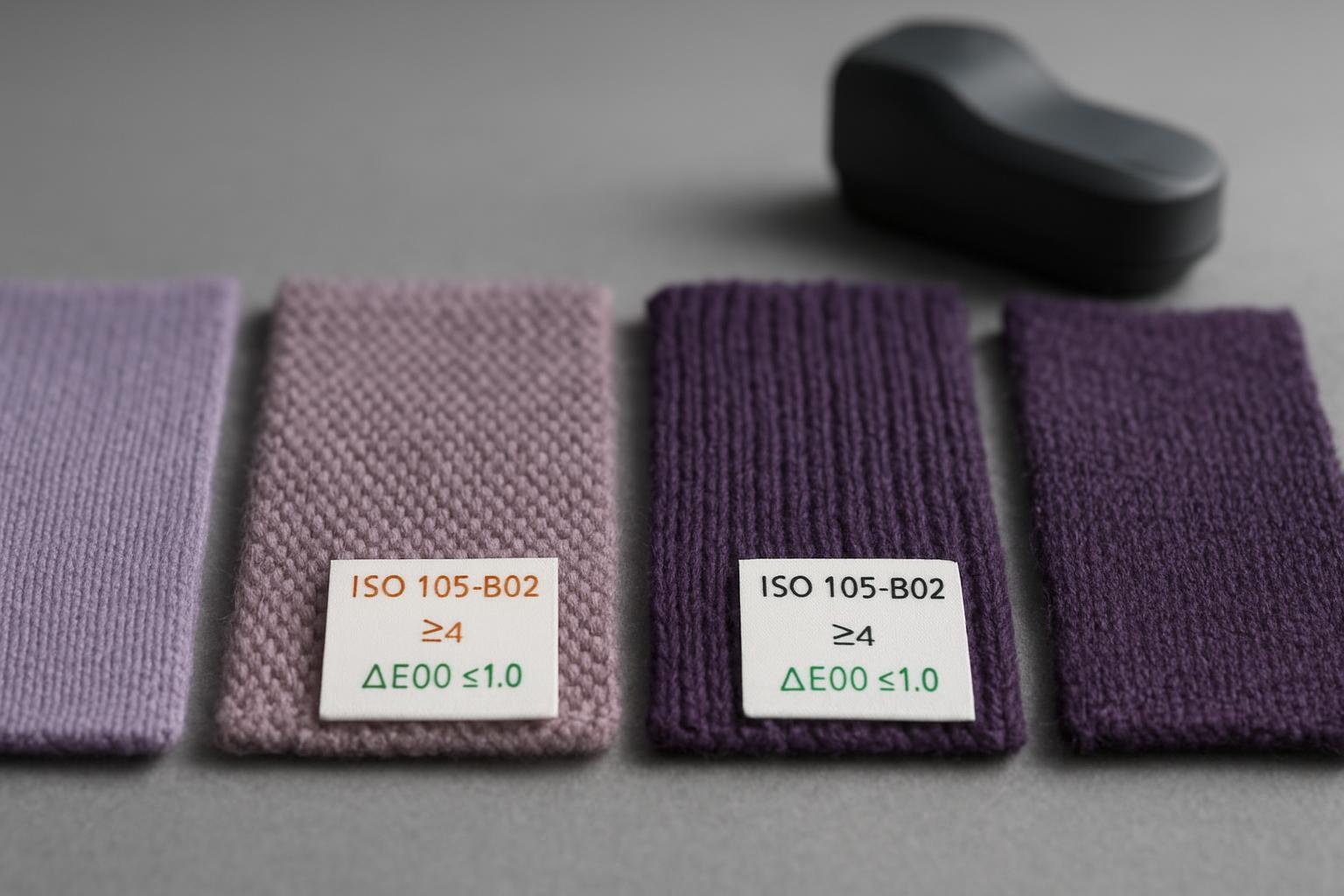
Set measurable acceptance criteria early—on the lab dip and on first bulk. The table below summarizes widely used methods and pragmatic targets for purple sweater yarns and knits. Use your lab’s exact method options (temperature, detergent, exposure endpoint) to match consumer care.
Performance area | Method (primary) | Practical target for purple knits | Notes |
|---|---|---|---|
Lightfastness (daylight) | ISO 105-B02 / AATCC TM16.3 | Grade ≥ 4 at the Blue Wool 4 endpoint | Xenon-arc exposure representative of daylight; reference scales and exposure stages per method. |
Wash fastness | ISO 105-C06 / AATCC 61 | ≥ 4 at 40 °C; ≥ 3–4 at 60 °C (shade change); staining ≥ 3–4 | Match variant to intended care temperature and detergent. |
Rubbing (crocking) | ISO 105-X12 / AATCC 8 | Dry ≥ 4; Wet ≥ 3 | Some buyer specs permit Dry 3–4 / Wet 2–3; aim higher for purple. |
Perspiration | ISO 105-E04 / AATCC 15 | Staining ≥ 4 (acid & alkali) | Dark shades should test both solutions. |
Color difference (approval/lot) | Spectrophotometry (CIEDE2000) | Lab dip ΔE00 ≤ 1.0; lot-to-lot ΔE00 ≤ 1.5 | Industry practice; lock tolerances in your PO/QA plan. |
If you don’t have in-house test capability, accredited labs provide these methods as services; see, for example, Intertek’s colorfastness testing overview for scoping and submission guidance (Intertek colorfastness testing).
Fibers and dye classes for fade-resistant purple sweater yarns
Solution-dyed synthetics (acrylic, polyester): Highest resistance to UV and laundering because the colorant is embedded during fiber extrusion. Ideal for outdoor and frequent-wash use cases. Tradeoff: a distinctly synthetic hand and visual character.
Fine wool/merino and blends: On protein fibers, select high-performance 1:2 metal-complex acid dyes in violet/purple families. These typically improve lightfastness versus leveling acid dyes. Maintain a controlled pH window (~4.5–5.5), adequate dyeing time at near-boil, and thorough wash-off to minimize unfixed dye and crocking.
Polyester (disperse dyes): Use HT exhaust at ~130 °C with disperse dyes optimized for violet/purple and lightfastness. Reduction clearing can improve rub and wash performance when needed. Consider UV absorber finishes for high-UV end uses.
Functional blends (wool–acrylic, wool–polyester): Engineer for shade harmony. You may sequence-dye or select compatible systems to achieve matched hue and fastness across both components. The blend gives you the handfeel of wool with the durability boost from the synthetic fraction.
A rhetorical check: are you optimizing for maximum fastness or best handfeel? Your answer should determine whether you prioritize solution-dyed synthetics or dial in a blended natural path with precise process control.
Manufacturing controls that actually move the needle
Color stability isn’t just a dye choice—it’s a discipline. Treat purple like a project with measurable gates.
Define the target color space. Store master spectral data (D65/10°) with tolerances in your QC software. Industry practice targets ΔE00 ≤ 1.0 on lab dips and ≤ 1.5 lot-to-lot.
Run lab dips under multiple illuminants (D65, TL84, A) to screen for metamerism. Record ΔE and hue angle changes so you can detect “red-drop” or “blue-drop” during UV exposure.
Control the dye bath: liquor ratio, pH buffering, temperature rise profile, hold time, and exhaustion. Log each batch; these factors materially affect purple fastness.
Polyester: choose carrierless HT exhaust where possible; perform reduction clearing if rub/wash tests are marginal.
Wool/merino: keep to pH ~4.5–5.5 with suitable leveling agents; fully wash-off to remove unfixed dye. Use metal-complex acid dyes for violets where lightfastness is critical.
In-process QA: spectrophotometer checks per dye lot; retain retainers for re-test. Audit ΔE before knitting and again on finished garments to catch finishing-induced shifts.
Educational resources from the standards bodies and instrument vendors reinforce these practices; AATCC’s testing archives outline method contexts, and instrument makers explain ΔE and tolerancing concepts, even if apparel-specific numbers remain brand-defined.
Practical micro-example using AzKnit’s yarn library
Disclosure: AzKnit is our product.
A brand needs a midweight purple crewneck for indoor wear, machine washable on gentle, with strong color retention. They decide on a 70/30 merino–acrylic blend for handfeel and durability. Step 1: they shortlist merino and acrylic yarns from the AzKnit yarn library, filtering for count and handfeel. They request two violet targets (one bluer, one redder) and specify the acceptance criteria: ISO 105-B02 Grade ≥ 4, ISO 105-C06 at 40 °C Grade ≥ 4, ISO 105-X12 Dry ≥ 4 / Wet ≥ 3, and lab dip ΔE00 ≤ 1.0 versus the master.
The lab produces paired dips: a metal-complex acid dye recipe for the merino component at pH ~5.0, near-boil for 60 minutes with a leveling agent and full wash-off; a disperse dye recipe for the acrylic component, tuned for violet lightfastness. Spectral data is captured for both and for the blended knitdown. The team evaluates under D65/TL84/A to check metamerism and approves the bluer violet, noting that the red component was slightly more UV-sensitive.
On first bulk, QA logs show bath pH and exhaustion, with spectrophotometer checks on every lot. A sample garment is tested to the methods above before full release. The result: tight ΔE across lots and no perceivable hue shift after simulated daylight and household laundering. You can browse candidate yarns and request purple swatches directly via the yarn library page (AzKnit Yarn Library).
Finishing and care that preserve color
Finishing can extend color life in high-UV scenarios. UV absorbers applied during or after dyeing—originally developed for demanding segments—can help keep vivid purples stable. Archroma’s publicly documented systems describe UV absorber finishes designed to improve lightfastness for polyester and acrylic; while the highest benchmarks come from transportation textiles, the principle translates to apparel, and results should be verified to your target exposure (Archroma UV absorber overview).
Care labeling matters just as much. For wool or wool-rich blends, neutral, mild, enzyme-free detergents reduce hydrolysis and minimize dye loss. The Woolmark Company explains why enzyme-heavy detergents and bleach/optical brighteners are risky for wool; their care pages provide accessible guidance you can adapt for label copy (Woolmark detergent guidance; see also their washing-machine guide for temperature and cycle tips).
Quick build checklist
Lock targets: ISO 105-B02 ≥ 4; ISO 105-C06 (40 °C) ≥ 4; ISO 105-X12 Dry ≥ 4 / Wet ≥ 3; ΔE00 ≤ 1.0 (lab dip), ≤ 1.5 (lot-to-lot).
Choose path: solution-dyed synthetic for maximum fastness; or wool–synthetic blend for handfeel/fastness balance; or premium merino with metal-complex acid dyes plus strict care.
Control process: pH, liquor ratio, HT profiles, leveling agents, reduction clearing where relevant; record exhaustion.
Verify early: lab dips under D65/TL84/A; xenon-arc lightfastness; wash and crock; spectro at each dye lot and after finishing.
Label care: neutral pH, enzyme-free detergent; avoid bleach/optical brighteners; match test temperature to label.
Timeline: from lab dip to bulk
Plan a fast, staged path aligned to realistic factory SLAs. A workable cadence:
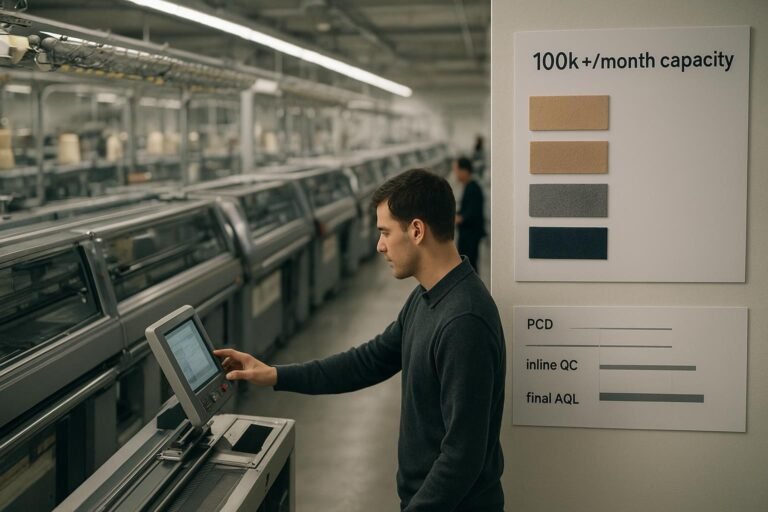
Sampling (3–5 days): Submit target purple(s), fiber/blend choice, and test thresholds. Receive dip cards and knitdowns with spectral files. Decide on the bluer/redder axis and lock ΔE00 ≤ 1.0.
Pilot/first article (about 1 week, overlapping lab tests): Produce a small run to validate on-garment fastness (light, wash, crock) and confirm finishing doesn’t shift the shade.
Bulk dyeing & knitting (≈ 3 weeks): Run with in-process spectro checks, pH/exhaustion logs, and retainers. Gate release on passing test reports against your acceptance criteria.
This timeline balances speed with enough checkpoints to prevent surprises. Think of it this way: a day saved by skipping a test often costs a week later.
Next steps
If you want certified purple swatches with spectral targets to evaluate, request them through our contact page and specify your fiber path and test thresholds. We’ll prepare dip cards and knitdowns aligned to your acceptance plan (AzKnit Contact).