
If you’re a EU/UK category manager planning autumn–winter knit assortments, the Guernsey (gansey) and Aran sweater archetypes sit at the heart of heritage and utility stories—but they behave very differently in cost, lead time, and compliance workload. This guide converts heritage language into measurable specs so you can brief suppliers, choose the right first samples, and estimate landed cost with fewer surprises.
Below, we use a supply‑chain and compliance lens—yarn/finishing, gauge/density, stitch complexity and SMV, durability and lab testing, traceability pathways, MOQ/lead times, and total cost drivers—to help you decide when a Guernsey‑style dense knit beats an Aran cable‑rich panel, and vice versa. Let’s dig in.
Key takeaways
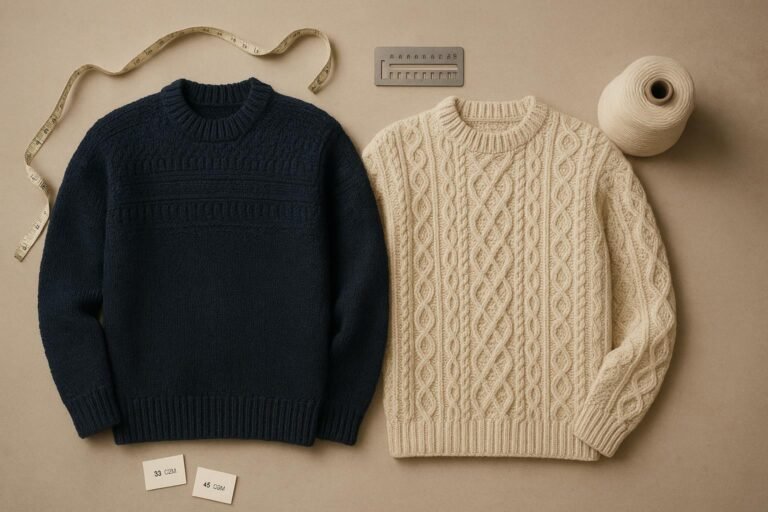
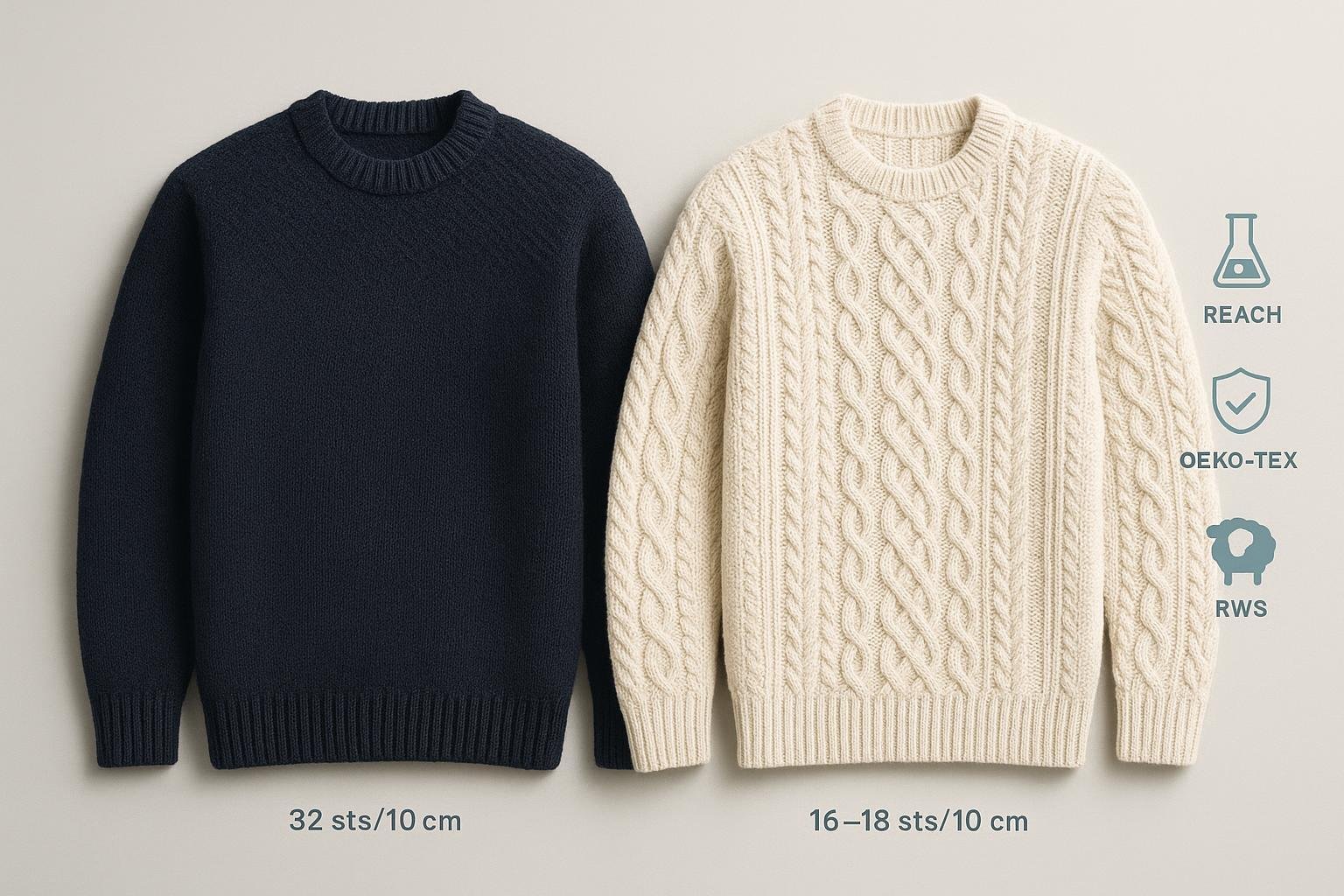
Guernsey is typically a dense, tightly knitted 5‑ply worsted program with simpler stitch transfers; Aran is an all‑over cable/texture program at a looser gauge. That structural difference drives SMV, defect risk, yarn usage, and lead time.
For maritime/workwear utility and wind resistance, Guernsey‑style density often performs better; for premium heritage storytelling and shelf impact, Aran’s visible cables win—but budget for higher COGS.
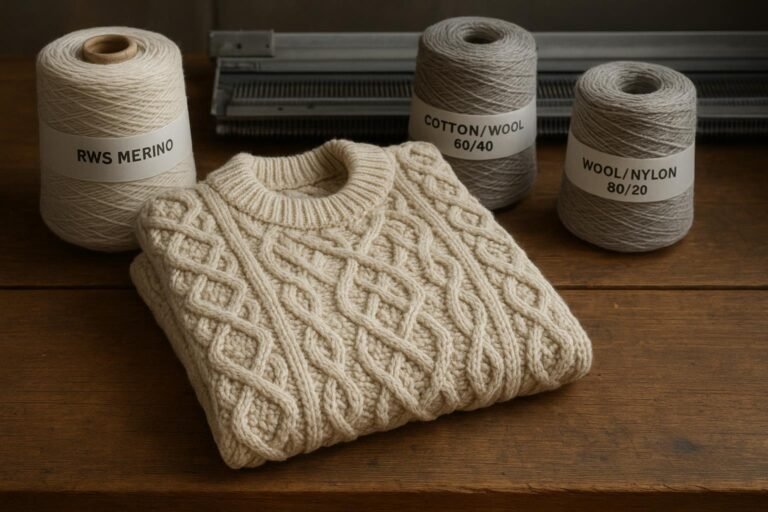
Style doesn’t change your compliance route: REACH screening and OEKO‑TEX component compliance still apply. If you need animal‑fiber welfare claims, pick certified yarns (RWS/RMS/RAS) first and protect chain‑of‑custody.
Cost model hinges on yarn kg/pc and SMV minutes. Dense Guernsey uses compact gauge; Aran cables add yarn path length and transfers, lifting both kg/pc and SMV.
Lead times and MOQs are typically friendlier on Guernsey or simplified‑panel Arans. Full all‑over cable programs stress programming, QC, and capacity during peak.
Guernsey vs Aran sweater — head‑to‑head at a glance
Dimension | Guernsey (Gansey) | Aran |
|---|---|---|
Origin & intent | North Atlantic workwear; dense, hard‑wearing fisherman’s jumper | Irish heritage fashion; all‑over panels and textures |
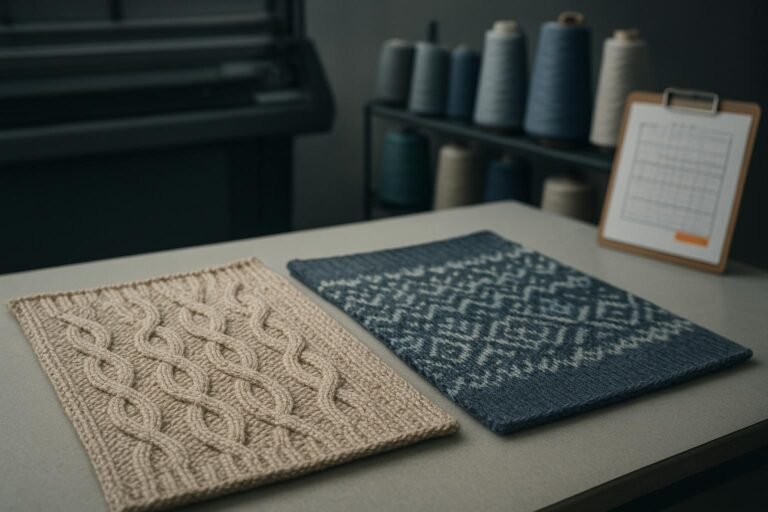
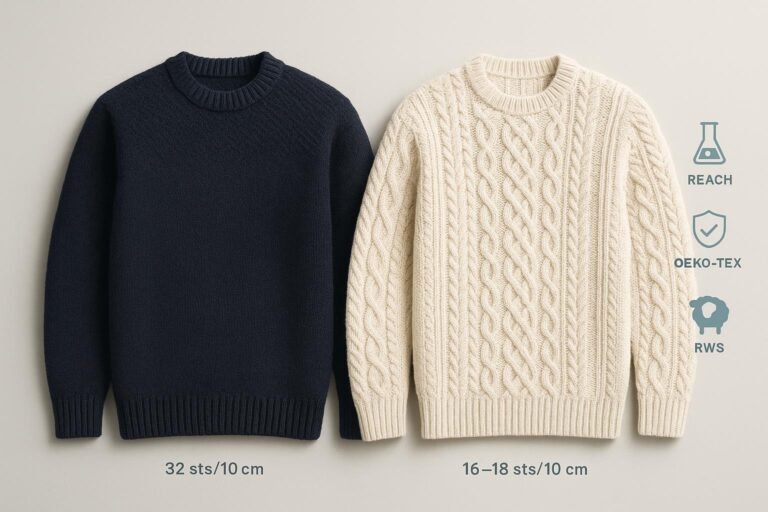
Typical yarn & finishing | 5‑ply worsted‑spun wool; high twist; often non‑superwash. Representative 5‑ply gansey gauges are documented by retailers of Guernsey yarns such as Frangipani (tight swatching guidance around 32 sts/10 cm). See the Frangipani listing via Wet Coast Wools: 5‑ply Guernsey Wool specs. | Aran‑weight wool (CYC 4) commonly knits ~16–18 sts/10 cm; texture compresses gauge, so swatch in pattern. See the encyclopedic overview: Wikipedia’s Aran jumper entry (2025). |
Gauge & density | Often ~28–32 sts/10 cm on ~2.25–2.5 mm needles; compact fabric at given gsm enhances wind resistance. | Commonly ~16–18 sts/10 cm on ~5–5.5 mm; thicker, loftier hand with visible cable relief. |
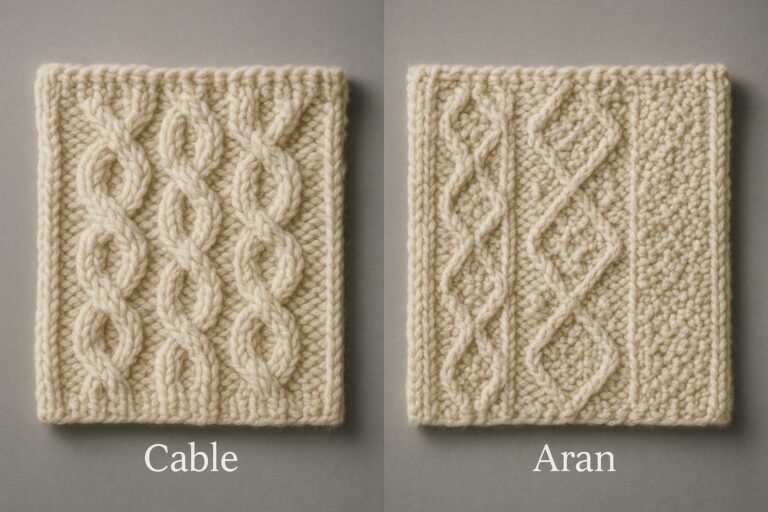
Pattern coverage & stitch complexity | Plainer bodies with limited textured yokes/shoulders; few stitch transfers → lower SMV and defect risk. | All‑over cable columns across body/sleeves; heavy transfer density → higher SMV, more racking/tension control. |
Durability & weather performance | Dense worsted structure supports abrasion and pilling resistance targets when paired with appropriate yarn and finishing; verify with ISO tests and water‑spray ratings. | Loft and relief add insulation; abrasion/pilling vary by yarn and program; performance should be specified and verified in lab. |
Compliance pathway | Same as Aran: REACH SVHC screen; OEKO‑TEX Standard 100 component compliance. | Same as Guernsey; style is neutral. For animal‑fiber claims, choose certified yarns (RWS/RMS/RAS) and maintain chain‑of‑custody. |
Labor content (SMV) & manufacturability | Simpler programs run faster on flat‑knit; easier to scale and plan. | Cable transfers/racking slow throughput; programming and QC add minutes; higher reject/rework sensitivity. |
MOQ & lead‑time tendencies | Friendlier to low MOQs and fast turns (yarn availability still a lever). | Typically longer lead times and higher MOQ pressure unless panels are simplified. |
Care & shrinkage | Often non‑superwash; specify ISO 5077 shrinkage targets and care symbols; hand/cool wash, dry flat common. | Similar unless superwash/scoured blends are chosen to ease care; still specify shrinkage/pilling targets. |
Landed‑cost drivers | Yarn kg/pc driven by density but with moderate SMV. | Higher SMV and potentially higher yarn use from cables; higher defect allowance. |
Sources named inline; see testing and standards links below for compliance details.
What really drives cost and lead time
Two numbers dominate FOB: yarn consumption (kg per piece) and labor minutes (SMV). Aran’s all‑over cables increase needle transfers and yarn path length, which typically lifts both metrics compared with a dense Guernsey body.
Yarn consumption rule of thumb: kg/pc ≈ (target gsm × total garment area in m²) ÷ 1,000, then adjust for stitch architecture. Cable‑rich fabrics can add noticeable overage because each crossed stitch travels farther and traps more air.
SMV drivers: Transfer‑heavy rows slow carriage speed and require racking and tension control on flat knitting machines—reducing effective throughput and raising programming/QA time. Industry and vendor materials consistently note productivity trade‑offs for complex transfer patterns.
To contain schedule risk, lock three checkpoints early: pattern simplification (limit panel count or transfer frequency), yarn availability (pre‑book dye queues), and lab‑approved swatches for pilling/abrasion so you don’t discover performance shortfalls at TOP.
For durability and appearance targets, specify lab methods in the tech pack:
Abrasion: ISO 12947 (Martindale), Parts 1–4. See ISO’s catalog for scope: ISO 12947 Martindale overview.
Pilling: ISO 12945 series; declare method and grade target at cycles.
Compliance pathway for EU/UK
Style doesn’t change your regulatory path—components and chemistry do. Build the compliance pack this way:
Chemical compliance: REACH SVHC screening plus restricted substances aligned to your brand RSL. For third‑party ecolabel assurance on components (yarns, trims), rely on OEKO‑TEX Standard 100; criteria update annually and certificates are time‑bound. See OEKO‑TEX Standard 100 overview.
Animal‑fiber claims: If you intend to market animal‑welfare or land‑management credentials, choose yarns certified under Textile Exchange’s Responsible standards—RWS (wool), RMS (mohair), RAS (alpaca)—and preserve chain‑of‑custody with transaction certificates. See Textile Exchange’s Responsible Wool Standard.
Weather claims: Avoid “waterproof” language for knitwear. If you need water‑shedding as a performance attribute, declare finishing state (before/after scouring) and verify with the AATCC 22 Spray Test.
Scenario picks — which should you sample first?
Workwear/maritime utility. When wind resistance and abrasion are non‑negotiable, prioritize a Guernsey‑style dense program using compact gauge and high‑twist worsted yarns. Validate appearance retention (ISO 12947/12945) and water‑spray ratings if you’ll reference weather resistance.
Heritage‑fashion capsule. If you’re charging a premium for narrative and texture, Aran’s all‑over cable panels deliver unmistakable shelf impact. Expect higher SMV and a tighter QC net for missed transfers and tension marks; negotiate realistic lead times in peak season.
Fast‑turn private‑label drop with tight MOQ. Dense Guernsey or simplified Aran (limited panels, spaced transfers) usually wins. The simpler the stitch program, the easier it is to hit 3–5‑week door‑to‑dock timelines once yarns are in.
Traceable premium yarn collection. Decide yarn first. RWS/RMS/RAS certificates and chain‑of‑custody matter more than whether the body is Guernsey‑dense or Aran‑textured. Aran’s visibility can help showcase premium fibers; just budget the extra minutes.
Lowest return risk via easy care. If your priority is fewer care‑label issues, choose scoured/superwash blends and specify dimensional stability (ISO 5077) and pilling grade targets. Style can be either; Guernsey density helps shape retention on body and cuffs.
Tech‑pack and testing checklist (copy‑ready)
Yarn & construction: fiber, ply, yarn count (Nm/tex), micron; finish (superwash/scoured vs untreated); supplier spec sheets. Gauge targets: Guernsey ~28–32 sts/10 cm (plain/texture); Aran ~16–18 sts/10 cm (in‑pattern swatch, blocked).
Performance labs: ISO 12947 (Martindale abrasion) targets; ISO 12945 pilling method and grade; ISO 5077 + ISO 6330 dimensional change thresholds; colorfastness (ISO 105 series) as needed; AATCC 22 spray rating if you reference water‑shedding.
Stitch map & complexity: panel coverage %, transfer rows per 100 rows, racking notes; QC checkpoints for missed transfers.
Production SLAs: SMV targets and takt assumptions; MOQ and lead‑time bands by complexity and yarn dye queues; inline/post‑wash measurement tolerances.
Pricing and version scope (what changes the quote)
Treat all unit costs below as indicative and time‑sensitive. Prices and specs change; verify with suppliers. EU/UK duties and VAT may apply.
Version scope: “Traditional Guernsey (dense 5‑ply worsted) vs Traditional Aran (Aran/heavy‑worsted weight), plus modern machine‑knit variants (scoured/superwash, blends).” Aran panels typically inflate SMV and yarn consumption; Guernsey density concentrates cost in yarn but keeps stitch programs simpler.
Primary cost drivers: yarn cost/kg, yarn kg/pc (rises with gauge looseness and cable architecture), SMV×labor/min, finishing surcharges, packaging/test pack, duty, freight, and a defect allowance (higher for transfer‑dense Arans).
Lead time sensitivity: yarn dye queues and machine time allocation spike in Q3/Q4. Aran complexity magnifies this; simplified panels or Guernsey bodies compress schedule risk.
FAQs
Is a Guernsey actually warmer or more weather‑resistant than an Aran? A Guernsey’s dense gauge and tightly spun worsted yarn can shed wind and bead water better at the same gsm, but results vary with finishing and fiber. If weather performance is a KPI, state finishing state (before/after scouring) and test with the AATCC 22 spray method and wearer trials.
How much more expensive is an Aran vs a Guernsey to make? Typically more, because all‑over cables increase both yarn consumption and SMV. The exact delta depends on panel count, transfer density, yarn class, and your factory’s programming efficiency. Ask for time‑and‑motion estimates and swatch‑based kg/pc from suppliers.
Can Aran cables be machine‑knit at scale without hand‑knit? Yes. Modern flat‑bed machines handle cables, but transfer density slows throughput and raises defect sensitivity. Expect longer lead times than a dense Guernsey program unless you simplify panels.
What compliance documents do I need for EU/UK? For chemistry, align to your RSL and screen REACH SVHCs; for product safety claims, cite test reports (ISO 12947/12945/5077; AATCC 22 if relevant). For animal‑fiber claims, maintain Textile Exchange chain‑of‑custody (e.g., RWS) with transaction certificates. For component safety assurance, OEKO‑TEX Standard 100 certificates are widely recognized.
Also consider your manufacturing partner
If you need rapid OEM/ODM execution for either archetype, a partner like AzKnit typically delivers samples in 3–5 days and bulk in about three weeks for simpler SKUs, offers flexible MOQs from around 50 pieces, and operates with recognized quality processes. For certificate requests and project scoping, contact the team via AzKnit’s contact page.
How to choose in one minute
If you need workwear‑grade wind resistance and a faster path to scale, start with a Guernsey‑style dense knit and verify performance in the lab. If you want premium storytelling and texture—and can afford higher SMV and longer lead times—sample a full Aran. When traceability is the hero, pick the certified yarn first, then map it to either Guernsey or Aran based on your visual brief.