

If you’re wondering how do you prevent size inconsistency in bulk sweaters, there are several key steps to follow. Start by using standard grading rules to check the fit and shape before producing large quantities. This approach helps you avoid wasting time and fabric on unnecessary samples. Ask manufacturers for patterns that account for sewing loss, ensuring the finished sweaters match the approved sizes. Rely on accurate size charts, detailed notes, and digital tools to maintain consistent measurements throughout the entire process.
Using standard grading rules helps you:
Address how do you prevent size inconsistency in bulk sweaters.
Check fit and shape early in production.
Save both fabric and time.
Ensure patterns align with the final, approved sizes.
Key Takeaways
Follow grading rules so every sweater fits the same.
Write down size changes clearly to stop confusion.
Match grading rules with body sizes for better fit.
Make size limits clear to keep quality and meet needs.
Look at old order data to find patterns and fix sizing.
Make detailed size charts for each style to lower returns.
Do regular checks during production to find size problems early.
Teach your team often so they know size consistency matters.
How Do You Prevent Size Inconsistency in Bulk Sweaters?
You want every sweater to fit the same. To stop size inconsistency, you need strong systems and clear rules. Focus on grading rules, keeping good records, and using data. These steps help you avoid mistakes and keep customers happy.
Standardizing Grading Rules
Brands often have size problems because factories use different grading rules. You can fix this by making one master grade rule document. This document sets the rules for all factories. When everyone uses the same rules, a size 8 sweater fits the same everywhere. You also need a fit system to check each size before making sweaters. This system helps you find mistakes early.
Documenting Size Increments
You must write down every size increment clearly. This step makes grading easy to follow and keeps it the same. The table below shows how recording size increments helps production:
Size Increment | Impact on Production |
|---|---|
+2 cm chest per size | Makes grading and fit stay the same |
Erroneous grading | Causes wrong sizing and complaints |
Size set samples | Check grading before making many items |
When you record each increment, you stop confusion and lower errors. You can also use size set samples to check grading before making lots of sweaters.
Aligning with Body Dimensions
You need to match grading rules to your customers’ body sizes. This step helps you stop size inconsistency in bulk sweaters. Use real measurements from your customers. You can also check industry standards for grading sweater parts. The table below shows grading rules:
Increment | Areas Graded |
|---|---|
1/4″ | Neck Width, Front Neck Drop, Sleeve Length |
1/2″ | Across Front, Across Back, Armhole Straight, Armhole Curve, Sleeve Opening |
1″ | Shoulder Width, Body Length |
2″ | Chest Width, Body Sweep |
Write measurements as flat measurements. This way, grading stays correct and easy to check.
Setting Size Tolerances
You must set clear size tolerances for every measurement. Tolerances show how much a sweater can change from the standard size. The table below shows common tolerances for sweaters:
Measurement | Tolerance (+/-) |
|---|---|
Chest Width | 1 cm |
Cross Front | 1 cm |
Waist | 1 cm |
Front Length | 1 cm |
Back Neck Width | 0.5 cm |
Front Neck Drop | 0.5 cm |
Back Neck Drop | 0.5 cm |
Shoulder Seam | 0.5 cm |
Armhole | 0.5 cm |
Sleeve Width | 0.5 cm |
Sleeve Length O/Arm | 1 cm |
Elbow Width | 0.5 cm |
Hem Depth | 1 cm |
Hem Width | 0.5 cm |
Cuff Depth | 1 cm |
Cuff Width | 0.5 cm |
Minimum Neck Stretch | 31 cm |
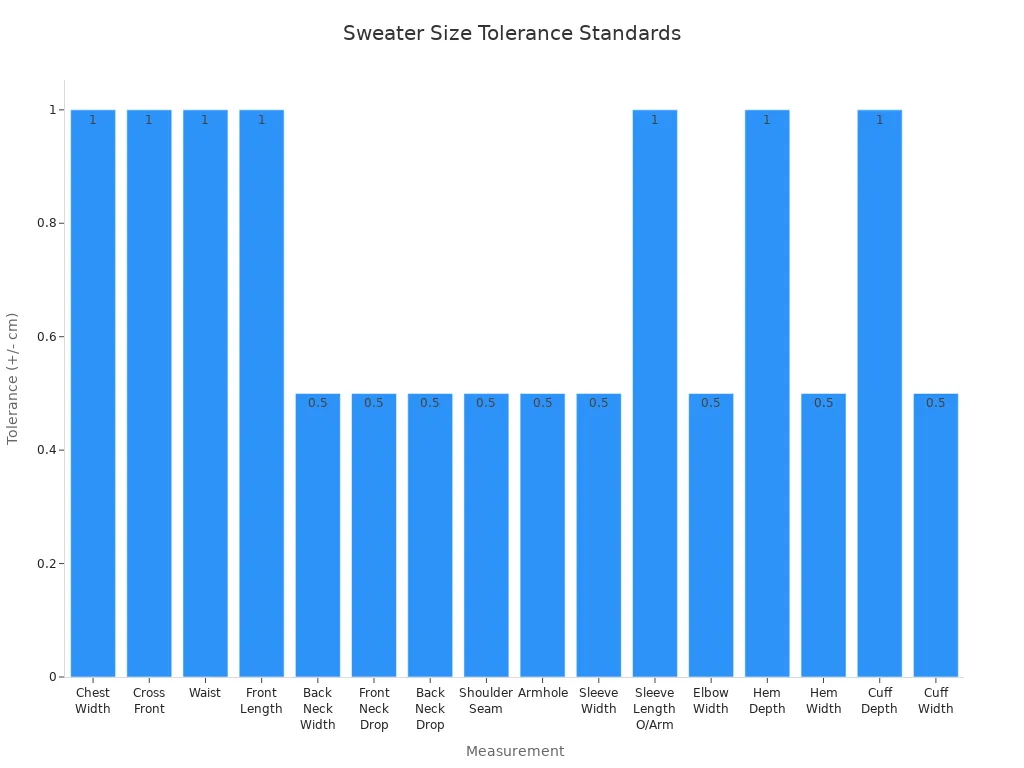
Size tolerances are important for customer happiness. Loose tolerances can make sweaters not fit well. Customers may complain or send sweaters back. Strict tolerances can mean you reject too many sweaters and lose sales. You need to balance your tolerance levels. You can use AQL to check how many defects are allowed in a batch. This system helps you keep quality high and customers happy.
Tip: Always check your tolerance levels before making sweaters. This step helps you stop size inconsistency in bulk sweaters and keeps your quality the same.
Using Past Order Data
You can use past order data to make sizes more consistent. Look at customer feedback, returns, and what people bought before. This information helps you find problems and make better choices. The table below shows some ways to use data:
Method | Description |
|---|---|
Customer Data Utilization | Look at what customers buy, return, and say to give better size advice. |
Machine Learning Algorithms | Use computer programs to find patterns and improve size advice. |
Virtual Try-On Technology | AI tools let customers see how sweaters fit online. |
Body Scanning Technology | Make 3D models of customers’ bodies for better size advice, even for custom sweaters. |
You can use these tools to stop size inconsistency in bulk sweaters. You will find patterns and make changes to improve fit and lower complaints.
Note: Using data helps you keep sizes right and customers happy.
You can stop size inconsistency in bulk sweater production by following these steps. Use standard grading rules, record every size increment, match body sizes, set clear tolerances, and study past order data. These ideas help you stop size inconsistency in bulk sweaters and keep your products the same.
Accurate Size Specifications
Getting the right size starts with clear details. You need to write down and share these details. This helps stop mistakes when making lots of sweaters. When you focus on accurate sizing, your team makes sweaters that fit well. Customers will be happy with their sweaters.
Creating Size Charts
You should make size charts for every sweater style. First, collect flat measurements like chest width, waist width, hip width, sleeve length, and total length. These measurements are the base for accurate sizing. Use grading rules to change sizes and fit types, like loose or fitted sweaters. Always add fit and ease allowances so sweaters feel good to wear. Product information management systems help you keep and update these charts for every SKU.
Tip: Make size charts for each product. This helps lower returns and makes customers happier.
Best practices for creating size charts:
Write down flat measurements for all key points.
Change measurements for fit and ease.
Use grading rules to keep sizes the same.
Store and manage data in one system.
Digital Forms for Size Collection
Digital tools help you collect sizes faster and better. You can use platforms like Gerber AccuMark and Lectra Modaris to grade patterns with millimeter accuracy. CLO 3D shows how sweaters fit on different body shapes before making samples. These tools help you avoid mistakes from doing things by hand. They support accurate sizing during production.
Digital Tool | Function |
|---|---|
Gerber AccuMark | Uses precise grading rules and measurements. This lowers manual errors. |
Lectra Modaris | Grades patterns digitally and makes sharing edits easy. |
CLO 3D | Shows how sweaters fit on many body shapes for accurate sizing. |
Share size details, fit notes, and pictures. |
Metrology is also important. You use special tools to check fabric size and sweater sizing. This makes sure sweaters match design details and keep the right size from cutting to sewing.
Communicating Specifications
You must share size details clearly with your team. Tech packs are the main tool for this job. They put pictures, numbers, and notes in one place. Standardized documents help everyone know what is needed and stop mistakes. Use graded measurement spec sheets, stitch density, seam allowance, and tolerance ranges to give all needed details.
Method | Description |
|---|---|
Tech Packs | Main tool for sharing with pictures, numbers, and notes. |
Standardized Documentation | Shares important information for accurate sizing. |
Numerical Data | Has graded measurement spec sheets and tolerance ranges for sweaters. |
Note: Tech packs give your team one place for all details. Use words everyone knows and clear sections to stop confusion.
When you do these steps, you get better sizing and fewer mistakes in bulk sweater production. Your team will make sweaters that fit and meet what customers want every time.
Measurements and Pattern Making
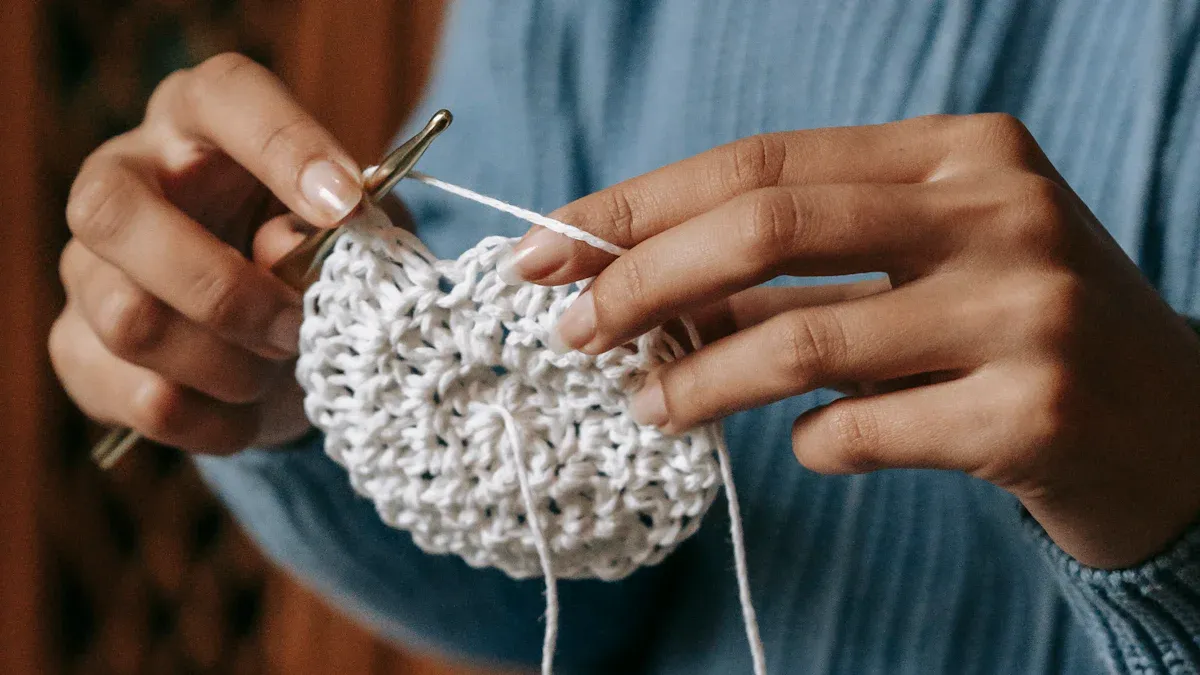
Getting the right measurements and making patterns carefully helps keep sweater sizes the same. You need to follow clear steps to avoid mistakes. This makes sure every sweater fits as planned.
Sampling and Prototyping
You start by making samples and prototypes before making many sweaters. Brands use both computer and real-life methods. You can design sweaters in 3D software first. Then you make real samples at important steps. This helps you find problems early and fix them fast. Here is a sample workflow:
Prototype (Proto): Make the first sample using your Tech Pack.
Fit Sample: Check measurements and comfort on a model or mannequin.
Sew By Sample: Give this sample to the factory as a reference.
Pre Production Sample (PPS): Review a near-final sample for approval.
Size Run Sample: Test all sizes to check grading and consistency.
TOP (Top of Production): Approve the first unit from bulk production.
Sampling helps you find design issues, save money, and deliver orders on time.
You should ask for a first prototype and look it over. Update your Tech Pack after checking fit and function. Send feedback for a second prototype. When you approve the sample, ask for a size set for all sizes. Confirm the design with a pre-production sample. Then approve the top of production sample to start making sweaters in bulk.
Pattern Accuracy
Pattern accuracy makes sure every sweater matches the size you want. You need to use measurement boards and test patterns before making sweaters. Many things can change pattern accuracy:
Technical Factor | Description |
|---|---|
Knitting Tension | Controls how tight or loose the knit is, affecting size. |
Yarn Relaxation | Yarn can change shape after knitting, which alters final measurements. |
Washing Formulas | Different washing methods can shrink or stretch sweaters. |
Blocking Techniques | Helps sweaters keep their shape after washing. |
Standardized Measurement | Using boards keeps sizes the same across batches. |
Pre-wash Testing | Predicts size changes before washing. |
Controlled Finishing | Keeps size tolerances within ±1–1.5 cm. |
Yarn Lot Consistency | Using the same yarn lot avoids size changes. |
Post-wash Handling | Careful handling after washing keeps sizes accurate. |
You should always measure carefully and pick sizes based on real body measurements. Beginners can use top-down sweater patterns to try on sweaters as they knit. You need to plan and test swatches for gauge. Measure key body parts and choose patterns that let you adjust the fit.
Common mistakes include:
Picking the wrong fabric, which changes the final fit.
Measuring gauge wrong, making sweaters too small.
Ignoring yarn behavior, which affects the finished size.
Tip: Always test your swatch and measure body dimensions before starting production.
Grading for Multiple Sizes
Grading means changing your pattern for different sizes. You need to use a basic block as a template for fit. Production patterns include design ease and seam allowances. Garment ease mixes wearing ease for movement and design ease for style.
Concept | Description |
|---|---|
Basic Block | |
Production Pattern | Finished pattern with design ease and seam allowances. |
Garment Ease | Includes wearing ease and design ease for comfort and style. |
You should add the planned ease as a separate row in your spreadsheet. Use formulas to copy measurements to other sizes. Fit types need different amounts of ease:
Fit Type | Ease Measurement |
|---|---|
Very fitted | up to 5 cm (2 in) negative ease |
Classic fit | around 5 cm (2 in) positive ease |
Relaxed fit | around 10 cm (4 in) positive ease |
Oversized fit | at least 15 cm (6 in) positive ease |
Note: Grading for multiple sizes keeps your sweaters consistent and comfortable for every customer.
Quality Control for Accurate Sizing

You need strong quality control to keep sweater sizes right. This helps you find mistakes early and give customers good sweaters. You can stop problems by checking each step, using the best tools, and following clear rules.
In-Process Checks
You should check sweater sizes at every step, not just at the end. These checks help you find problems before they get worse. For example, a “station-to-station” system can catch most defects while making sweaters. If you see a problem, like a collar sewn wrong, you can fix it fast. This way of checking saves time and keeps fabric good.
Checking during production works best when you do it often and watch closely.
You can use first article checks to find mistakes in early samples.
Checking a lot helps you stop color and size mistakes.
Tip: Early checks help you stay in the allowed size error range and cut down on waste.
Final Inspection
You need a final check to make sure every sweater is good. This step checks if sweaters match the approved samples and size charts. You should look at weight, fit, and design details. Use a checklist to compare each item with your files and samples.
COMMENTS | RESULT | |
|---|---|---|
Check the net weight for sweater garments (unit: lbs per dozen). Check 3 pieces per size. | PASSED | |
Fitting check on a model or a doll. If no mannequin is available, ask someone to wear his size and insert pictures of front, back, and side. The sweater should fit perfectly and look like the client’s pictures. | PASSED | |
Compare the item with the approval sample or technical files (check material, color, accessories, labels, packing, logo, workmanship, sewing, and washing effect). Check 2 pieces per color. | PASSED |
Final checks help you make sure all sweaters meet your size and fabric rules. This step also helps you stop returns and unhappy customers.
Measurement Tools
You need good measurement tools to keep sizes the same. Use measuring tapes, rulers, and boards for every key point. The most important points are bust, waist, hips, inseam, sleeve length, shoulder width, and neck size. These tools help you check if each sweater matches the size chart.
Measurement Point | Purpose |
|---|---|
Bust/Chest | Makes sure the sweater fits and feels good. |
Waist | Keeps sizes the same for all styles. |
Hips | Helps design and production, so sweaters meet the rules. |
Inseam | Helps online shopping with clear measurements. |
Sleeve Length | Makes sure the sweater fits and feels good. |
Shoulder Width | Keeps sizes the same for all styles. |
Neck Circumference | Helps design and production, so sweaters meet the rules. |
You can also use digital tools that match customer body sizes with product sizes. These tools look at fabric and stretch, so you get better sizing for everyone. When you use the right tools and follow clear steps, you stop problems and keep sweaters in the right size range.
Note: Good tools and regular checks help you give customers sweaters that fit and keep quality high in every batch.
Feedback and Rework
Error Detection
You need good feedback systems to find size problems early. This helps you stop sweaters from being the wrong size. Early error checks keep your products trusted by customers. There are many ways to spot mistakes:
Pre-production samples help you check fit before making lots of sweaters.
Detailed tech packs give clear steps to your team and help stop size problems.
Quality control checks during production help you find and fix size issues fast.
Modern factories use technology to make error checks better. Machine learning finds patterns in old production data and spots mistakes. Computer vision lets machines see and measure sweaters, catching errors people may miss. Robots can check many sweaters quickly and with care.
To build a strong error check system, do these steps:
Look at your process and find quality control problems.
Gather data about mistakes, steps, and materials.
Pick AI tools that work for your needs and budget.
Tip: Catching mistakes early saves time and money. It also helps you keep sweater sizes the same.
Corrective Actions
When you find a size problem, you must fix it fast. Corrective actions help you solve issues and stop them from happening again. Different fabrics act in different ways, so use the right fix for each one. The table below shows common ways to control popular sweater fabrics:
Fabric Type | Control Method | |
|---|---|---|
Cotton | 2–5% | Sanforization, washing test, cutting allowance |
Linen | 3–5% | Heat-setting, washing, pressing |
Wool | 2–4% | Steaming, careful drying, dimensional finishing |
Silk | 1–3% | Gentle steaming & pre-treatment |
Polyester | 0–1% | Heat-setting, minimal shrinkage |
Nylon | 0–1% | Heat-setting, controlled drying |
Acrylic | 1–2% | Controlled washing, heat-setting |
Spandex / Lycra | <1% | Heat-setting, blended carefully |
Always test your fabrics before you start making sweaters. Change your cutting and finishing steps to control shrinkage and keep sizes right. If you find a size issue, check your tech pack and grading rules. Update your process so the same mistake does not happen again.
Continuous Improvement
Continuous improvement helps you keep sweater sizes the same over time. You can make your process better by using feedback and fixing weak spots. This lowers size problems and helps customers trust your sweaters.
Aspect | Contribution to Size Consistency |
|---|---|
Streamlining Processes | Makes production steps more uniform, so sizes stay the same. |
Reducing Waste | Cuts down on mistakes and size problems in finished sweaters. |
Enhancing Quality Control | Makes sure every sweater meets quality rules, which keeps sizes right. |
You should check raw materials before making sweaters. Standard checks help you find problems early and stop size issues later. When you keep making your process better, you lower the chance of size problems and give customers sweaters that fit.
Note: Continuous improvement never stops. You need to check, change, and update your process often to keep sizes accurate.
Training and Standardization
Staff Training
You need to train your team if you want sweaters to fit the same every time. Training helps everyone understand why size consistency matters. When your staff knows what to look for, they can spot mistakes before sweaters leave the factory. You can use different training programs to teach these skills.
Here are some effective training programs:
Training Program | Description |
|---|---|
Focuses on designing comfortable, consistent, well-fitting clothes through theory and practice. | |
Customized Workshops | Tailored workshops that address your specific projects and needs, optimizing pattern design and size charts. |
Fit, Pattern and 3D Design training gives your team both theory and hands-on practice. Your staff learns how to make sweaters that fit well and look good. Customized workshops help your team solve real problems. You can focus on the patterns and size charts that matter most to your brand.
You should also encourage your team to ask questions and share ideas. When people talk about what works and what does not, everyone learns. You can use role-playing or real-life examples to make lessons stick. Training should happen often, not just once. This keeps everyone up to date with new tools and methods.
Tip: Regular training builds confidence and helps your team catch size issues early.
Standard Operating Procedures
Standard operating procedures, or SOPs, help you keep every step of sweater production under control. SOPs give your team clear instructions for each task. When you follow SOPs, you make sure that everyone uses the same methods every time.
During the knitting process, you need to check fabric for spots or bad stitches. These checks help you catch problems before they grow. SOPs tell your team when and how to do these checks. This keeps your sweaters the same size and quality from start to finish.
SOPs also cover how to fix and grade pattern sizes. If you skip this step or do it wrong, you can end up with sweaters that do not fit. By following SOPs, you make sure that every pattern gets checked and corrected before production begins.
Quality control is part of every SOP. Your team checks for even stitches and strong seams as they work. These checks help you avoid size problems and keep your sweaters looking good. When you use SOPs, you lower the risk of mistakes and make it easier to train new staff.
Note: SOPs help you build a strong system. You get better results and fewer returns when everyone follows the same steps.
You can stop size inconsistency in bulk sweater production by using simple steps. Pay attention to making size charts that are correct. Do quality checks often. Review your process regularly. Use digital tools to keep track of measurements and share details. Make sure everyone uses the same methods.
Make size charts and keep them updated
Check sweater sizes while making and after finishing
Teach your team new skills often
Tip: Try online classes and read industry guides to help you get better at sizing.
FAQ
What is grading in sweater production?
Grading means changing a pattern to create different sizes. You use grading to make sure each sweater fits well for every customer. This step helps you keep size consistency in bulk production and improves the quality of your sweaters.
Why do you need fit samples before bulk production?
Fit samples let you check the fit and comfort of your sweater design. You use these samples to test grading and spot problems early. This step helps you avoid mistakes in bulk production and keeps your process on track.
How do you keep sweater sizes consistent in bulk orders?
You follow a clear process with grading rules, size charts, and fit samples. You check measurements at every step. This approach helps you keep the fit and quality the same for all sweaters in bulk orders.
What tools help you with grading and fit?
You use digital tools like pattern software and 3D modeling. These tools help you test grading, check fit, and improve your process. They also help you keep quality high during bulk production.
How does feedback improve the bulk production process?
Feedback from fit samples and quality checks helps you find problems fast. You use this information to fix grading or fit issues. This process keeps your sweaters consistent and improves the quality of every batch.
Why is quality control important for sweater fit?
Quality control checks help you catch mistakes in grading, fit, and measurements. You use these checks during every step of bulk production. This process keeps your sweaters fitting right and builds trust with your customers.
How do you handle grading for different body types?
You collect real body measurements from your target market. You use these numbers to guide grading and fit. This process helps you make sweaters that fit many people and keeps your bulk production consistent.
What steps help you keep the process smooth in bulk production?
You set clear grading rules, use fit samples, and check quality at every stage. You update your process with feedback. This approach helps you avoid mistakes and keeps your sweaters fitting well in every batch.