
You should know about moq when you start making custom clothes or want your brand to grow. In knitwear manufacturing, minimum order quantity is the smallest number of clothes you can order for each style. Manufacturers decide moq by looking at the type of clothing, how hard it is to make, and the materials you pick.
For example, at Hook and Eye UK, moq usually begins at 50 pieces for each style or color.
The moq affects your business in different ways:
Reason | Explanation |
|---|---|
Dyeing lots of fabric at once saves money, but small batches cost more and can change colors. | |
Trims & Accessories | If you buy fewer zippers or buttons, you pay more for each one. |
Machine & Line Efficiency | Short runs make machines stop working and raise the cost for each piece. |
Commercial & Logistics Costs | Shipping and paperwork cost more when you order less. |
You can use this knitwear MOQ guide for custom orders to help you make good choices in 2025.
Key Takeaways
Understand MOQ: Minimum Order Quantity (MOQ) means the fewest items you can order for each style or color. Knowing this helps you plan your production well.
Cost Efficiency: If you order more pieces, each item costs less. This helps you save money and make more profit over time.
Flexibility in Orders: Some manufacturers let you split your MOQ between sizes or colors. This gives you more choices and helps you meet what customers want.
Choose Simple Designs: Pick simple designs to keep your MOQ lower. Harder styles often need more items because they take longer to set up.
Timing Matters: Order during slow times to ask for lower MOQs. Factories may give better deals when they have less work.
Use Inventory Tools: Use inventory software to watch your stock and orders. This helps you not run out of products or have too many.
Explore On-Demand Options: Try on-demand production to skip high MOQs. This lets you test new ideas without spending a lot at first.
Build Relationships: Talk openly with your manufacturer. A good relationship can help you get better deals and more choices in your orders.
MOQ Basics in Knitwear
What Is MOQ?
You will see the word moq a lot when you work with custom knitwear makers. MOQ means minimum order quantity. This is the smallest number you must buy for each style or color. Manufacturers use moq to keep their work going and save money. For example, basic styles might need 300 pieces. Structured blazers may need 500 pieces. Detailed dresses could need 400 pieces.
Style Type | Minimum Order Quantity |
|---|---|
Basic styles | 300 pieces |
Structured blazers | 500 pieces |
Detailed dresses | 400 pieces |
Most manufacturers set moq for each design and color. If you want more than one color, you must meet the moq for each color. Some factories let you split the moq between sizes. This means you can order small, medium, and large together to reach the moq.
MOQ’s Role in Custom Orders
MOQ is important when you make custom knitwear. If you order more, you pay less for each piece. This helps you save money over time. Manufacturers can work faster and do not waste time setting up. You also get a steady supply of products. This keeps your customers happy.
Advantage | Description |
|---|---|
Cost Reduction | Buying more at once makes each piece cheaper, so you save money in the end. |
Efficient Production | Factories can work better and faster, with less time wasted. |
Improved Cash Flow | MOQ helps you manage your money by not needing to order small amounts often. |
Consistent Supply | You get a steady flow of items, so you do not run out and customers stay happy. |
Tip: Ask your factory if you can split your moq between sizes. This gives you more choices and helps you meet what customers want.
Balancing Demand, Cost, and Inventory
You need to balance demand, cost, and inventory when you set your moq. Manufacturers buy lots of raw materials at once to get better prices. This keeps costs low and makes sure you have enough yarn and fabric. A higher moq helps you plan your money and avoid surprises.
Use inventory software to watch your stock and orders. This helps you not run out or have too much.
Predictive tools can help you guess what you will sell. You can use real-time data to change your moq if sales go up or down.
Buying in bulk saves money and keeps your production moving without stops.
You should think about your sales goals and storage space before you pick your moq. Planning ahead helps your brand grow and keeps your customers happy.
Knitwear MOQ Guide for Custom Orders
If you want to do well in custom knitwear, you need a clear knitwear moq guide for custom orders. This guide helps you see how manufacturers set moq. It shows what things change the moq and how you can make good choices for your brand. You will learn how to balance cost, design, and production needs. Knowing this gives you more control over your orders and helps your business grow.
How Manufacturers Set MOQ
Manufacturers use different rules when they set moq for custom knitwear. They look at the type of garment, the materials, and the design details. They also think about how much work and time each order needs. The knitwear moq guide for custom orders shows that factories want their machines to run well and not waste anything. If you ask for a hard design or special fabric, the moq will be higher. Simple styles with basic yarns often have lower moq.
Here is a table that shows the main things manufacturers think about:
Factor | Description |
|---|---|
Complexity of construction | More complicated garments require higher MOQs due to intricate features like panelling and zips. |
Fabric choice | Manufacturers must adhere to fabric suppliers’ MOQs, often requiring at least 100 metres. |
Embellishments/applications | Certain design elements necessitate higher MOQs due to increased setup and labor intensity. |
You should talk to your manufacturer early. Ask about their moq rules and see if you can change your design or fabric to lower the minimums. This step helps you avoid surprises and plan your money.
MOQ Calculation Factors
You need to know what goes into the moq calculation. The knitwear moq guide for custom orders explains that three main things change the number: fabric and yarn costs, labor and setup, and production efficiency.
Fabric and Yarn Costs
Yarn and fabric costs are a big part of the moq. Factories buy yarn in bulk to get better prices. If you want a special color or blend, you may need to order more to meet the supplier’s minimums. The knitwear moq guide for custom orders says that most suppliers ask for at least 100 meters of fabric. If you order less, the price for each piece goes up.
Here is a table to help you see how costs add up:
Metric | Purpose | Example Calculation |
|---|---|---|
Total Fabric Cost | Calculates total expenses in producing textiles, including materials, labor, and overheads. | TC = Material Cost + Labor Cost + Overhead Cost = $500 + $200 + $150 = $850 |
Cost per Unit of Fabric | Determines the cost of producing one unit of fabric. | CPU = Total Cost / Fabric Weight = $850 / 100 kg = $8.50/kg |
If you want to keep costs low, pick common yarns and colors. This helps you meet the moq without spending too much.
Labor and Setup
Labor and setup costs also change the moq. Every time a factory starts a new order, workers must set up machines and get materials ready. This takes time and money. If you order a small batch, the setup cost for each piece is higher. The knitwear moq guide for custom orders says that simple designs with fewer steps need less setup, so the moq can be lower.
You can ask your manufacturer if they can group your order with others to share setup costs. This can help you save money and lower your moq.
Production Efficiency
Production efficiency means how well the factory uses its machines and workers. High efficiency leads to lower costs and lower moq. If machines run fast and workers stay busy, the factory can make more pieces in less time. The knitwear moq guide for custom orders shows that factories measure things like production rate, machine efficiency, and labor productivity.
Here are some key metrics:
Metric | Purpose | Example Calculation |
|---|---|---|
Production Rate | Measures the quantity of fabric produced per hour. | PR = Fabric Weight / Production Time = 100 kg / 8 h |
Machine Efficiency | Shows how well machines perform. | ME = (Actual Output / Theoretical Output) × 100 |
Labor Productivity | Measures output per worker. | LP = Fabric Weight / (Number of Workers × Time) |
If you want a lower moq, pick designs that are easy to make and do not slow down the machines. This helps the factory keep production smooth and costs down.
Tip: Always ask your factory for their production schedule. If you can fit your order into a busy time, you may get a better moq.
Practical Tips for Startups and Small Brands
You may worry about meeting the moq if you run a small brand or startup. The knitwear moq guide for custom orders gives these tips:
Look for manufacturers that allow smaller order quantities.
Choose flexible factories that offer low moq, sometimes as low as 30 pieces.
Pick simple designs to keep costs down and stand out in the market.
Explore eco-friendly options to attract more customers.
Ask for quick production times to meet demand.
Use advanced knitting technology for better quality and lower moq.
You can also ask if the factory offers fully customizable options with no minimum order quantity. This helps you test new ideas without spending a lot.
Note: Always compare different factories. Some offer better terms for small brands. Do not be afraid to negotiate or ask for samples before you decide.
The knitwear moq guide for custom orders helps you make smart choices. You can balance your money, design, and production needs. Knowing this gives you the power to grow your brand in the world of knitwear manufacturing.
MOQ Impact on Brands
Access to Production
You need to understand how moq shapes your ability to start production. When you work with a factory, moq sets the lowest number of pieces you can order. If you meet the moq, you gain access to professional equipment and skilled workers. This helps you launch new products and keep quality high. If your order falls below the moq, you may face extra fees or delays. Factories want to run their machines efficiently, so they prefer larger orders. You should plan your collection and choose styles that fit the moq. This makes it easier to begin production and avoid unexpected costs.
Tip: Ask your manufacturer if you can combine styles or colors to reach the moq. This gives you more options and helps you start production faster.
Pricing and Scalability
Moq has a big effect on your pricing and how much you can grow. When you order more pieces, you pay less for each one. Factories offer price breaks at certain order sizes. You can see how this works:
Higher order volumes lead to lower unit prices because factories work more efficiently.
Price breaks happen at specific order volumes:
100 meters: $3.80 per meter
300 meters: $3.30 per meter
500 meters: $2.90 per meter
1000 meters: $2.50 per meter
Orders below moq may have extra charges, like a $200 fee for orders under 200 meters.
You should think about your budget and sales goals. If you plan to grow your brand, ordering more pieces helps you save money and scale up. Small-batch production lets you test the market, but you pay more for each item. As you increase your order size, you unlock better prices and more profit.
Flexibility for Startups
If you run a startup or a small brand, moq can affect your flexibility. High moq makes it hard to offer many styles or test new ideas. Low moq gives you more freedom to try different products and manage your inventory. You can see the difference in this table:
High MOQ | Low MOQ | |
|---|---|---|
Flexibility in product variety | Limited | Enhanced |
Market testing capability | Difficult | Efficient |
Inventory management | Challenging | Improved |
Storage costs | Higher | Reduced |
You should look for factories that offer low moq. This helps you test new designs and respond to customer feedback. You can keep your storage costs low and avoid having too much unsold stock. In knitwear manufacturing, low moq supports small-batch production and helps your brand stay flexible.
Note: If you want to grow your business, start with low moq and increase your order size as demand rises. This strategy helps you manage risk and build a strong brand.
Factors Influencing MOQ
Yarn and Material Choices
When you pick yarn and materials, you make big choices. These choices change the moq for your order. If you want custom fabrics, you must order more pieces. Stock items need fewer pieces. Factories use many yarn types, like spun or filament yarns. The spinning process can change the number you must order. You also pick between natural and synthetic fibers. Cotton and wool are natural and feel soft. Synthetic fibers make your knitwear stronger. Your choice changes how your knitwear feels and lasts. It can also make the moq go up or down.
Here is a table that shows how yarn and material choices influence moq:
Aspect | Details |
|---|---|
Minimum Order Quantity (MOQ) | Custom fabrics need a bigger moq than stock items. Some producers let you pick flexible moq designs for fashion brands. |
Yarn & Spinning Process | The yarn type changes the moq. Spun or filament yarns make production easier or harder. |
Sourcing Raw Fibers | Picking natural or synthetic fibers changes how your knitwear feels and lasts. This also changes the moq you need. |
Tip: To get a lower moq, ask about using stock yarns or common blends. This helps you keep costs low and avoid high minimums.
Design Complexity
Your design choices change the moq. Simple designs, like plain t-shirts, need a lower moq. Factories make these fast with little setup. If you add things like panels or decorations, the moq goes up. Hard designs need more work and time. For example, pants with many pockets need a higher moq than a plain shirt. Factories look at your design and decide the best number to make. You should think about how many details you want. More details mean a higher moq.
Note: You can get a lower moq if you make your design simple. Take away extra layers or decorations to make things easier to produce.
Factory Capabilities
You need to know what your factory can do. Factory skills help set the moq for your order. Some factories are good at certain knitwear types. These factories work fast and can offer a lower moq for those items. If your design matches what they do best, you get better results. Factories also set moq by their machines and worker skills. If they have new machines, you may get a better moq. When you order also matters. If the factory has free time, you might get a lower moq. You should talk to your factory about what they can do and when.
Ask what the factory is best at and what machines they use.
See if your order fits their schedule.
Pick factories with experience in your knitwear type for better moq.
Tip: Plan your order early and talk to your factory. Good timing and clear talks help you get the best moq for your brand.
Order Timing
Order timing plays a big role in how manufacturers set moq for custom knitwear. You need to think about when you place your order and how it fits into the factory’s schedule. If you order during busy seasons, factories may raise the moq. They want to use their machines for large orders that keep production moving. If you order during slow periods, you might get a lower moq because factories want to fill their schedules.
Factories plan their work months ahead. You should talk to your manufacturer early. Ask about their busy times and slow times. This helps you pick the best moment to place your order. If you wait too long, you may miss your chance for a lower moq.
Here is a table that shows how timing affects moq:
Season | Factory Workload | Typical MOQ | Chance for Lower MOQ |
|---|---|---|---|
Spring | High | 300+ | Low |
Summer | Medium | 200-300 | Medium |
Fall | High | 300+ | Low |
Winter | Low | 100-200 | High |
You can see that winter often gives you the best chance for a lower moq. Factories have fewer orders and want to keep their machines running. You should plan your production calendar with this in mind.
Tip: Ask your factory if they offer special deals during slow seasons. Some factories give discounts or lower moq to fill empty slots.
Order timing also affects how fast you get your products. If you order during busy times, you may wait longer for your knitwear. If you order during slow times, factories can finish your order faster. You should think about your sales plan and when you need your products. Good timing helps you avoid delays and keeps your customers happy.
You can use these strategies to manage moq with order timing:
Place orders early to get the best spot in the factory’s schedule.
Avoid peak seasons if you want a lower moq.
Work with your manufacturer to plan ahead.
Use a production calendar to track busy and slow periods.
Order timing gives you more control over moq. You can save money, get products faster, and grow your brand. Smart planning helps you make the most of your custom knitwear orders.
Typical MOQ Ranges 2025
Sweaters and Pullovers
When you make a knitwear collection, you should know the moq for sweaters and pullovers. In 2025, factories set different moq levels. These depend on your design and their rules. If you pick a simple style, the moq is lower. Small brands can start making products more easily. If your design is complex, the moq is higher. You pay less for each piece when you order more. You should talk to your factory about your design. Ask how the moq changes for each style. Ordering more sweaters saves you money. This helps your business grow and lets you offer more styles.
Accessories
You can add knitwear accessories to your brand with flexible moq choices. In 2025, the moq for accessories depends on the type of product and where you make them. Some factories have very low moq. Others set higher moq for orders from other countries. You can see the differences in this table:
Product Type | Minimum Order Quantity |
|---|---|
Knit Cardigans | Starts from 100 pcs |
Knit Hoodies (International) | 3,000 pieces |
Knit Hoodies (Domestic – Hongyu) | 50 pieces |
Knit Hoodies (Domestic – Raja Sri) | 100 pieces |
Other Knitwear (Accessories) | No minimum order required |
If you want to compare these moq levels, look at this chart:
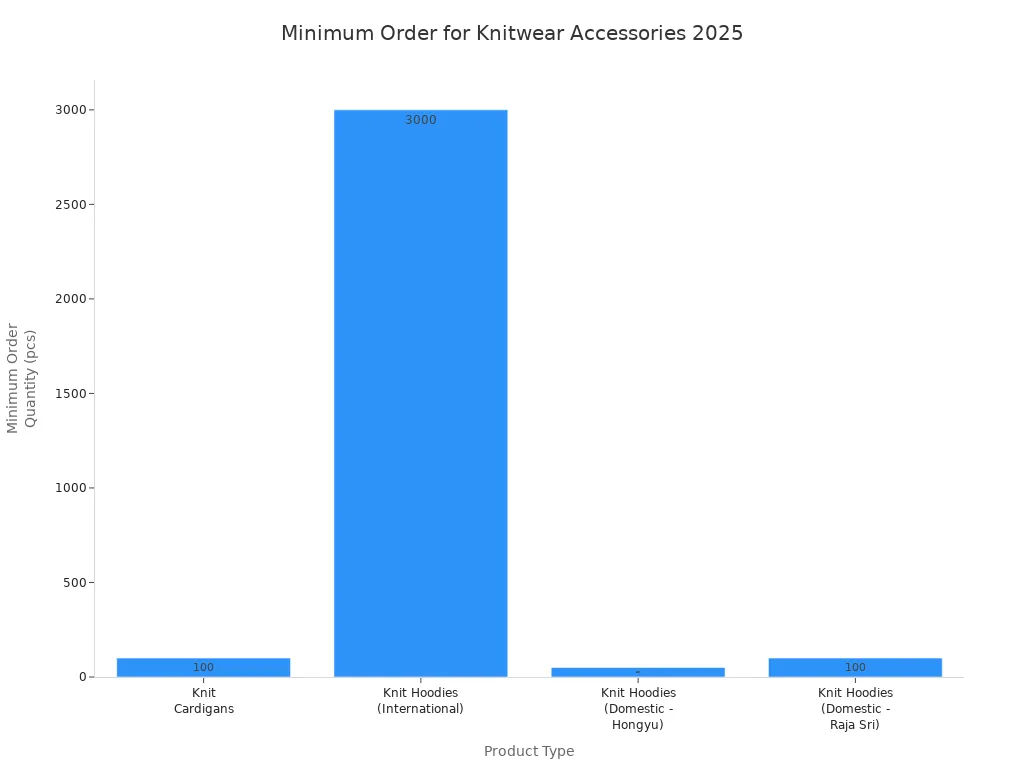
You can pick products with no minimum order if you want to try new ideas. This gives you more freedom and helps you control your spending.
Children’s Knitwear
You will see that moq for children’s knitwear is usually lower than for adult styles. Factories know small brands want to offer many kid designs. You can order as few as 3 to 50 pieces. The number depends on the product and the factory. Handmade and custom items have the lowest moq. You can check the range in this table:
Product Description | Minimum Order Quantity | Manufacturer |
|---|---|---|
Baby Sweater Clothes | 50 pieces | Dongguan Yue Bai Wan Clothing Co., Ltd. |
Checkered Jacquard Cardigan | 30 pieces | Guangzhou Tianmiao Pu Clothing Co., Ltd. |
Girls Sweaters with Patchwork | 50 pieces | Taizhou Luqiao Xinjun Children’s Clothing Factory |
Thick Crochet Twist Outwear | 3 pieces | Fujian Nan’ An Huangda Clothing Co., Ltd. |
Handmade High Quality Cotton Sweater | 5 pieces | Huizhou Qian Qian Industrial Co., Ltd. |
Custom Striped Pattern Sweater | 5 pieces | Taizhou Chentao Garment Co., Ltd. |
Fashion Kids Knitted Jacquard Sweaters | 50 pieces | Yiwu Maxine Trading Co., Ltd. |
You can also look at the chart for a visual comparison:
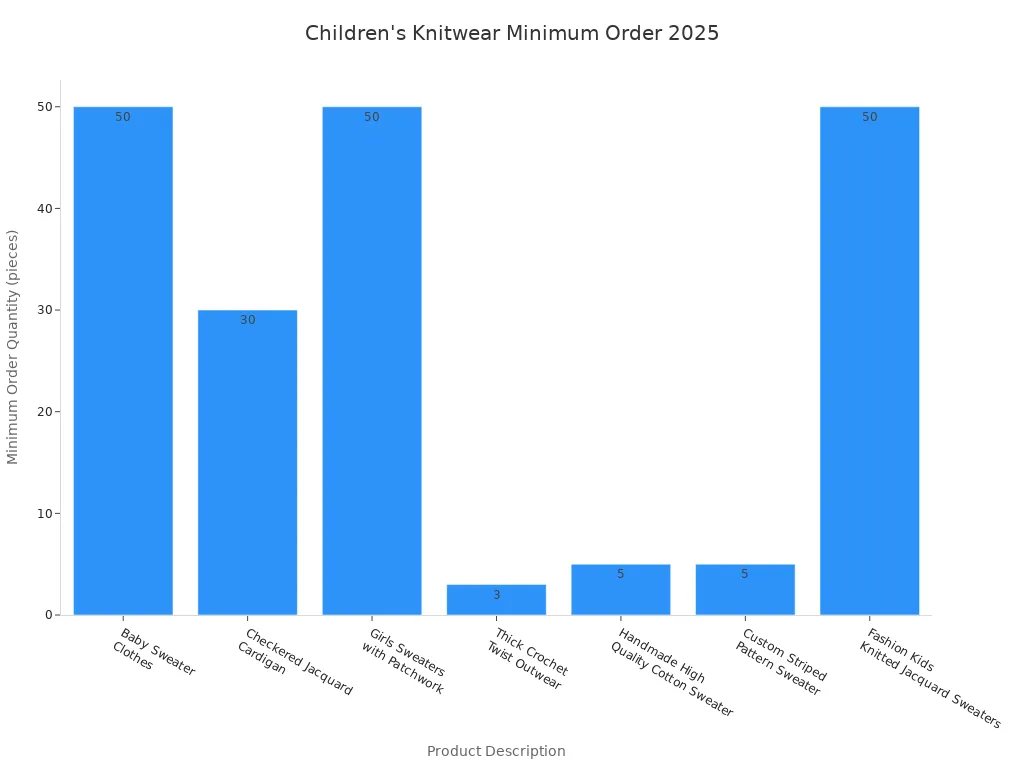
If you want to start a children’s line, you can begin with a small moq. This helps you test the market and change your designs quickly.
On-Demand and Low MOQ Options
You have more ways to start a knitwear brand in 2025. On-demand production and low moq choices help you try new ideas. These options lower your risk and help you control your money. Many websites let you order custom sweaters and accessories with no minimums. You can design what you want online and get it shipped fast.
Here is a table that shows some popular platforms for on-demand and low moq knitwear:
Platform | Product Range | Materials | MOQ & Pricing | Design Tools | Production Time | Integrations |
|---|---|---|---|---|---|---|
Knitwise | Sweaters, cardigans, vests, beanies, blankets | Cotton/polyester (55%/45%) | No moq; ~$38 per sweater | 3D Design Maker, Photoshop templates | 1–2 weeks | Shopify, Fourthwall, Order Desk |
Wildemasche | Sweaters, scarves, beanies, blankets, pillows | 100% acrylic | No moq; ~€69.90/sweater | Online Designer with simulation | 1–2 weeks | None |
Knitup | Fashion sweaters, accessories | Cotton, wool, viscose, sustainable | No moq (~$100/sweater) | Essentials + Atelier toolsets | ~3 weeks | Shopify |
Tailored Industry | Sweaters, cardigans, dresses, accessories | Merino wool, cashmere, eco-viscose | No moq with subscription | Silhouette Toolkit, custom studio | 3–9 days | Shopify |
You can use these websites to make knitwear without high moq. You design your items with easy online tools. Some sites have 3D design makers or Photoshop templates. You can see your design before you buy it. You can change colors, patterns, and styles any time.
Most on-demand services use good materials like cotton, wool, or eco-friendly blends. You pick the yarn and style that match your brand. You do not need to buy hundreds of pieces. You can start with just one item. This helps you test what people like and get their thoughts.
Production is quick. You get your knitwear in one to three weeks. Some sites send your order in just a few days. You can link your online store, like Shopify, to these services. This makes selling and handling orders simple.
You save money and do not need extra stock with low moq. You do not need a big warehouse. You only order what you need. You can make new designs fast and keep your brand exciting.
Tip: Order samples first. This helps you check the quality and fit before you sell to customers.
On-demand and low moq sites give you freedom and more choices. You can grow your brand at your own speed. You do not have to spend a lot of money at once. You can follow trends and listen to what customers want. You control your stock and keep costs down.
If you want to start a knitwear brand or add more products, look for sites with no moq. This makes it easier to run your business and reach your goals in 2025.
Managing and Negotiating MOQ
Reducing MOQ Strategies
You can use smart ways to lower your moq. Pick simple designs for your knitwear. Factories make these faster and need less setup. Choose standard yarns and colors for your order. This helps the factory group your order with others. It makes it easier for them to offer a lower moq.
Ask if you can combine sizes or colors in one order. Some factories let you split the moq between sizes. This helps you give more choices to your customers. If you use standard specs, you cut down setup time. This makes the process smoother for everyone. Factories often give a lower moq for this.
Try to build a good relationship with your supplier. If you show you want to order more later, they may trust you. They might lower the moq for your first order. You can ask for a trial moq as a new buyer. Many fabric mills offer this as a courtesy.
Tip: Always tell your needs clearly. Ask your manufacturer about slow seasons or extra space. You may get a better deal if you order at the right time.
Negotiation Tips for Startups
If you run a startup, you need good negotiation skills. Use different tactics to get better terms from your manufacturer. Here is a table with some helpful methods:
Tactic | Effectiveness | Notes |
|---|---|---|
Rolling PO commitment | ✅✅✅ | Builds supplier trust, reduces risk |
Colorway consolidation | ✅✅ | Easier batching, less dye waste |
Accepting standard specs | ✅✅✅ | Cuts setup time, increases willingness |
Requesting trial MOQ as new buyer | ✅✅ | Common courtesy among fabric mills |
Promise to place regular orders over time. This rolling purchase order commitment builds trust with your supplier. If you combine colorways, batching is easier for the factory. This reduces waste and may lower your moq.
Accepting standard specs is another strong tactic. Factories like orders that fit their usual process. If you ask for a trial moq as a new buyer, you show respect for their business. Many suppliers will work with you if you explain your plans and show you want to grow.
Note: Always get ready before you negotiate. Know your numbers and be ready to explain your business goals. This helps you get the best deal.
Pre-Order and Crowdfunding Models
You can use pre-order and crowdfunding models to manage moq. These models help you match production to real customer demand. With pre-orders, you only make what has been sold. This reduces extra inventory and waste.
Pre-ordering lets you figure out the exact amount of materials you need from customer orders.
You avoid making too much, which is a big problem in fashion.
Customers benefit because they can get their favorite items before they sell out.
Pre-order inventory planning changes the usual production process. You sell products before you make them. This method gives you real-time demand insights. You can make smart choices about what to produce. You also improve your cash flow because you get paid before production starts.
Pre-orders help you make only what you have sold, so you do not end up with extra stock.
You get demand data as orders come in, which helps you plan better.
You collect money up front, which makes it easier to pay for materials and labor.
Crowdfunding works in a similar way. You launch a campaign and ask customers to support your new product. If you reach your funding goal, you make the items. This model helps you test new ideas and manage moq without taking big risks.
Tip: Use pre-order and crowdfunding tools to connect with your customers. You can build excitement and make sure you only make what people want.
These models give you more control over your business. You can manage moq, reduce waste, and support small-batch production. You also build a loyal customer base that helps your brand grow.
Partnering with Other Brands
You can lower your moq by working with other brands. This strategy helps you share costs and reach production goals that might be too high for one brand alone. Many small brands face the same challenge. Factories often set moq at a level that feels out of reach. When you join forces, you can meet these numbers together.
You might wonder how to start. Here are some ways you can partner with other brands:
Group Orders: You and other brands place one large order. The factory treats it as a single batch, so you all benefit from lower prices and shared moq.
Shared Materials: You can buy yarn or fabric together. This helps you meet the supplier’s moq for raw materials. You also get better prices.
Joint Collections: Sometimes, brands create a special line together. You both promote the products and split the production. This makes it easier to reach the moq for each style.
Tip: Always choose partners with similar quality standards and timelines. Good communication helps you avoid problems.
Here is a table to show the benefits of partnering with other brands:
Benefit | How It Helps You |
|---|---|
Lower Costs | You share setup and material expenses |
Easier MOQ Management | You reach the moq faster |
More Product Variety | You can offer more styles or colors |
Shared Risk | You do not carry all the risk alone |
You should set clear rules before you start. Decide how you will split costs, handle payments, and manage delivery. Write down your agreement so everyone knows their role. This keeps the process smooth and fair.
You can find partners at trade shows, online forums, or through industry groups. Many brands look for others to share moq. You can also ask your manufacturer if they know brands with similar needs.
Working together gives you more power when you talk to factories. You can ask for better terms or faster production. You also build strong relationships in the industry. This can help your brand grow in the future.
Note: Always check that your partner’s brand values match yours. Trust and clear goals make the partnership work well.
By partnering with other brands, you make moq less of a barrier. You get more flexibility and can bring new products to market faster. This approach helps you manage costs and build a stronger business.
Choosing a Low MOQ Manufacturer
Finding the Right Factory
You want a factory that fits your brand’s needs. Start by looking for factories with low moq. These factories help you save money and control your stock. If a factory takes small orders, you can try new products. This lowers your risk. You also build better relationships with your suppliers. This shows you are flexible and want to work together.
Here are some steps to help you pick a factory:
Check what moq they want for each style and color.
Ask how long it takes to make your order.
Request a sample to check the quality before buying more.
Find out how they check the quality of their products.
Look for certificates that show they follow the rules.
Ask if they have worked with brands like yours before.
A good factory will answer your questions. They will help you learn about their process. You should feel sure they can give you what you need.
Evaluating Flexibility
You need a factory that can change with your business. Factories with low moq let you try new ideas. You can test the market without spending too much. You can order small amounts and see what sells. If you want to grow, flexible factories help you change fast. This helps you keep up with new trends.
Here are ways to see if a factory is flexible:
Check if they let you make small batches for new styles.
Ask if you can change your order size if you need to.
See if they let you change the design or color quickly.
Make sure they help you lower your money risk with low moq.
Flexible factories help you be creative and try new things. You can launch new products and change your plan as you learn from your buyers.
Key Questions to Ask
Before you pick a factory, ask important questions about their moq. These questions help you know how they work and what to expect.
What is the smallest number I can order for each style or color?
How do you decide your moq for each product?
What steps do you take to get each order ready?
How do you set prices and what payment rules do you have?
Can you tell me about your quality checks?
Do you make samples before big orders?
What certificates do you have?
Have you worked with brands like mine?
Use this table to keep your questions organized:
Question | Why It Matters |
|---|---|
Minimum order quantity per style/color | Helps you plan your collection |
Shows why moq is needed | |
Pricing and payment terms | Lets you manage your budget |
Quality control process | Ensures product consistency |
Sample production | Tests quality before big orders |
Certifications | Confirms industry standards |
Experience with similar brands | Proves expertise |
Asking these questions helps you pick a factory that supports your goals. You can make smart choices and build a strong brand.
Warning Signs
You want to choose a low moq manufacturer who supports your brand’s growth. However, you need to watch for warning signs that show a factory may not be the right fit. If you see these red flags, you should think twice before working with them.
Unclear Pricing or Hidden Fees
If a manufacturer does not give you clear prices for your moq, you may face surprise costs later. Always ask for a full price list and check for extra charges. Some factories add fees for small orders or special requests.Poor Communication
Good communication helps you avoid mistakes. If a factory takes too long to reply or gives short answers, you may have problems during production. You want a partner who answers your questions and explains their moq rules.No Written Agreement
You should always get a contract that lists the moq, prices, and delivery times. If a factory refuses to give you a written agreement, you risk losing money or getting poor service.Inconsistent Quality
Ask for samples before you place a big order. If the sample quality does not match what you want, the final products may disappoint you. Factories with low moq should still meet your standards.Lack of Transparency
A good manufacturer will show you their process and explain how they set their moq. If they avoid your questions or do not let you visit, you should be careful.
Here is a table to help you spot warning signs:
Warning Sign | What It Means for You |
|---|---|
Unclear moq or pricing | You may pay more than you expect |
Slow or poor communication | You might face delays or confusion |
No contract or paperwork | You have less protection as a buyer |
Poor sample quality | Your products may not meet your needs |
No process transparency | You cannot trust their business |
Tip: Trust your instincts. If something feels wrong, ask more questions or look for another factory.
You should always check reviews or ask other brands about their experience with the manufacturer. If you see many complaints about moq or quality, you should keep searching. Picking the right partner helps you avoid costly mistakes and keeps your brand strong.
Real-World MOQ Example
Brand Challenge Overview
You run a small knitwear brand. You want to launch a new sweater collection. The factory tells you their moq is 300 pieces per style. You only need 80 sweaters to test your market. You feel stuck. You worry about spending too much money and holding extra stock. You want to find a way to meet the factory’s moq without risking your business.
Solutions and Outcomes
You start looking for answers. You talk to other small brands. You ask your factory if they can help you lower the moq. You learn that some factories allow you to combine small orders. You use the same fabric and color for different sweater styles. This helps you reach the moq faster. You also ask the factory if they can run a partial batch. They agree to make a smaller run, but you pay a little more for each piece.
You find a jobber who sells leftover fabric. You buy enough for your small order. You also negotiate with the factory. You ask if you can meet the moq by ordering several colors of the same fabric. The factory says yes. You agree to a reduced moq with a price surcharge. You get your sweaters made and test them with your customers.
Here is a table that shows the strategies you use:
Strategy | Description |
|---|---|
Use similar fabrics or colors across styles to optimize fabric use. | |
Negotiating partial runs | Work with factories to allow flexible line planning for small orders. |
You also try these ideas:
Work with jobbers who sell surplus fabric at lower moqs.
Negotiate to meet moqs across multiple colors of the same fabric.
Agree to a reduced moq with a price surcharge.
Your brand launches the new sweaters. You sell most of your stock. You learn what your customers like. You avoid wasting money and keep your business safe.
Lessons for 2025
You see that small brands can overcome moq challenges. You learn to talk with your factory early. You ask about combining orders and using standard fabrics. You find that jobbers help you buy fabric in small amounts. You learn that factories may allow partial runs if you pay a little more.
Tip: Always ask your factory about flexible moq options. You can save money and test new ideas.
You discover that planning and teamwork help you grow your brand. You use these lessons to make better choices in the future. You keep your business strong and ready for new trends in 2025.
You now know how moq affects custom knitwear in 2025. When you plan your brand, knowing about moq helps you save money and avoid errors. This guide lets you look at different factories, pick styles, and handle your orders. If you want your brand to grow, talk to manufacturers and make a plan for making products. MOQ lets you try new ideas, keep track of your stock, and make your business strong.
Tip: Check your moq choices before you order anything. This helps you make good decisions for your brand.
FAQ
What does MOQ mean in knitwear manufacturing?
MOQ means Minimum Order Quantity. It is the smallest number you must order for each style or color. Factories use MOQ to keep work fast and costs low.
Why do factories require a minimum order quantity?
Factories need MOQ to pay for setup and buy lots of materials. This helps machines run well and stops waste. If MOQ is lower, each piece may cost more.
Can you negotiate MOQ with manufacturers?
You can talk to factories about MOQ. Ask if you can mix sizes or colors, use regular yarns, or try a small order first. Talking clearly helps you find better options.
How does MOQ affect your pricing?
If you order more, each item costs less. Big orders save you money. Small orders might cost extra or have higher prices.
What happens if you cannot meet the MOQ?
If you do not reach MOQ, you might pay more or wait longer. Some factories let you order less but charge extra. You can also use on-demand sites or team up with other brands.
Are there manufacturers with no MOQ?
Yes, some factories and websites let you order any amount. You can buy just one piece or a few. This helps you try new styles and manage your stock.
How can you reduce your MOQ?
Pick easy designs, use common materials, and order when factories are not busy. You can join orders with other brands or use pre-orders to lower MOQ.
Does MOQ change for different knitwear products?
MOQ is different for each product, design, and material. Accessories and kids’ knitwear often need fewer pieces than adult sweaters or fancy styles.