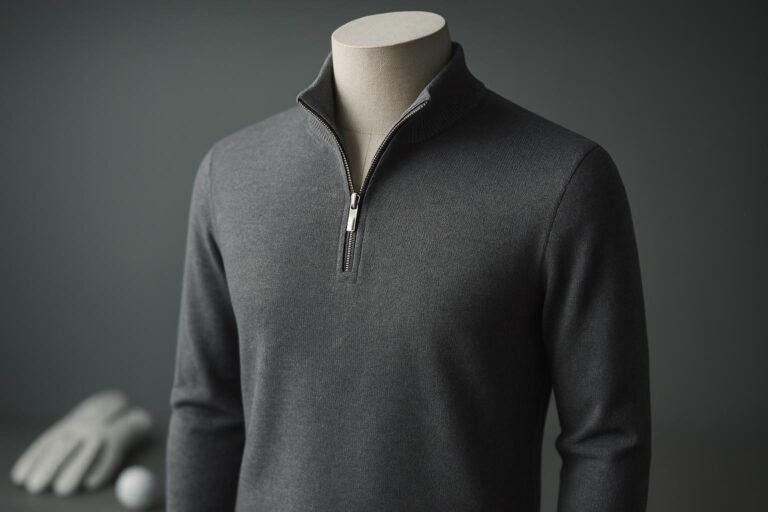

A men’s luxury jersey quarter‑zip pullover sweater succeeds or fails on materials first. For athleisure and golf, the difference shows up in handfeel on the neck, how the placket sits under a blazer or wind shell, and whether the knit springs back shot after shot. This guide turns that intuition into an OEM‑ready plan you can take straight to a factory—starting with yarn fineness and blend choices, then translating those into knit construction, trims, sampling gates, AQL inspections, and OTIF/PCD controls.
Key takeaways
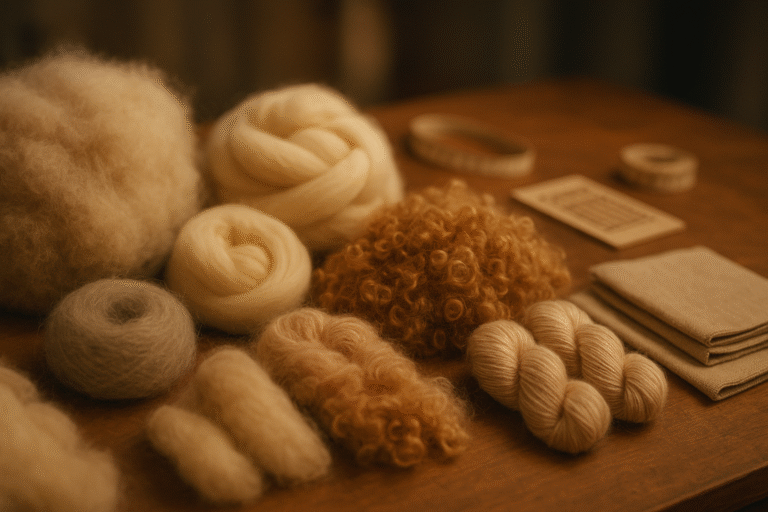
Start with fiber fineness and yarn quality. Superfine Merino defined around 16.6–18.5 µm by the wool industry pairs well with cashmere or silk blends to achieve a soft, breathable hand suitable for commute and golf layering, as outlined by the International Wool Textile Organisation in its Wool Notes 2024 publication. See the definition context in the IWTO’s own resource at the Wool Notes 2024 PDF.
Treat GSM as a sampling outcome, not a promise. Target ranges should be validated on real swatches by measuring fabric weight and thickness after finishing.
Choose zippers by function and feel. A slim coil chain keeps bulk low and drape clean, while polished metal families provide a visible luxury accent; always verify slider lock type and tape compatibility for knits.
Build a clear critical path. Use gated proto, PP, size set, TOP, inline, and pre‑shipment inspections to protect OTIF and cash flow; purchase bulk yarn only after approvals.
Anchor QA to test methods. Use Martindale pilling tests, laundering stability methods, and an AQL plan based on ANSI/ASQ Z1.4 or ISO 2859‑1.
What defines luxury for athleisure and golf
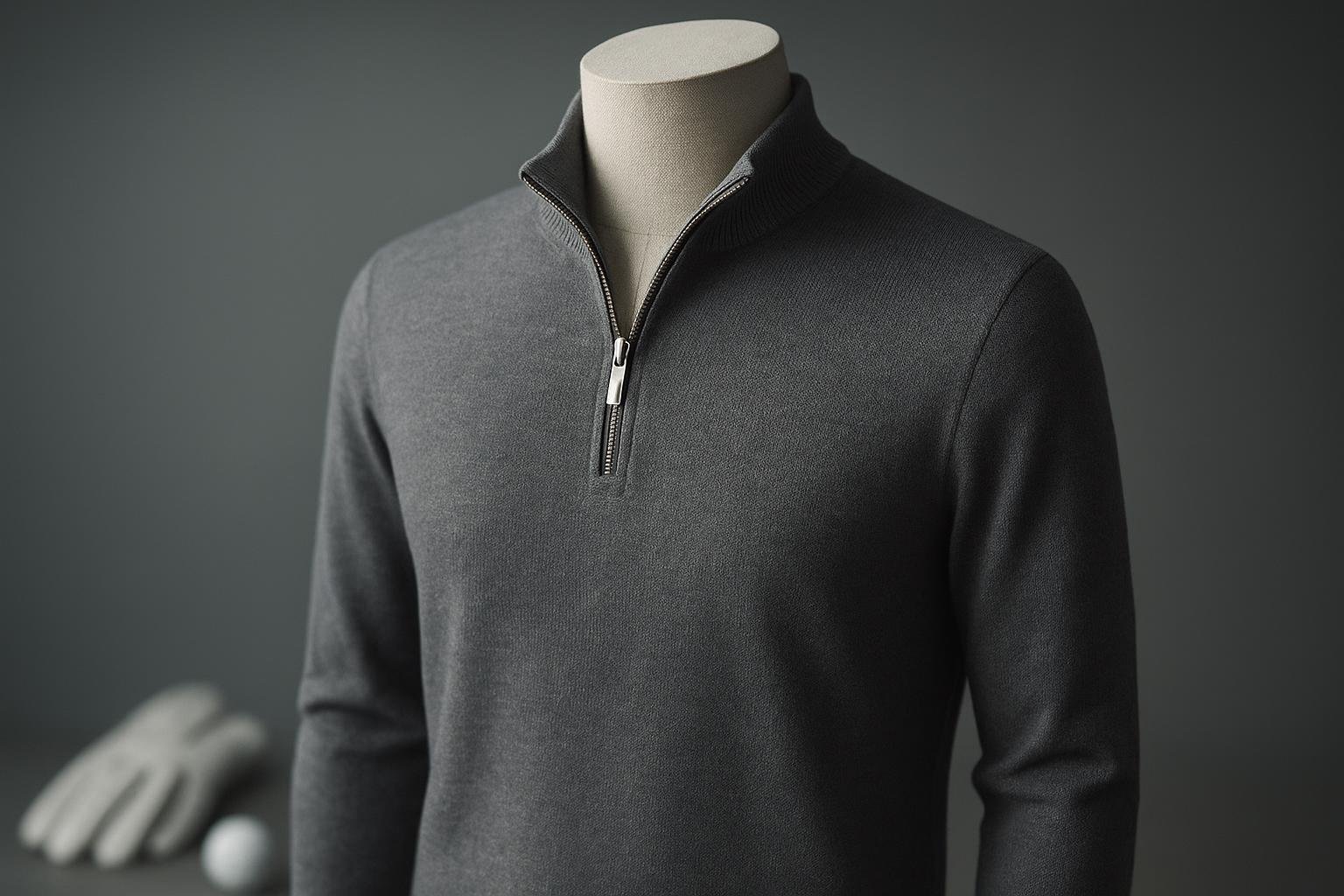
Luxury here means a fine‑gauge jersey that feels soft against skin, breathes through exertion, and holds a crisp silhouette with minimal placket bulk. On course and during the commute, the quarter‑zip must move quietly with the body, resist unsightly pilling at the chest and sleeves, and keep its shape under layering. That specification starts with superfine Merino and considered blends, then flows into gauge, placket engineering, and a zipper that operates smoothly without adding weight.
Materials first for a men’s luxury jersey quarter‑zip pullover sweater
The fastest route to a consistently premium result is to define fiber and yarn quality up front and record those decisions in the tech pack.
Fineness and handfeel: The International Wool Textile Organisation describes “superfine” Merino in the 16.6–18.5 µm band, which aligns with next‑to‑skin knits prized for softness and recovery. See the definition and context in the IWTO Wool Notes 2024 document at the IWTO website: International Wool Textile Organisation — Wool Notes 2024.
Cashmere and silk blends: Adding cashmere raises perceived luxury through finer fibers and loft; small silk percentages can add drape and a subtle sheen. Validate claims with supplier Certificates of Analysis and pre‑production samples rather than relying on marketing labels.
Yarn count and construction: Specify count in Nm and the ply and twist profile. These parameters, combined with the intended gauge and post‑finish processes, will determine drape and the measured GSM after finishing.
GSM as a validated metric: Because knit weight depends on yarn, gauge, tension, and finishing, set a target range and then measure approved swatches using a standard fabric weight method after finishing. Document the readings in the tech pack.
In your copy and supplier communications, keep descriptions precise and testable. For example, write “superfine Merino target 16.6–18.5 µm blend with cashmere, Nm count and ply to be selected in sampling to meet target handfeel and weight” rather than a vague “premium wool blend.” That clarity is the foundation for a men’s luxury jersey quarter‑zip pullover sweater that performs across commute and golf use.
Knit construction and gauge you should specify
A fine‑gauge jersey with either fully fashioned panels and quality linking or a seamless approach can both meet luxury goals if the specification is clear.
Construction choice: Fully fashioned with hand‑linking enables precise shaping and traditional luxury finishing. Seamless production can improve comfort and reduce waste by eliminating panel seams; choose the path that fits brand positioning and factory capability.
Gauge intention: State the planned fine‑gauge band appropriate for luxury jersey. Because GSM is not fixed by gauge alone, instruct your factory to produce a small matrix of swatches across two or three yarn counts and two gauge settings with the same finish to converge on your target drape and weight.
Measurements and tolerances: Record relaxed measurements post‑finish with clear tolerances appropriate for knit stretch. Include shrinkage allowances tied to the laundering method to be used in testing.
This is where a men’s luxury jersey quarter‑zip pullover sweater differentiates itself—through a crisp, even jersey face, a clean placket build, and a collar that holds its line after wear and care.
Zippers, trims and hardware that suit luxury jersey
Zipper choice changes both the aesthetic and how the placket feels against the chest. For luxury knits, two families dominate functionally, with metal options used as a deliberate design accent.
For a polished metal look, YKK’s EXCELLA line provides finely polished metal elements and a smooth slide suitable for visible luxury accents in premium apparel. See product context on the YKK Americas page for EXCELLA.
For low bulk and soft drape, YKK’s coil zippers use a continuous nylon coil that conforms well to delicate knits, with options like concealed looks or weather‑resistant finishes. See the coil zipper overview from YKK’s European line pages.
For a high‑end alternative with distinctive finishes, Riri publishes seasonal and technical collections that outline metal and nylon families with luxurious tapes and finishes. A representative entry point is the Oerlikon Riri seasonal collection page.
Table — Zipper selection snapshot
Family | Core material | Typical strengths | Quarter‑zip usage note |
|---|---|---|---|
YKK EXCELLA | Polished metal elements | Luxurious shine and smooth slide | Premium visible accent on luxury knits; confirm weight and hand with your fabric |
YKK Coil | Continuous nylon coil | Lightweight, flexible, low bulk | Excellent for delicate knits and subtle look; pair with auto‑lock sliders |
YKK VISLON | Molded polyacetal | Bold tooth definition with color options | Suited to casual‑luxury or statement looks with higher tooth definition |
Riri Metal and Nylon lines | Metal elements and high‑end tapes | Distinctive finishes including PVD options | Luxury accent; verify tape compatibility and slider lock for knit plackets |
When you specify, include chain size, slider type, tape composition, finish or color code, and any care constraints. For quarter‑zips intended for movement, an auto‑lock slider helps prevent zip creep during play.
Sampling and prototyping timeline with gated approvals
A disciplined timeline protects OTIF and keeps cost under control. Use these gates and do not release bulk purchases before sign‑off.
Proto sample: 3–5 working days once yarn and gauge are confirmed. Approve handfeel, drape, and placket behavior. Record actual fabric weight and thickness from the proto.
Pre‑production sample: Confirms trims, exact zipper family and size, labeling, and construction details. Book zipper SKUs and color codes only after PP approval.
Size set and TOP: Validate grading and fit early in production with a TOP sample to confirm the production line is holding specs.
Inline inspections and pre‑shipment: Link inline checks to measurement and appearance standards and finish with a pre‑shipment inspection per your AQL plan.
Tie each step to an owner and a date, and keep a simple Gantt visible to the whole team. A men’s luxury jersey quarter‑zip pullover sweater benefits greatly from early attention to placket bulk and collar recovery—problems are far cheaper to solve at proto than at TOP.
MOQ tiers, costing drivers and lead‑time tradeoffs
Flexible MOQ from 50 to 1000 units allows test launches and phased buys. Cost and time move with material bookings, lab dips, and zipper lead times.
Lower tiers: Expect relatively higher unit cost due to yarn and trim minimums spread over fewer units.
Colorways and trims: Each additional color adds approvals and potential minimums; consolidate where possible. Zipper families and finishes can be long‑lead, so lock those at PP.
Resample loops: Reserve time for a rapid re‑sample if the first proto misses target handfeel or placket performance; success here prevents much larger schedule risk later.
Document your assumptions and update the critical path every time the BOM changes.
QA, testing and inspection plan
Luxury knitwear demands evidence. Anchor acceptance to published methods and define responsibilities in your QA plan.
Pilling resistance: The Martindale method is widely used to assess resistance to pilling and fuzzing on knits. You can reference the ISO 12945‑2 overview page from the International Organization for Standardization and the ASTM D4970 method page from ASTM International to align on how results are evaluated.
Dimensional stability and care: Home laundering simulations such as AATCC TM135 for fabrics and AATCC TM150 for garments, along with the AATCC laundering hub for current guidance, provide a consistent way to measure shrinkage and fit retention. Internationally, ISO 6330 offers equivalent procedures; pick one system and stick with it across styles.
Color fastness battery: Use the appropriate AATCC or ISO 105 methods for crocking, perspiration, laundering, and light; record the method numbers you will apply for this style in your QA checklist.
AQL inspections: Garment inspections typically use sampling plans derived from ANSI/ASQ Z1.4 or ISO 2859‑1. For an accessible explanation and calculator, see QIMA’s guide to AQL where acceptance numbers are illustrated for different inspection levels.
Table — QA checkpoints and standards
Checkpoint | Purpose | Suggested method or standard |
|---|---|---|
Yarn COA verification | Confirm fiber content, fineness, and lot QA | Supplier Certificate of Analysis; third‑party lab if needed |
Proto pilling pre‑screen | Early surface durability check on jersey face | ISO 12945‑2 or ASTM D4970 Martindale method |
Dimensional stability | Fit retention after laundering | AATCC TM135 and TM150, or ISO 6330 equivalents |
Color fastness battery | Crocking, laundry, perspiration, light | AATCC or ISO 105 method set appropriate to the style |
Inline and DUPRO | Defect detection and measurement control | Sampling per ANSI/ASQ Z1.4 or ISO 2859‑1 plan |
TOP sample | Early production conformity and grading check | Brand measurement tolerances and visual standards |
Pre‑shipment inspection | Lot acceptance prior to shipping | AQL plan with defined acceptance numbers and re‑inspection triggers |
Define DHU and RFT formulas explicitly in your plan so partners calculate them the same way. For example, DHU equals defects observed divided by units inspected times 100; RFT equals defect‑free units divided by total units times 100. Track them by operation to reveal where training or machine maintenance will pay off.
Supplier selection, audits and communication
Choose suppliers that can show experience with fine‑gauge jersey, stable linking or seamless capability, demonstrable zipper handling on knits, and familiarity with the test methods you intend to use. Ask for anonymized reports and certificates where possible and verify certificate scope rather than taking claims at face value.
In your email brief, include the intended use case, target handfeel adjectives mapped to measurable tests, the zipper family short list, and the timeline gates. Clarify who will book lab tests and when.
Practical micro‑example of an athleisure quarter‑zip workflow
A brand confirms a superfine Merino dominant blend with a small cashmere percentage and targets a fine‑gauge jersey with a slim coil quarter‑zip and auto‑lock slider. The development partner produces a proto in 3–5 working days once yarn and gauge are confirmed, captures post‑finish fabric weight and thickness, and records zipper operation under motion. After PP approval, the zipper family, size, and tape color are booked; size sets and a TOP sample validate grading and spec hold on line; inline inspections follow an AQL plan and all acceptance data is filed with the shipment. A manufacturer like AzKnit can support this neutral, materials‑first flow with rapid sampling, flexible MOQs, and fine‑gauge jersey experience. See capability context at AzKnit.
Downloadables and next steps
To make this guide actionable, assemble five working documents and keep them versioned: a materials‑first tech pack page for yarn and knit parameters, a zipper and trims spec sheet with brand family and slider notes, a BOM that tracks colorways and minimums, a QA checklist with method numbers and acceptance criteria, and a one‑page production Gantt with the gated approvals above. Share them with each supplier early and update them at every approval step so the record stays authoritative.
Before you kick off, scan this guide and pull out the two tables for your internal checklist. Then write your first inquiry email that states your use case, yarn fineness target, zipper family preference, inspection method set, and the dates for proto and PP. That clarity is how a men’s luxury jersey quarter‑zip pullover sweater goes from concept to a shelf‑ready result without drama.
Appendix
Glossary notes
DHU: Defects per Hundred Units. Calculated as defects observed divided by units inspected times 100. Use by operation to isolate problem steps.
RFT: Right First Time. Calculated as defect‑free units divided by total units times 100. Indicates first‑pass quality.
AQL: Acceptable Quality Limit. Statistical sampling approach used to decide whether to accept a lot; plans commonly reference ANSI/ASQ Z1.4 or ISO 2859‑1.
Measurement tolerance note
Record relaxed measurements post‑finish. For fine‑gauge jersey, keep tolerances tight where visible symmetry matters, such as placket length, collar height, and chest width, and slightly wider where knit recovery varies. Lock these values before size set so TOP and inline checks have a clear target.
References cited in context
Superfine Merino fineness and context appear in the International Wool Textile Organisation’s Wool Notes 2024 PDF on the IWTO website.
Zipper families and usage references appear on the YKK Americas EXCELLA product page, YKK coil zipper overview on YKK’s European line site, and Oerlikon Riri’s seasonal collection page for luxury trim context.
Martindale and laundering methods are introduced via ISO 12945‑2 overview at ISO and ASTM D4970 at ASTM International, plus the AATCC laundering hub for TM135 and TM150 guidance.
AQL sampling approaches are explained on QIMA’s AQL overview page for accessible calculations and examples.