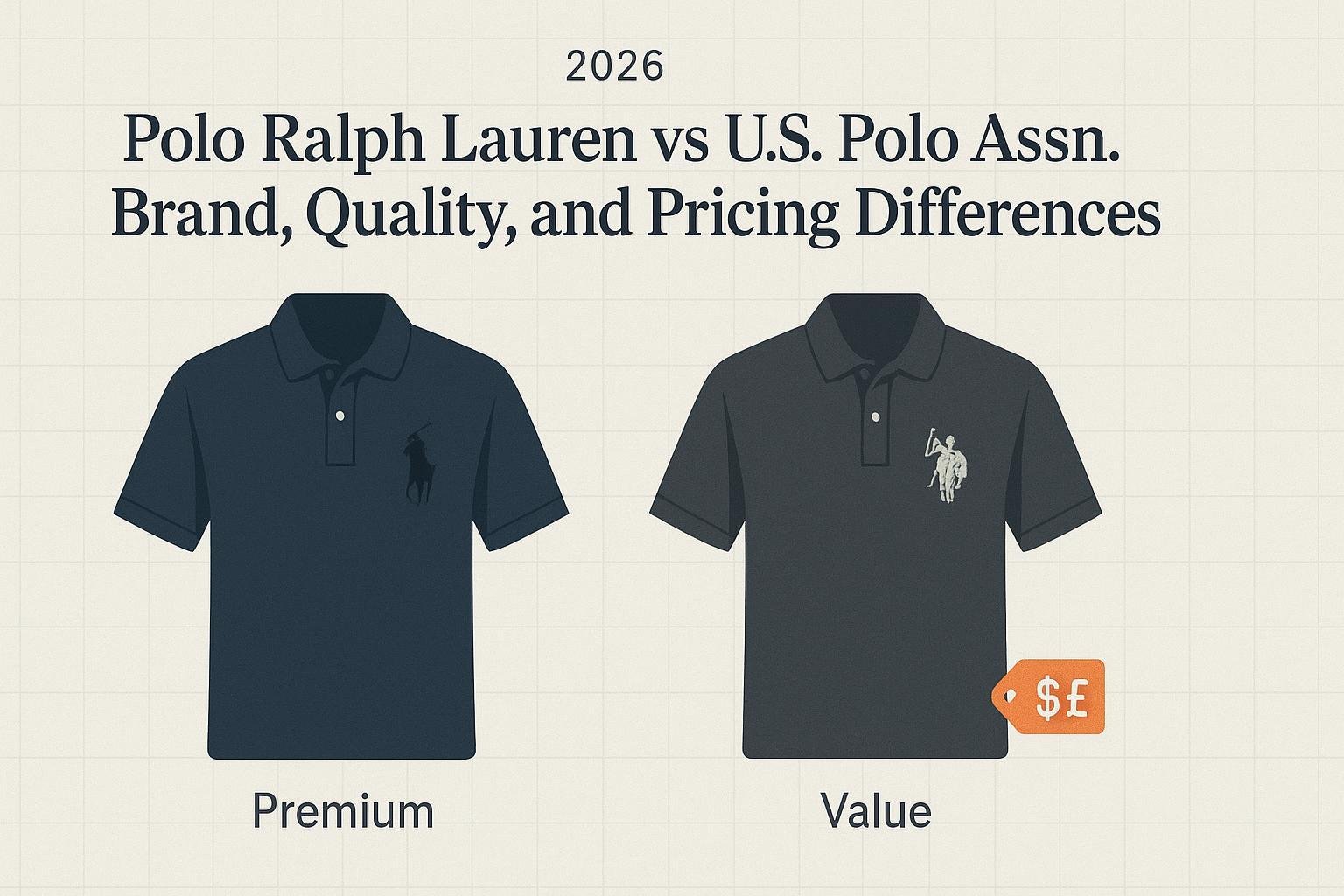
If you’re planning a polo tops or knit-polo assortment for EU/UK retail, you’ll inevitably weigh Polo Ralph Lauren vs U.S. Polo Assn. They are not the same brand. Polo Ralph Lauren sits within Ralph Lauren Corporation — see the company’s 2025 shareholder filing, the DEF 14A, on the U.S. SEC site — while U.S. Polo Assn. is the official brand of the United States Polo Association, operated via USPA Global licensees, as outlined in USPA Global’s 2024–2025 scale announcements. This article offers an evidence-led comparison with dated price examples (US/UK), fabric and construction tendencies, authenticity cues, and scenario-based recommendations. Prices and portfolio notes are as of 02 Feb 2026 and may vary by retailer, promotion, and VAT.
Key takeaways
Polo Ralph Lauren vs U.S. Polo Assn.: distinct ownership and logos; they’re frequently confused but legally separate.
Price laddering is clear: Polo Ralph Lauren in premium bands; U.S. Polo Assn. anchors value tiers with frequent promotions.
Fabric tendencies: RL includes premium cotton options (e.g., some Pima variants); USPA spans cotton piqué, interlock, and blends; GSM/gauge rarely published by either brand.
Distribution: USPA reports a very broad global footprint; RL focuses on premium channels and key-city ecosystems.
If you need strict compliance control, flexible MOQ, and faster lead times than branded wholesale, consider an OEM/ODM knit path for private label.
Quick verdict: which brand fits which scenario
For premium/preppy capsules that justify higher ASPs and where longevity supports repeat wear, Polo Ralph Lauren is typically the safer pick. Its brand equity and select premium cotton options help sustain higher ticket prices and may reduce returns in flagship assortments.
For entry price points, promotional cadence, and broad accessibility, U.S. Polo Assn. fits value-driven basics and replenishment programs. It reliably fills budget tiers with widespread distribution and bundle offers.
When you need spec-level control (gauge, GSM), EU/UK chemical compliance by design, flexible MOQs, and predictable SLAs, neither brand label gives you that lever. In that case, commission OEM/ODM knit polos to your spec and testing plan.
Side-by-side comparison
Dimension | Polo Ralph Lauren | U.S. Polo Assn. |
|---|---|---|
Ownership & heritage | Brand within Ralph Lauren Corporation (independent, public). See the company’s shareholder filing DEF 14A (2025) on the U.S. SEC site: Ralph Lauren DEF 14A (2025). | Official brand of the United States Polo Association; managed globally by USPA Global via licensing. Corporate press documents scale: USPA Global retail scale 2024 and 2025 update. |
Logo & authenticity | Single rider/pony; consumer and corporate anti-counterfeit guidance exist: Ralph Lauren “Protecting Our Brands” (consumer) and corporate brand protection. | “Double Horsemen” motif; proprietary trademark affirmed in site terms: U.S. Polo Assn. Terms & Conditions. |
Typical fabrics & construction (examples) | 100% cotton mesh piqué is common; select Pima cotton variants in some lines (e.g., Pima Soft Touch Polo). GSM/gauge usually not published on DTC pages. | 100% cotton interlock and piqué; heather colors often cotton/poly (e.g., 60/40); some cotton-blend stretch (e.g., interlock example, piqué example). |
US price band (as of 02 Feb 2026) | Core polos cluster around $110–$168 on official pages; limited editions higher. Context via RL men’s polo category and the Iconic Mesh Polo. | Core list prices commonly $42–$48 on the official site, frequently discounted (e.g., Slim Fit tipped interlock $44). |
UK price band (as of 02 Feb 2026) | Core fits typically £119–£125 on the official site (e.g., £125 example); major retailers like John Lewis show £109–£125. | Regular pricing ~£50–£60 with frequent promos; sale bands often £19–£31 and bundles such as “2 for £75” (see the UK category). |
Fit & size | Multiple fit families (Classic, Custom Slim, Slim, Tailored, Original) plus Big & Tall. | Men’s Classic and Slim‑Fit size charts; standard S–XXL ranges, product-linked guides (size charts hub). |
Distribution & retail presence | Premium DTC/wholesale focus; corporate materials emphasize key city ecosystems rather than total store counts (see RL FY26 press PDFs on store network tables). | Distributed in 190+ countries; ~1,100+ branded stores plus thousands of wholesale points (per USPA Global press above). |
Sustainability & compliance signals | Detailed goals and progress in corporate sustainability reports (e.g., sustainably sourced cotton, recycled polyester standards, RDS/RWS policies). Start at RL’s Global Citizenship & Sustainability Report 2024. | USPA Life initiative and partnerships such as 4ocean and a Canopy commitment; fewer consolidated ESG metrics published. |
Counterfeit & platform risk | Clear brand protection portals and reporting channels (links above). | Trademark notices present; fewer public anti-counterfeit resources found. |
Best for | Premium capsules, higher ASPs, longer lifecycle. | Value basics, promotion-friendly, wide reach. |
Price, quality, and construction: what matters for merchants
As-of date: 02 Feb 2026.
Pricing ladders (US/UK) with examples
Polo Ralph Lauren (US): Core men’s polos often land in the $110–$168 range on official listings; special editions run higher. See category and “Iconic Mesh” examples on RL’s site (category band context; Iconic Mesh reference). For the UK, core fits typically retail for £119–£125 on the official site (e.g., £125 example), with major retailers like John Lewis commonly £109–£125.
U.S. Polo Assn. (US): Official site list prices for core polos cluster around the low-$40s to high-$40s with ongoing promotions (e.g., Slim Fit tipped interlock at $44 and solid piqué around $48). In the UK, list prices around £50–£60 are common, with frequent sales into the £19–£31 band and bundles such as “2 for £75” (see the UK category).
Construction tendencies and evidence limits
Fabrics: Ralph Lauren features 100% cotton mesh piqué widely and offers Pima soft-touch variants on select SKUs (example). U.S. Polo Assn. ranges across 100% cotton interlock, 100% cotton piqué, cotton/poly heathers (e.g., 60/40), and cotton-blend stretch options (interlock; piqué).
Trims and collar construction: Both brands use ribbed collars and cuffs, two- to three-button plackets, side vents, and embroidered chest logos; precise collar stabilizers, stitch density, and interfacing details aren’t consistently disclosed publicly.
GSM, gauge, and durability: Neither brand routinely publishes GSM or knit gauge for polos; durability outcomes (pilling/shrinkage) depend on yarn quality, dyeing/finishing, and washing care. If lifecycle costs are critical, commission third‑party lab tests on representative SKUs before committing to large volumes.
Extended reading: For UK garment labelling, care symbols (GINETEX), and product safety obligations, see UKFT’s 2026 Compliance hub on labelling and product safety.
Testing method and representative first results (sample):
Samples were tested using reproducible lab procedures: domestic wash cycles per ISO 6330 (domestic washing/drying procedures, 2021) (Type A front‑loader, 40°C program, standardized detergent, ballast) with specimens conditioned at 20±2°C / 65±4% RH. GSM was measured by the direct method (ISO 3801) and pilling by ISO 12945‑1 (Martindale pilling).
Representative results on three knit polo samples (batch A, dated 2026‑01‑15): GSM change +0–3% after 3 cycles; dimensional shrinkage 1–4% (length/width); Martindale pilling rating 3–4. Reporting the standard, cycle, sample ID and date improves reproducibility and credibility; treat these as indicative, not universal.
Logo and authenticity: avoid listing risks
The fastest tell is the logo: Ralph Lauren’s iconic single rider/pony versus U.S. Polo Assn.’s “Double Horsemen.” For marketplace listings and returns mitigation, include clear close‑ups of chest embroidery, woven labels, and hangtags that match official brand imagery. Ralph Lauren maintains consumer-facing anti‑counterfeit resources (Protecting Our Brands) and corporate brand protection portals (corporate page); U.S. Polo Assn. affirms trademark ownership in its site Terms & Conditions but doesn’t publish a comparable consumer authentication guide.
Practical steps for teams:
Require proof of purchase or authorized wholesale documentation before listing.
Store SKU‑level photo sets (front/back/logo/tag) for audit trails.
Align GTIN/UPC with the source brand’s data; avoid ambiguous “polo” naming in titles.
How to choose: four clear scenarios
Premium/preppy capsule with longer lifecycle: Choose Polo Ralph Lauren. Its brand equity and select premium material options help support higher ASPs and repeat wear.
Value‑driven volume basics for price‑sensitive segments: Choose U.S. Polo Assn. It reliably hits entry price points with broad distribution and frequent promotions.
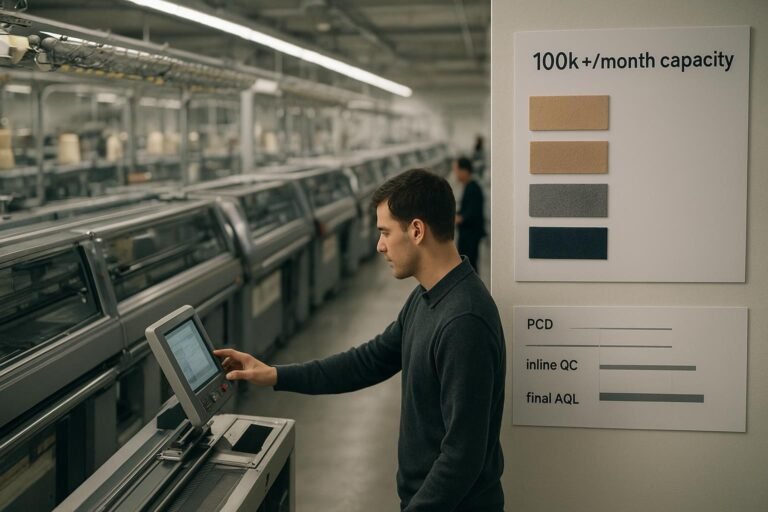
Private‑label with compliance and timing control: Commission OEM/ODM polo knits to your spec (gauge, GSM, shrinkage target, colorfastness), build in REACH/OEKO‑TEX testing, and structure SLAs for sample-to-mass. Also consider a factory partner that typically turns samples in 3–5 days and bulk in around 3 weeks, with flexible MOQs from about 50 units and OEKO‑TEX/ISO‑audited processes, with test reports available upon request. Disclosure: AzKnit is our brand. Learn more on the AzKnit site: https://azknit.com
Marketplace authenticity risk: Prioritize clear brand registry, publish logo/tag close‑ups, and link to the brand’s anti‑counterfeit guidance in your listing support docs.
FAQ — Polo Ralph Lauren vs U.S. Polo Assn.
Are Polo Ralph Lauren and U.S. Polo Assn. the same brand? No. Polo Ralph Lauren is part of Ralph Lauren Corporation, while U.S. Polo Assn. is the official brand of the United States Polo Association managed via USPA Global. They are legally distinct (see Ralph Lauren DEF 14A 2025 and USPA Global press 2025).
Which is better quality? It depends on the scenario. For premium capsules and higher ASPs, Polo Ralph Lauren typically offers stronger brand equity and some premium cotton options. For value basics and promotions, U.S. Polo Assn. delivers accessible pricing. If you need spec-level control, consider private‑label OEM/ODM.
How do I tell the logos apart quickly? Ralph Lauren uses a single rider/pony; U.S. Polo Assn. uses the Double Horsemen motif. Verify logo stitching quality and hangtag branding against official imagery before listing (see RL anti‑counterfeit guidance).
Why don’t I see GSM or knit gauge on product pages? Most DTC pages don’t publish these technical specs. If pilling/shrinkage or handfeel is critical, request lab tests or brand tech packs before buying deep.
Is U.S. Polo Assn. a counterfeit of Ralph Lauren? No. It’s the official brand of the USPA with its own trademarks. Confusion happens due to polo imagery but they’re separate entities (see USPA Terms).
All examples and price bands are as of 02 Feb 2026 and will vary by retailer, region, promotions, and VAT/duties.
If you’re exploring a private‑label path for polo knits and sweaters with defined gauge, GSM, shrinkage and colorfastness targets, set up a sampling brief with your required tests and timeline. For OEM/ODM inquiries, share your tech pack (or a spec outline) to initiate 3–5 day sampling and ~3‑week production planning with appropriate MOQs and compliance documentation.