
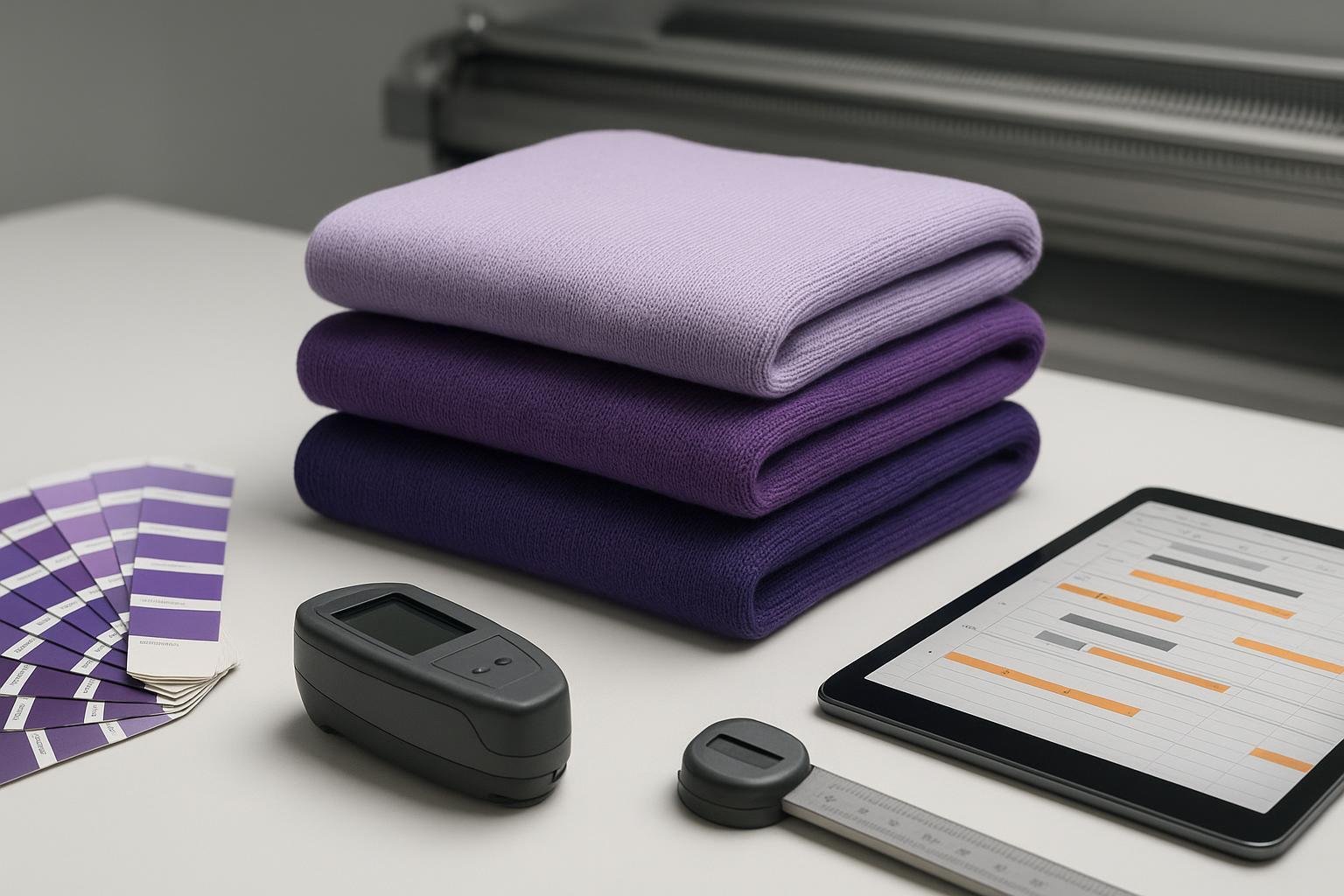
When you search for a private label purple knit sweater manufacturer, you’re usually juggling two pressures at once: color accuracy for purple shades and the need for a genuinely fast turnaround. This guide is written for sourcing managers and brand owners who need to validate 12GG capability, set realistic SLAs, and de‑risk color and quality—without sacrificing speed. We’ll keep claims tied to verifiable practices and cite sources where methods and tools are involved.
Why 12GG matters for private label
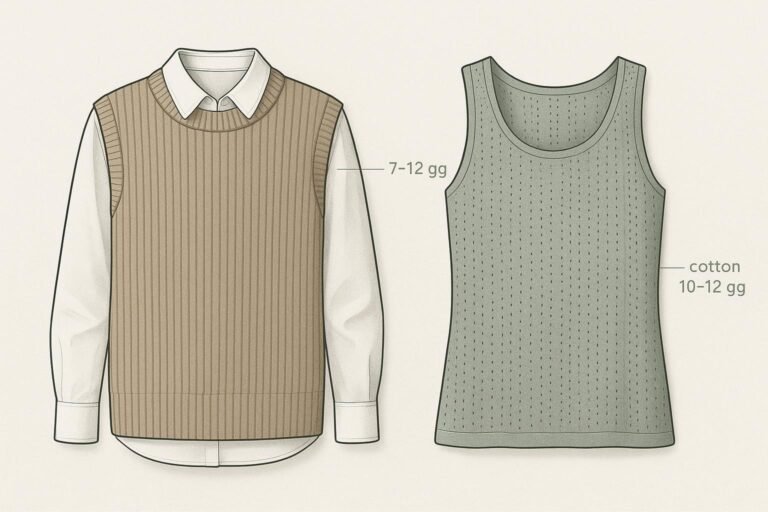
12GG (12‑gauge) in flat knitting refers to roughly twelve needles per inch on the bed—producing a fine, smooth fabric with higher stitch density than mid‑gauge alternatives. In practical buying terms, 12GG typically yields lighter GSM, a refined handfeel, and higher visual resolution for plain jersey or subtle textures. Authoritative primers explain how gauge relates to fineness and stitch density; for context, high gauges like 12–18 are generally considered fine in knitwear.
For a concise overview of gauge and fineness in knitting, see the background explanation in the industry’s general reference on gauge terminology, which frames gauge as needles‑per‑inch and its effect on fabric density. Read more via the gauge entry in the knitting gauge overview) (encyclopedic reference).
For buyer‑facing expectations on fine gauges in sweaters, an industry explainer classifies 12GG and above as fine/lightweight in consumer terms; see the discussion in the sweater types by gauge explainer (industry blog context).
Think of gauge as the “pixel density” of your knit. Higher gauge lets you achieve a cleaner, more refined surface, but it also asks more from your yarn choice and finishing.
Yarn, stitch, and construction choices at 12GG
At 12GG, you’re working with finer yarns and tighter stitch densities. Common yarn systems include extra‑fine merino, cashmere or cashmere blends, viscose/nylon, and lyocell/silk blends. In industry practice, plain‑stitch 12GG often pairs with counts in the neighborhood of 2/26–2/36 Nm, although exact pairings depend on fiber, ply, and fabric structure. Finer counts support the smooth hand you want in private‑label 12GG programs.
Stitching and linking: Fine gauges reward precise tension control and consistent linking quality. If you’re not running seamless, set tolerance bands for needle‑line visibility, seam bulk, and shoulder alignment in your tech pack.
GSM and drape: Expect lighter weights, but don’t over‑optimize for low GSM if your target market expects durability and recovery. Specify minimum recovery after wash and stretch tests in your QC plan.
Design constraints: Complex jacquards and heavy cables are typically better suited to lower gauges; at 12GG, clean plains, fine ribs, Milano/rice textures, and fully fashioned silhouettes are the sweet spot.
From a speed perspective, simpler stitch programs and pre‑approved trims accelerate setup. If you need color‑specific purples across a capsule, consider consolidating stitch variants to reduce changeovers.
Pantone purple control: approval SOP and tests
Purple shades are notorious for metamerism—looking different under store lights vs. daylight. That’s why a disciplined approval process matters as much as picking the right Pantone TCX.
Recommended, procurement‑ready SOP grounded in color‑science frameworks:
Define your target
Provide the Pantone TCX reference alongside target spectral data.
Instrument settings: D/8 sphere spectrophotometer, D65 illuminant, 10° standard observer. Specify SCI/SCE per your SOP.
Tolerancing: Use CIELAB ΔE00 or CMC(2:1). Many brands operate with tight bands (approximately ≤1.0–2.0 ΔE00) for commercial acceptability depending on fiber/dye; set and document your threshold explicitly.
Rationale and frameworks are detailed in color‑science education from AATCC and in digital approval guidance from X‑Rite; see the AATCC color vision/technology overview and X‑Rite’s digital color specification and approval guide.
Lab dips and metamerism checks
Request 2–3 lab dips around the target; measure ΔE under D65 and cross‑check under A and F illuminants.
Flag metamerism if pass/fail flips between illuminants; resolve by adjusting dye recipe or setting a multi‑illuminant acceptance.
Pre‑production verification
Run a PP sample with instrumented pass (≤ your ΔE threshold) and a visual booth check. Lock the recipe and tie bulk lots to the approved PP.
Colorfastness and durability testing
Use the test methods that map to your market’s requirements. The official methods are published by AATCC and ISO (manuals/paywalled). For an accessible orientation, a recognized lab’s explainer is helpful; see the QIMA colorfastness guide. Below is a quick mapping for procurement planning.
Property | Common AATCC Method | ISO 105 Equivalent | What it evaluates |
|---|---|---|---|
Rubbing (crocking) | AATCC 8 | ISO 105‑X12 | Color transfer in dry/wet rubbing |
Lightfastness | AATCC 16 | ISO 105‑B02/B01 | Resistance to fading under light |
Washing/laundering | AATCC 61 | ISO 105‑C06 | Color retention after wash cycles |
Perspiration | AATCC 15 (if used) | ISO 105‑E04 | Resistance to acid/alkaline sweat |
Document acceptance grades (e.g., dry crock ≥4; wet crock ≥3–4 depending on fiber) in your QC plan. Purples may need closer monitoring for lightfastness.
Sampling to bulk: realistic fast‑turn SLAs
Everyone wants a 3–5 day sample and ~3‑week bulk. When is that realistic? Only when the right enablers are in place.
What compresses the calendar
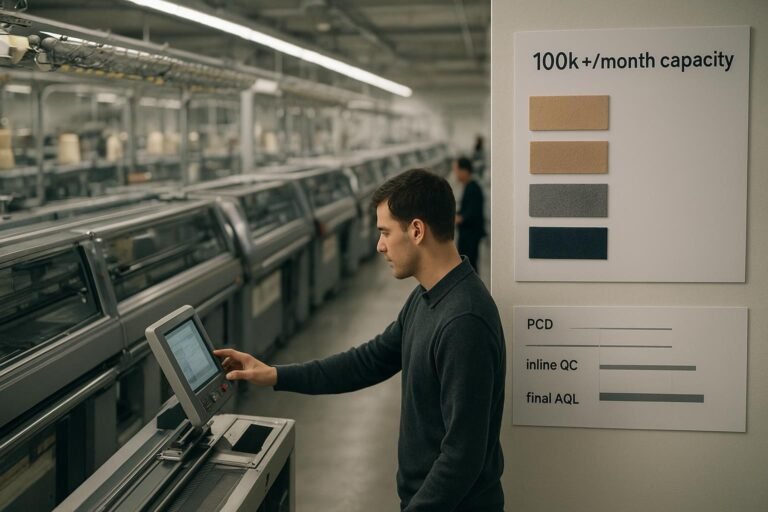
Production Planning Systems (PPS) that integrate scheduling, inventory, and line balancing cut setup time and idle gaps. See how PPS supports shorter response times in the Stoll PPS overview.
Seamless/digital workflows: WholeGarment and virtual sampling can remove linking stages and reduce approval cycles. Shima Seiki documents these efficiencies across software and machine platforms; see their APEXFiz digital sampling and capability summaries in Shima Seiki’s JIAM 2024 briefing and the Tailored Industry case for on‑demand models.
Yarn availability: In‑stock yarn programs or rapid dye partnerships keep development moving. If you must dye a specialty purple, build that time into your estimator.
Conditional timeline model
Sample 3–5 days: feasible with in‑stock yarn, simple stitch program, digital approvals, pre‑certified trims.
Bulk ≈ 3 weeks: achievable for small/medium runs under PPS‑optimized lines, minimal changeovers, and no extensive dye queues.
If yarn dyeing, complex jacquards, or multi‑round approvals are involved, plan for longer windows (e.g., 4–8+ weeks depending on scope). For a step‑by‑step time share, see an independent factory narrative on development and knitting time in the Knitwise production‑time explainer.
The question to ask yourself: do we have all the preconditions for speed, or are we assuming them?
How to choose a private label purple knit sweater manufacturer
Selecting the right partner goes beyond quotes. For a 12GG knit sweater factory that can support speed and purple accuracy, verify:
PPS or equivalent planning tools and evidence of line balancing
Demonstrated 12GG programs with fine‑gauge linking quality
Stock‑yarn options in purples or fast‑dye partners
A documented Pantone approval SOP (D65/10°, ΔE metric, multi‑illuminant checks)
Colorfastness testing capability to AATCC/ISO with acceptance grades
Clear MOQ policy and scale‑up pathway after validation
MOQ and cost tradeoffs for purple 12GG programs
Minimums are a lever, not a rule. For test lots or color‑specific capsules:
MOQ flexibility: Some OEMs can accommodate 50–100‑piece runs when the program uses stock yarn or consolidated sizes. Expect unit costs to rise for very small lots.
Dyeing vs. stock color: A dyed‑to‑match purple adds time and MOQs at the yarn supplier. Consider starting with a nearest‑neighbor stock purple for speed, then move to exact Pantone once sales validate demand.
Pattern and trim complexity: Each added operation (e.g., intarsia, special linking, hand‑finish) extends cycle time and cost. Keep early lots simple if speed is the hero.
Negotiation posture: Offer a rolling forecast or multi‑drop plan so the factory can plan yarn and machine time. It’s fair to trade some flexibility (e.g., size‑ratio adjustments) for faster SLAs.
QC and acceptance criteria buyers should set
For 12GG purple programs, set crisp, testable criteria:
Dimensional stability: Post‑wash measurements within your tolerance bands. Document shrinkage allowances by panel and finish.
Linking and seams: Define stitch density at joins, seam bulk limits, and acceptable needle‑line visibility.
Color acceptance: Instrumented ΔE (your threshold) plus light‑booth visual pass under D65, A, and F. Lock lot‑to‑lot controls.
Colorfastness: Specify methods and acceptance grades (AATCC/ISO mapping above). Record results in PP and TOP sample reports.
Quality doesn’t have to slow you down—if you set these gates early, they prevent rework.
Example workflow (neutral)
Disclosure: AzKnit is our product. The following neutral example shows how a fast‑turn flow can look when key enablers are in place. Treat it as a model you can request from any qualified OEM.
Fast‑turn 12GG purple sampling flow (illustrative)
Day 0 (AM): Buyer submits tech pack, Pantone TCX, and tolerance bands (ΔE00 target, acceptance grades for AATCC/ISO tests).
Day 0 (PM): OEM confirms stock yarn availability in nearest purple; schedules knitting via PPS.
Day 1–2: Knits PP sample; runs instrument reading (D65/10°) and quick colorfastness pre‑checks.
Day 3–4: Digital/visual approval; minor tension tweak if needed; courier dispatch.
Day 5+: Upon approval, bulk is scheduled on pre‑balanced lines; lead time depends on dyeing needs and changeovers. Small/medium runs without dyeing may complete in roughly three weeks when enablers align, per the operational frameworks linked above.
AzKnit’s published positioning (from internal knowledge) emphasizes quick sampling (3–5 days), approximately three‑week production for small/medium runs, flexible MOQs (down to ~50 pieces in certain cases), and 12GG capability. Because conditions like dyeing and queue length can change, always align on assumptions in writing before you lock the SLA.
Tools and templates you can use today
You don’t need fancy software to get rigor. Start with these buyer‑side tools you can recreate:
Sample approval checklist
Tech pack completeness (gauge, yarn count, stitch, tolerances)
Pantone TCX + spectral target attached
Instrument settings (D65/10°, SCI/SCE) + ΔE metric and threshold
AATCC/ISO methods and acceptance grades listed
PP sample measurements and wash shrinkage recorded
12GG tech pack essentials
Gauge (12GG), stitch program, yarn system (fiber + count + ply)
Tension notes, target GSM, finish requirements
Linking specifications and seam tolerances
Color approval workflow and batch controls
Lead‑time estimator logic
If stock yarn + simple stitch + digital approval → sample 3–5 days; bulk ≈ 3 weeks (small/medium runs)
If yarn dyeing + complex stitch + multi‑round approvals → extend by dye queue and setup days; plan 4–8+ weeks depending on scope
FAQs about hiring a private label purple knit sweater manufacturer
What does “12GG” mean for buyers? It’s a fine gauge with higher stitch density and a smoother handfeel—good for lightweight sweaters and refined plains.
How many factories can truly do fast turnaround? Fewer than you’d think. Look for PPS‑driven planning, digital sampling, and stock‑yarn programs. Without those, “fast” is wishful thinking.
Are purples harder to match than other colors? Often yes. They show metamerism more readily. That’s why multi‑illuminant checks and clear ΔE thresholds matter.
What acceptance grades should I set for colorfastness? It depends on fiber and end‑use, but many buyers require dry crock ≥4 and wet crock ≥3–4, plus appropriate washing and light grades. Document your levels and test to AATCC/ISO methods.
Can I start with 50–100 pieces? In many cases, yes—especially with stock yarns and simple stitch programs. Expect higher unit costs at very low MOQs.
How do I keep bulk lead time near three weeks? Pre‑approve trims, pick simple stitches, use in‑stock yarn or pre‑book dyeing, and align on digital approvals. Confirm line capacity and changeover plans.
Do seamless sweaters matter for speed? They can. WholeGarment or similar approaches remove linking steps and reduce rework risk, which helps schedules.
What should go into my purchase order terms? Tie payment and ship windows to PP/TOP approvals, spell out ΔE/fastness thresholds, and list rework responsibilities.
Closing: your next steps
Finalize a 12GG tech pack with stitch program, yarn system, and QC tolerances.
Define purple approval: Pantone TCX, instrument settings, ΔE threshold, and colorfastness methods.
Align timelines conditionally: write down assumptions (stock yarn, digital approval, PPS capacity) next to each SLA.
Request an example schedule and a PPS screenshot before you sign.
If you keep the decision gates clear and the assumptions explicit, you can get speed without surprises—and your private label purple 12GG knit sweaters will land with the color and quality your customers expect.