
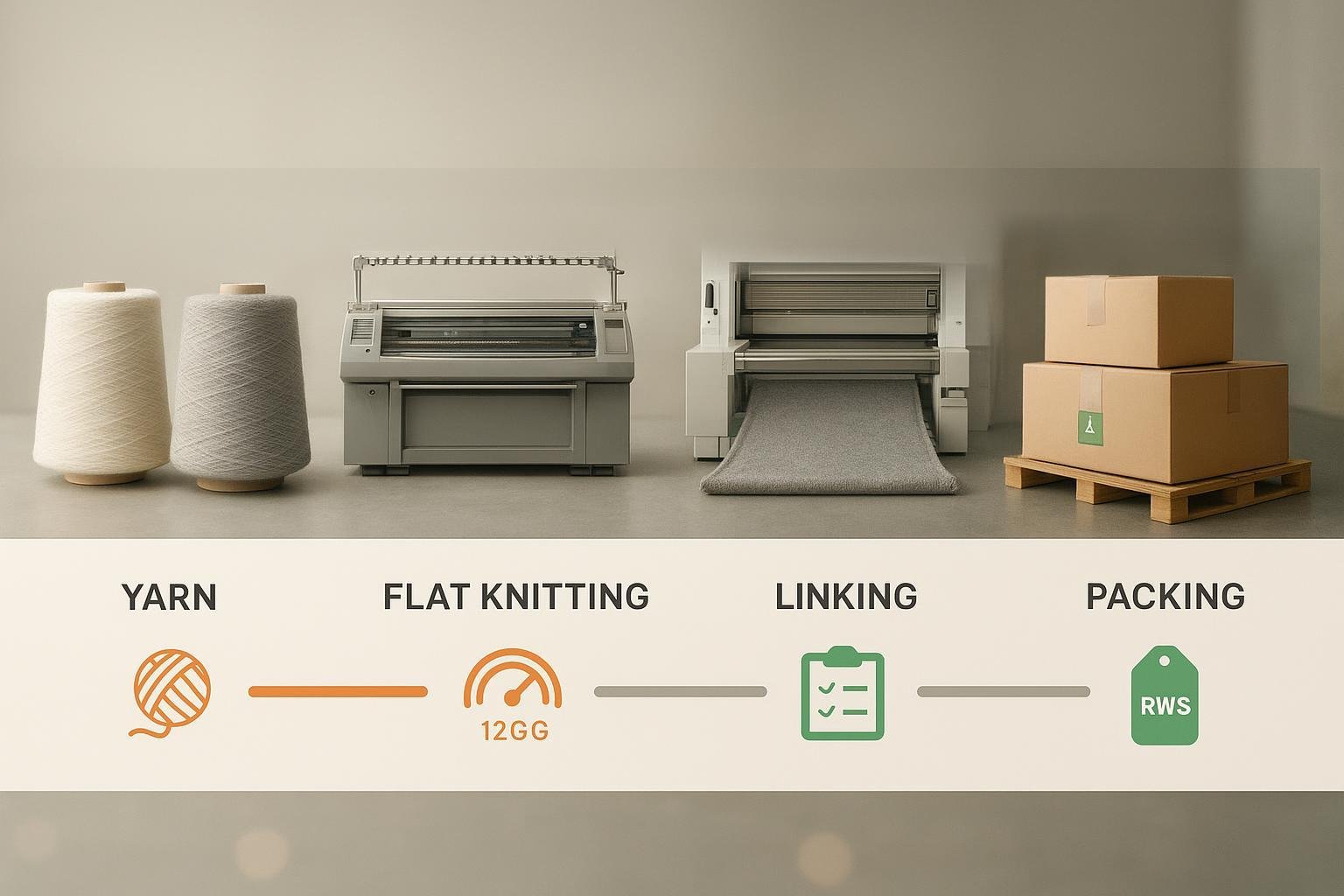
Bringing a premium Merino knit from sketch to shipment takes more than great yarn. It takes disciplined engineering, crystal‑clear specs, and steady control of MOQs, approvals, and lead times. If you are searching for an Australian merino wool sweater manufacturer OEM ODM partner, this guide lays out the end‑to‑end process brands use to get reliable outcomes—without surprises.
You will find a plain‑English workflow, an indicative gauge–yarn–GSM table, test targets tied to ISO/AATCC/ASTM methods, and a pragmatic playbook for MOQs and timelines. Use it to brief vendors, de‑risk production, and measure progress with the same KPIs your ops team tracks.
Key takeaways
Lock the engineering early: gauge, GSM band, yarn count/ply, and blend or finish choices are the levers that drive handfeel, durability, and price.
Treat sampling as risk insurance: Proto → PP/PPS seal → TOP keeps bulk aligned with the gold standard and reduces rework.
Control the critical path: yarn readiness and approval cadence decide whether you hit planned lead times more than any other factor.
Agree on measurable QA and test methods up front: pilling, shrinkage, colorfastness, and final AQL should have numeric targets and named standards.
Verify claims, not logos: validate RWS or its successor Materials Matter via scope and transaction certificates; check OEKO‑TEX on the official portal.
The end‑to‑end workflow from brief to shipment
A smooth OEM/ODM program follows the same bones every time. The details you write into each step determine how consistent your bulk will be.
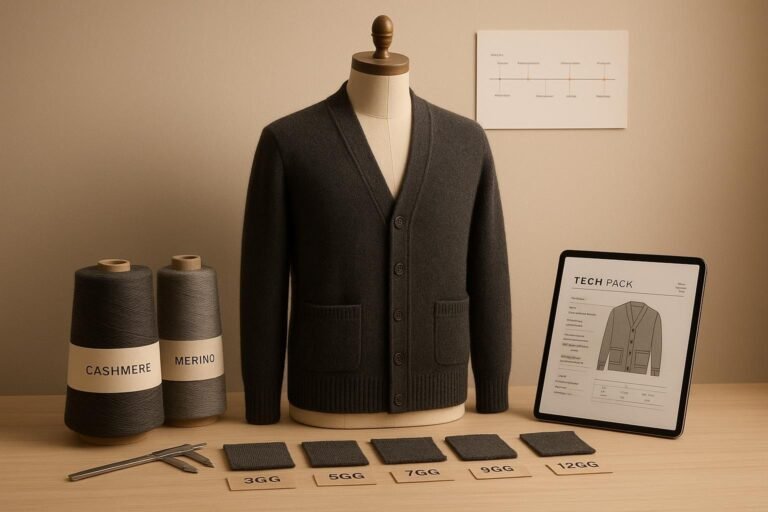
Translate your design brief into manufacturable specs
Start with a focused tech brief that includes:
Target gauge (e.g., 7GG mid‑weight, 12GG fine) and an indicative GSM band.
Yarn system and count (Nm) with intended ply; 100% Merino vs common blends like Merino‑nylon for durability.
Stitch structure (jersey, links‑links, rib) and areas needing reinforcement.
Finish choices (e.g., superwash for machine‑washable care, anti‑pilling treatments) and care label intent.
Tolerance bands for chest, length, sleeve, and rib recoveries.
Think of this as your engineering blueprint. It tells the factory which machine bed, yarn count, stitch density, and finishing route to plan. A precise brief saves weeks later.
Sampling stages that de‑risk bulk
Prototype sample: Confirms feasibility and silhouette. Substitute yarns are acceptable here to prove construction.
PP or PPS sample: Built with the final yarn, trims, and finishing on the production line. This becomes the sealed gold standard for bulk.
TOP sample: Pulled from early bulk to reconfirm that production matches the sealed PP. Any deviation triggers corrective action before the whole lot advances.
Use checklists, comment logs, and visual markups. Keep a running deviation register—if it is not documented, it will drift in bulk.
Critical path and lead‑time control
Lead time is decided long before the knitting starts.
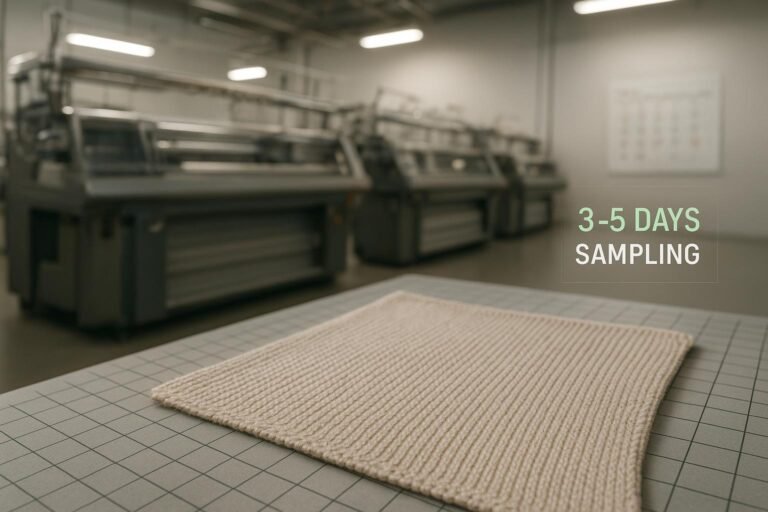
Yarn readiness: Stock‑service yarns and colors can keep sampling inside a week and bulk inside several weeks; custom spins and dye lots add weeks. Book early.
Capacity planning: Reserve machines and linking resources when you send your brief; do not wait for PP approval to get in line.
Approval cadence: Timebox each round of feedback. One day of delay at Proto easily becomes a week by TOP if it forces rescheduling.
Logistics buffers: Build around holiday calendars and add a small buffer for inspection and documentation time.
Engineering the knit with gauge, GSM, and yarn count
The table below is an indicative planning aid. Final GSM depends on stitch structure, density, yarn loft, and finishing relaxation. Validate with lab swatches during Proto.
Gauge (GG) | Typical Yarn Count/Ply (Nm) | Indicative GSM Band | Typical Use Case |
|---|---|---|---|
3–5 | 1/8–2/16 in 2–4 plies | 400–900+ | Chunky sweaters and outerwear knits |
7–9 | 2/16–2/28 in 2–3 plies | 280–450 | Mid‑weight sweaters and cardigans |
12–14 | 2/28–2/48 in 1–2 plies | 150–300 | Fine‑gauge pullovers, polos, layering |
These mappings reflect industry practice from knit engineering explainers and calculators. Stitch choices and finishing can swing GSM by 20–30%, so treat them as starting points rather than promises.
Merino material choices that matter
Not all Merino feels the same against the skin, and not all of it behaves the same in a sweater program. Micron class is a primary driver: finer fibers are usually softer; coarser fibers are often more robust.
Micron guidance: Industry classifications by the International Wool Textile Organisation place superfine and fine Merino in the apparel sweet spot. IWTO’s Wool Notes outline ranges designers use to balance handfeel and durability. See the reference in the IWTO document Wool Notes 2024 for classification context: IWTO Wool Notes 2024.
Comfort research: Dermatology‑oriented studies cited by The Woolmark Company associate next‑to‑skin comfort with finer Merino; for example, research on skin responses with fine Merino is summarized by Woolmark here: Woolmark industry research on wool and eczema.
Practical positioning: Many brands target approximately 18.5–19.5 μm for everyday sweaters to balance softness, durability, and cost. Confirm actual microns and staple characteristics with your spinner’s datasheet.
Blends and finishes you will see often:
100% Merino: Natural handfeel and thermoregulation; good for premium lines.
Merino‑nylon: Adds abrasion resistance and seam strength for active or high‑wear garments.
Merino‑cashmere: Softer hand at higher cost; use where drape and touch are the hero.
Superwash finishing: Improves machine‑wash performance; align with care label testing.
Enzyme or anti‑pilling treatments: Can reduce fuzzing; always validate against pilling tests and handfeel changes.
Quality targets and test methods to agree up front
Set numeric targets, name the test method, and choose the lab or apparatus model. That turns opinions into evidence.
Pilling and fuzzing: Target appearance grade at or above 3–4 after testing by ISO 12945‑2 (Martindale) or ASTM D3512 (random tumble). Cite the standard you will use on the PO and sample reports. See the ISO catalog entry for methods such as ISO 12945‑2 on the ISO Online Browsing Platform: ISO OBP – search ISO 12945‑2.
Dimensional stability: Keep length and width change within 3–5% after laundering by ISO 6330 or AATCC TM135 (use wool‑appropriate cycles). Method listings and apparatus references are available from the AATCC Quality Control Catalog: AATCC Quality Control Catalog 2024 and from the ISO OBP for ISO 6330: ISO OBP – search ISO 6330.
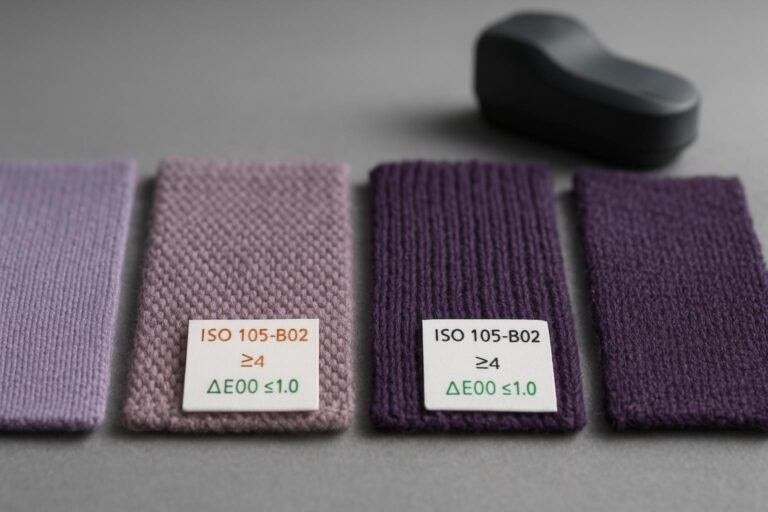
Colorfastness: Use ISO 105 or AATCC families (e.g., lightfastness and laundering). Align numeric grades for change and staining during your PP approval.
Final AQL inspection: Use attribute sampling per ISO 2859‑1 or ANSI/ASQ Z1.4. Typical fashion settings are Critical 0.0, Major 2.5, Minor 4.0. Document inspection level and lot sizing on the booking.
When brands and manufacturers fix these targets at PP, bulk becomes a confirmation exercise rather than a debate.
Compliance and traceability you can validate
For Australian Merino programs with responsible sourcing claims, tie every claim to checkable documents.
RWS and the Materials Matter transition: Textile Exchange’s Responsible Wool Standard is being unified into the broader Materials Matter program. Chain‑of‑custody remains essential. Review Textile Exchange’s standards hub for current status and guidance documents: Textile Exchange Standards overview. For pilot chain‑of‑custody guidance within the unified framework, see the official pilot CoC summary: Textile Exchange Materials Matter CoC pilot guide.
How to verify: Collect scope certificates for each certified site and transaction certificates for each shipment; ensure the fiber claim and quantities flow end‑to‑end. Confirm certificate validity with the issuing certification body.
OEKO‑TEX validation: Use the official portal to check certificate numbers, scope, and expiry for STANDARD 100, STeP, and MADE IN GREEN. Start at OEKO‑TEX official site and navigate to the certificate or label check.
Logos are a starting point; verified certificate numbers and transactions are the proof.
MOQs, costs, and timelines you can actually control
Merino programs vary widely, but a few levers consistently move the schedule and budget.
Yarn strategy: Stock‑service yarns and house colors shorten both sampling and bulk. Custom spins and colors improve uniqueness but add weeks; reserve early.
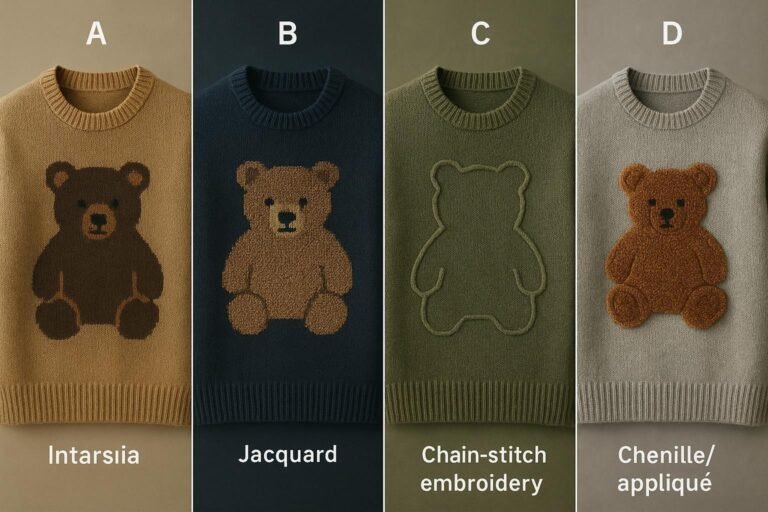
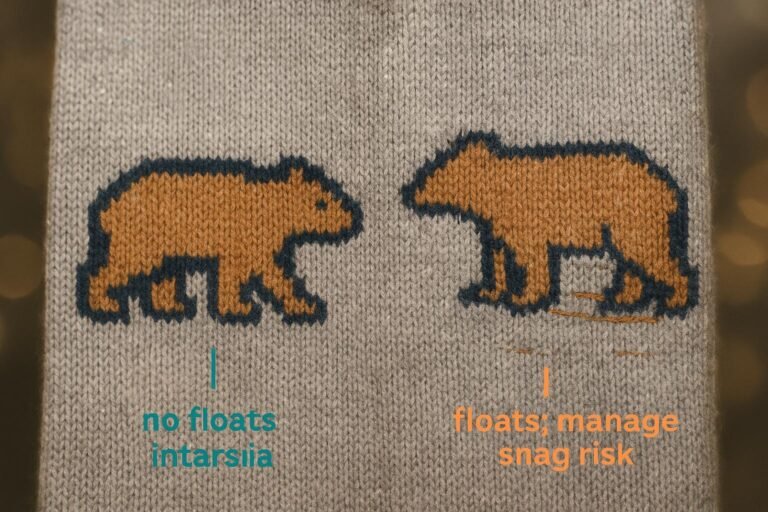
Gauge and construction complexity: Cables, intarsia, and engineered ribs demand more machine time and skilled linking; plan capacity accordingly.
Approval discipline: Compress turnaround time by scheduling standing review slots and issuing consolidated comments with clear accept/reject decisions.
Seasonal calendars and logistics: Book around national holidays and peak freight periods; add a modest buffer for inspections and documentation.
Many OEM/ODM partners can meet fast sampling and concise bulk windows when these inputs are firm. The difference is rarely on the knitting floor—it is upstream.
Example workflow with a neutral OEM partner
Disclosure: AzKnit is our product. For a straightforward fine‑gauge men’s crew at 12GG using approximately 18.5–19.5 μm Australian Merino and a superwash finish, a practical, repeatable flow looks like this:
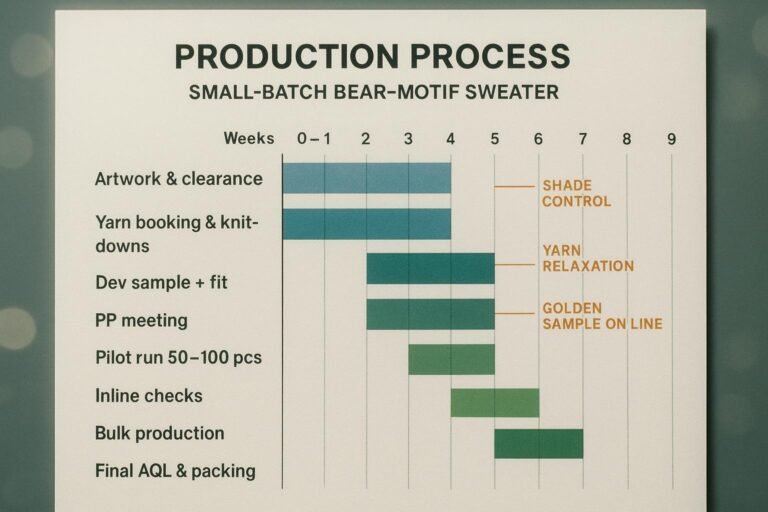
Week 0: Brand sends a brief with target GSM band, yarn count, structure notes, size set, and test targets. The OEM checks stock yarn availability and reserves a machine bed.
Week 1: Proto swatches confirm gauge and handfeel; silhouette proto ships. Review is limited to one consolidated round.
Week 2: PP/PPS is produced on the intended line with the final yarn and finish. The sealed PP includes labeled shrinkage allowances and a named laundering method for care validation.
Week 3–5: Bulk production proceeds. Early TOP is pulled and measured against the sealed PP; any variance beyond tolerance is corrected before continuing.
Week 5–6: Final inspection to ISO 2859‑1 settings, pack‑out per spec, and shipment.
Any experienced Australian merino wool sweater manufacturer OEM ODM should be able to execute a similar path when yarns are ready and approvals move on schedule. When you evaluate partners, prioritize evidence of on‑time approvals, clean TOP alignment, and clarity in QC documentation rather than generic speed claims.
Vendor selection checklist for an Australian merino wool sweater manufacturer OEM ODM
Use this short list to compare candidates objectively:
Proven gauges that match your line plan and the ability to show PP/TOP alignment on past programs.
Access to Australian Merino yarns and the willingness to share spinner datasheets and lot traceability where applicable.
Familiarity with test methods you require and sample reports that cite ISO/AATCC/ASTM numbers, not just “pass/fail.”
Transparent MOQ ladders for stock yarn versus custom spin and dye, with realistic lead‑time bands.
A documented sampling calendar with accountable approval windows and escalation paths.
Willingness to support certificate verification for RWS or Materials Matter and to share OEKO‑TEX validation links.
Clean AQL inspection history and examples of defect Pareto and corrective actions.
Clear English communication across time zones with a single point of contact for change control.
KPI discipline that keeps projects on track
Track what matters the same way every time. Many apparel teams use a small KPI set to see problems early and to run continuous improvement:
OTIF (On‑Time, In‑Full): Orders delivered within the committed window and complete, expressed as a percentage. Use it to measure whether your planning and partner capacity are aligned.
RFT (Right First Time): Stages completed correctly the first time without rework—notably Proto and PP/PPS approvals. High RFT correlates strongly with low change‑order risk.
PCD adherence: How often production completion dates match the plan. Deviations should link to root causes like yarn delays or approval slippage.
Keep these visible on a simple dashboard from Proto through shipment. If they slip, tighten the inputs, not just the promises.
Next steps
Start your brief with gauge, GSM band, yarn count/ply, blend or finish preferences, stitch structure, and numeric QA targets with named methods. Include a size set and tolerance table.
Ask shortlisted OEM/ODM partners to return a one‑page critical‑path plan with yarn readiness, machine booking assumptions, and approval windows. Request two anonymized PP→TOP documentation examples.
If you need a neutral starting point, speak with an RWS‑capable OEM/ODM that can share certificate verification steps and sample test reports; ensure your agreement names the methods and numeric targets so approval is objective.
References and further reading
Responsible Wool Standard and its transition to the Materials Matter program are maintained by Textile Exchange. See the standards overview and the pilot chain‑of‑custody guide for current guidance: Textile Exchange Standards overview; Materials Matter CoC pilot guide.
Micron classifications and apparel guidance are summarized by IWTO; dermatology‑oriented comfort research summaries are provided by Woolmark: IWTO Wool Notes 2024; Woolmark industry research on wool and eczema.
Test methods and apparatus references: ISO Online Browsing Platform (search ISO 6330, ISO 12945‑2); AATCC Quality Control Catalog 2024.