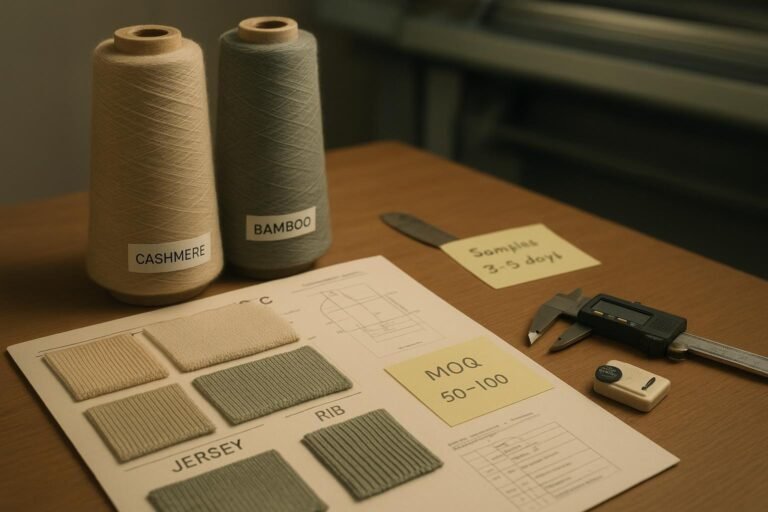

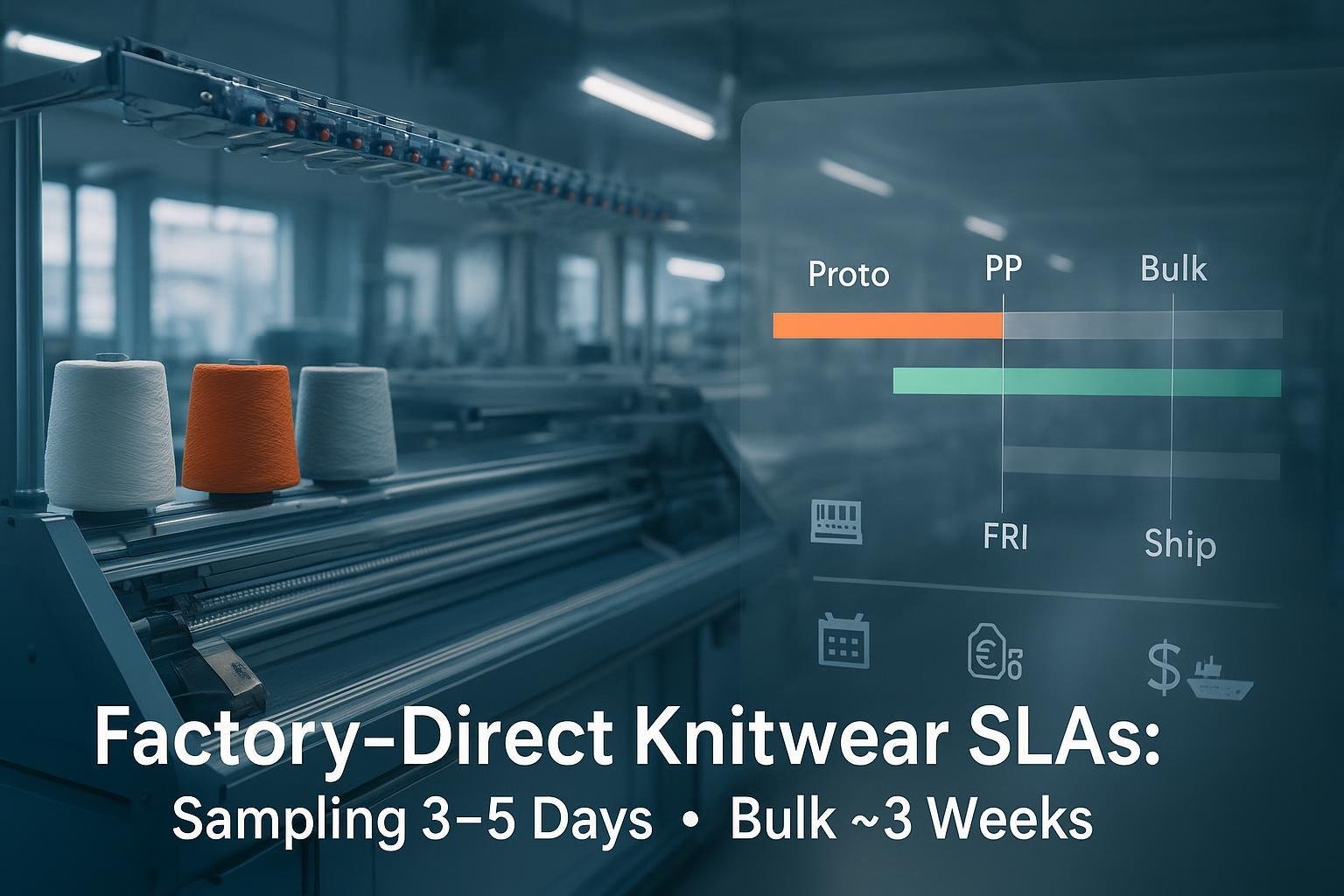
When you strip out the intermediaries and work factory‑direct, the production clock changes. Knitwear teams that commit to an auditable SLA can turn around proto samples in 3–5 working days and move from approvals to bulk in roughly three weeks for suitable styles—provided yarn availability, linking capacity, and finishing are locked early. Independent snapshots in 2026 show similarly compressed cycles on low‑MOQ lanes, which signals feasibility when the plan is enforced.
This guide shows exactly how switching from multi‑tier traders to a factory‑direct partner straightens your critical path and clarifies total landed costs—so you can hit in‑season launches with less variance and better margin control. We’ll keep it evidence‑driven, audit‑ready, and free of hype.
Key takeaways
SLA first: For many knit SKUs, proto sampling in 3–5 working days and bulk in ~3 weeks is realistic when the TNA is enforced and yarn is pre‑positioned or readily available.
The switch that matters: Moving from multi‑tier traders to factory‑direct reduces handoff delays, improves booking certainty for PP/bulk, and exposes the true cost drivers (yarn, make, trim, logistics, duty/VAT).
What to audit: Lock a knitwear‑specific TNA with gates (Proto → Fit/Grading → PP → Knit/Link/Finish → FRI → Ship). Publish it as a Gantt, track actuals, and hold both sides to the SLA.
Landed‑cost clarity: Use official tariff tools to verify duty/VAT and model logistics/QC/contingency explicitly to avoid “invisible” costs in trader bundles.
Compliance without drama: Map REACH restrictions and EU/UK textile labelling to your test plan and technical files; verify any OEKO‑TEX claims in the public directory.
2026 logistics reality: Build a 10–14 day ocean buffer for EU/UK due to Red Sea/Suez variability; pre‑book space ahead of peaks.
What factory‑direct changes in China knitwear manufacturer lead times
Factory‑direct removes the opaque hops that often sit between your tech pack and the knitting floor. That means faster pattern programming, earlier PP slot booking, and fewer back‑and‑forths on trims/tests. Here’s the practical difference across decision criteria that determine speed and cost certainty.
Criterion | Multi‑tier traders | Factory‑direct partner |
|---|---|---|
Schedule control | Indirect; approvals relayed via intermediaries; variable slot booking | Direct line to planning; PP/line slots booked on proto approval with visible TNA |
Cost transparency | Bundled quotes; limited view into yarn/make/logistics | Full breakdown (yarn, make, trims, QC, logistics, duty/VAT) for landed‑cost modeling |
Quality gates | Inconsistent AQL usage; post‑hoc inspections | Standardized gates (TOP/PP/FRI) and ISO 2859‑1 sampling plans agreed up front |
Compliance flow | Document chasing via multiple parties | Single owner for certificates, lab tests, labelling proofs, traceability |
Change management | Slow, sequential communications | Faster decisions; shorter feedback loops; fewer resets |
The bottom line: fewer handoffs, fewer blind spots, and a timeline you can actually defend to your merchandising calendar.
The SLA and knitwear TNA you can audit
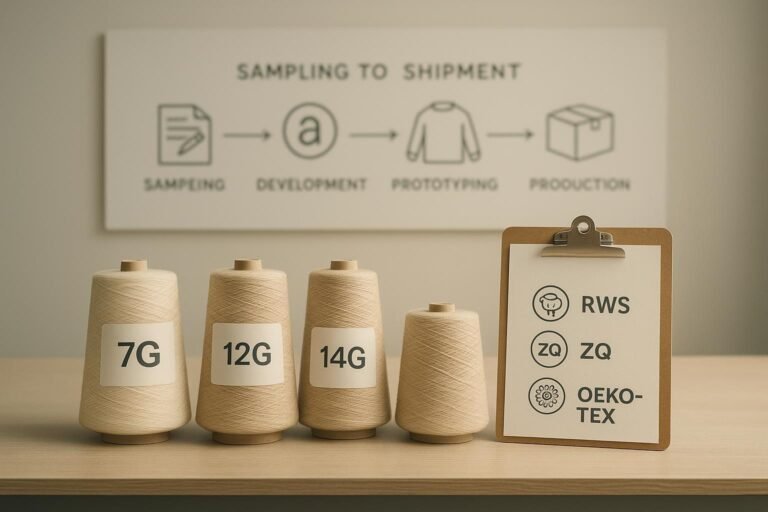
An SLA only works if the Time‑and‑Action plan underneath is specific to flat‑knit realities. Apparel planning explainers show why clear gates and owners keep calendars on track, and the structure adapts well to sweaters: tech pack → proto → fit/grading → PP → knit/link/finish → FRI/packing → ready to ship, with inspection plans and wash tests attached to the right milestones. See methodology and milestone logic in time‑and‑action guides for merchandisers from 2024–2025, which outline sequencing, gatekeeping, and approval responsibilities.
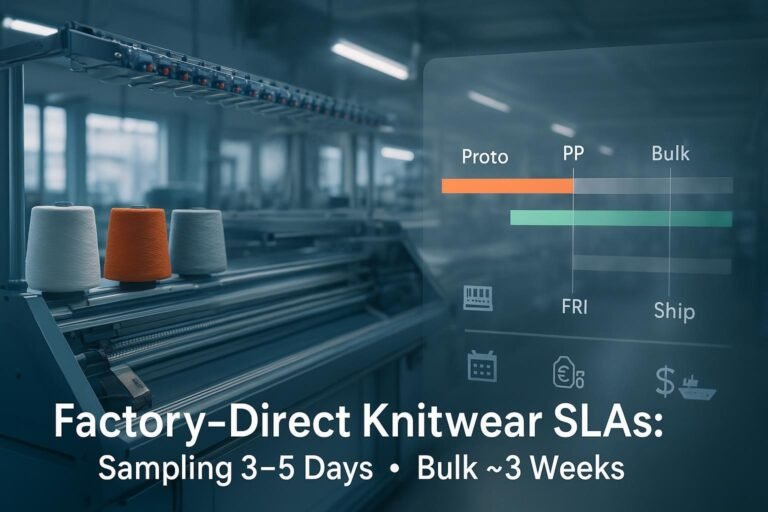
Below is a visual, audit‑ready Gantt to anchor your SLA. It shows three lanes you can choose from based on yarn and seasonality.
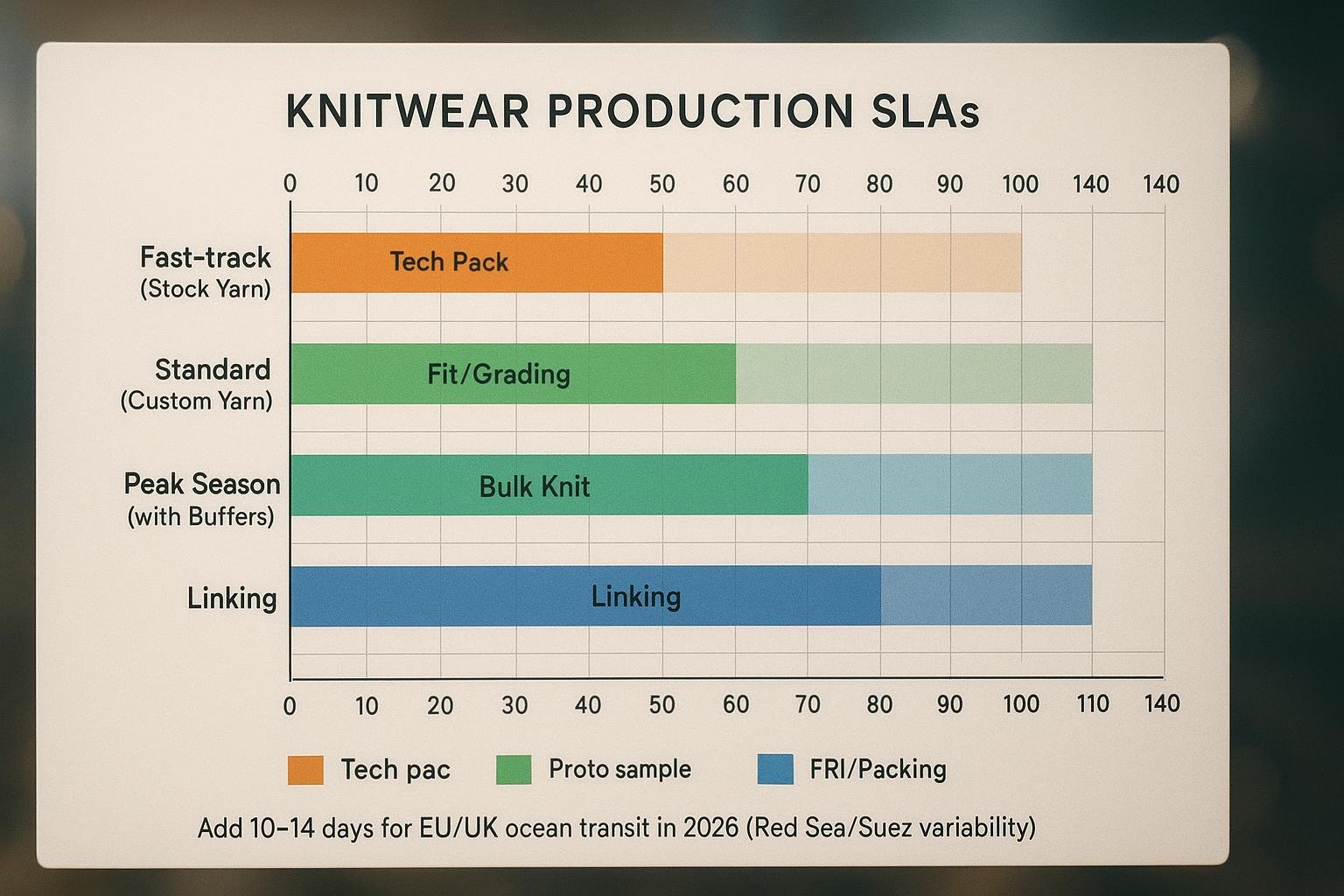
Fast‑track works best when you select from stock yarns or pre‑positioned greige; commit to color early to avoid dye room congestion. Standard fits custom yarns or small dye lots; your risk is mostly in yarn‑dye timing and finishing queues. Peak‑season bakes in operator and finishing buffers; use it for Q4‑bound assortments and complex stitches.
Quality and inspection are non‑negotiable. Align on AQL defaults (Critical 0; Major 2.5; Minor 4.0) and general inspection Level II under ISO 2859‑1; practitioner primers explain how acceptance numbers vary by lot size, and the ISO OBP entry describes the single‑sampling plan structure.
Why this is enforceable: Each milestone has a single owner, acceptance criteria, and a bookable capacity slot behind it. When proto is approved on D‑3 to D‑5, PP prep can be booked immediately; once PP passes, knit/link/finish windows open and you’re effectively on rails. If a delay hits, the Gantt shows where you re‑plan—without re‑arguing the entire calendar.
Method references (inline):
AQL norms and ISO 2859‑1 sampling are summarized by apparel QC practitioners in 2024 and in the ISO Online Browsing Platform entry for 2859‑1.
Landed‑cost transparency: model it once, repeat it across SKUs
The promise of factory‑direct sourcing isn’t just tighter China knitwear manufacturer lead times—it’s also the ability to model every euro and pound in your total landed cost.
Duty/VAT verification should be done with official tools. For EU imports of knitted apparel (HS Chapter 61), confirm TARIC codes and rates in the European Commission’s Access2Markets portal; non‑preferential duty around 12% is common but varies by code and origin rules. For the UK, check HMRC’s UK Trade Tariff and apply VAT (typically 20%) on the customs value plus duty. A practical 2025 overview from the Dutch Chamber of Commerce explains how these components stack up for clothing importers.
Make the quote intelligible by separating: yarn, make, trims, packaging, labels/hangtags, finishing (wash/blocking), inspection/QC (inline + FRI), inland drayage/export fees, ocean or air freight, insurance, duties, VAT, and a contingency buffer for seasonality and reroutes. What’s often “invisible” in trader bundles—material wastage assumptions, stitch‑complexity changeovers, third‑party lab test fees and re‑tests, FCR/terminal/documentation fees, and peak‑season surcharges—becomes visible and negotiable once you own the model.
Quick links you’ll actually use in planning:
EU tariff lookups via the Commission’s Access2Markets portal (official, up to date).
UK rates via HMRC’s Trade Tariff.
Compliance playbook for EU/UK buyers (built for speed without shortcuts)
Label the fibre correctly, manage restricted chemicals, and maintain a technical file a regulator would accept. Keep these anchors close to your TNA:
Fibre labelling (EU): Regulation 1007/2011 requires accurate fibre composition names from Annex I, displayed before purchase and in local language(s). The European Commission’s revised FAQs consolidate enforcement practice and scenarios in a single official PDF (latest update).
UK labelling mirrors the EU rule set post‑Brexit; Business Companion offers a concise, government‑backed overview for UK teams.
REACH restrictions: ECHA’s Annex XVII lists textile‑relevant restrictions (e.g., azo colorants, phthalates, PFAS, metals, formaldehyde). Use ECHA’s textiles/leather/footwear pages to map your test plan to yarn/finish lots.
Product safety (EU): The General Product Safety Regulation (EU) 2023/988, effective Dec 2024, strengthens documentation and traceability expectations for brands placing products on the EU market; maintain risk assessments, traceability maps, and lab reports in technical files. 2025–2026 legal and policy briefings distill the key responsibilities for apparel.
Verifying OEKO‑TEX claims: Validate supplier claims via the public Label Check directory and record certificate numbers and validity dates in your files.
Inline references to keep your counsel aligned:
European Commission — FAQs on Regulation 1007/2011 (official PDF).
ECHA — REACH restrictions overview and the textiles/leather/footwear page.
OEKO‑TEX — public Label Check directory.
Legal/policy briefings on GPSR impacts for apparel (2025–2026) by recognized firms and analysts.
Practical workflow example (neutral, auditable)
Here’s how the SLA gates play out when working directly with a capable knitwear partner. After proto approval within 3–5 working days, PP prep is booked for the next available window (often within 72 hours) with inspection criteria attached. On PP pass, the plan releases bulk knit → linking → finishing as a coordinated block; inline checks and wash tests are executed to the agreed matrix; FRI is scheduled with AQL Level II and 0/2.5/4.0 thresholds. A partner like AzKnit can support this workflow by providing an auditable TNA, booking confirmations for PP and bulk lines, and a landed‑cost breakdown finance can review before ex‑factory. Capability still depends on style, yarn availability, and season.
Logistics in 2026: plan buffers into the calendar
Even the cleanest factory SLA is only half the story; lanes to EU/UK remain variable. Trade and maritime analyses through early 2026 document sustained Suez Canal traffic declines and extended Asia→Europe transits as carriers detour the Red Sea, adding about 10–14 days to ocean lead times. Treat this as a working baseline while monitoring carrier advisories; model premium air or rail for must‑arrive SKUs.
Practical steps: Book space early for Q3/Q4; keep an expedite lane scoped for top movers; and treat ocean buffers as a standard line in your landed‑cost model rather than an afterthought.
Frequently asked checkpoints when switching to factory‑direct
Will my China knitwear manufacturer lead times actually shrink? If your current bottleneck is approval relays and late PP booking, yes—removing tiers typically converts idle time into booked capacity. If yarn lead time dominates, gains are smaller but variance usually falls.
How do I keep the SLA honest? Publish the Gantt, log actuals against plan, and tie any re‑planning to explicit causes (e.g., PP fail, yarn delay). Hold quarterly reviews and update buffers seasonally.
What about compliance risk? Centralize certificates and test reports; verify OEKO‑TEX numbers; map REACH tests to lots; align fibre labels to 1007/2011. Speed improves when documents aren’t scattered across three entities.
Final perspective and next steps
Factory‑direct doesn’t remove complexity—but it moves critical decisions closer to the machines and gives you line‑of‑sight to both time and money. If you adopt an SLA‑anchored TNA, verify duties with official tools, and plan sensible buffers for EU/UK lanes, the calendar stops slipping and the margin math gets clearer. Ready to pilot on one SKU? Start with a fast‑track style, publish the TNA Gantt, and ask your partner for a landed‑cost breakdown you can audit. If you need a practical starting point, the team at AzKnit can share a sample TNA and help you run a pilot under the 3–5 day sampling, ~3‑week bulk framework.
Selected references (canonical)
European Commission — Revised FAQs on Textile Fibre Names and Related Labelling (Reg. 1007/2011): https://single-market-economy.ec.europa.eu/document/download/34fcf863-59ef-4352-8489-a2577102fd8f_en?filename=revised+FAQs+on+Regulation+1007-2011+-+published.pdf
ECHA — REACH restrictions overview: https://echa.europa.eu/reach-restrictions and textiles/leather/footwear listing: https://echa.europa.eu/substances-restricted-under-reach/textiles-leather-footwear
OEKO‑TEX — Label Check directory: https://www.oeko-tex.com/en/label-check
EU duties — Access2Markets: https://trade.ec.europa.eu/access-to-markets/en/home
UK duties — HMRC Trade Tariff: https://www.gov.uk/trade-tariff
Logistics buffers — Global Maritime Hub (Feb 2026): https://globalmaritimehub.com/suez-canal-traffic-declines-for-another-month-amid-red-sea-disruption.html
AQL/ISO 2859‑1 primers: ISO OBP entry: https://www.iso.org/obp/ui/ and QC practitioner overview: https://qualityinspection.org/inspection-level/