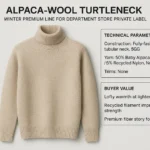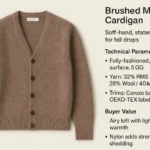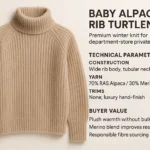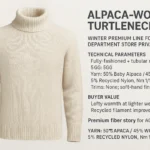

Choosing the right blend ratio is one of the fastest ways to improve customer satisfaction and margin without redesigning an entire style. For high-end sweaters and premium knit tops in the FOB $25–60 tier, the decision often narrows to two workhorse matrices—70/30 and 90/10. The catch? Each ratio shifts handfeel, pilling, shrinkage, and durability in different ways, and those shifts show up in pass rates, returns, and markdowns.
Key takeaways
70/30 tends to maximize handfeel when the 30% is a premium fiber like cashmere, but it can increase pilling and shrinkage risk without careful yarn engineering and finishing.
90/10 generally improves durability, pilling resistance, and dimensional stability when the 10% is a reinforcing fiber like nylon; perceived handfeel can be tuned via gauge, twist, and finishing.
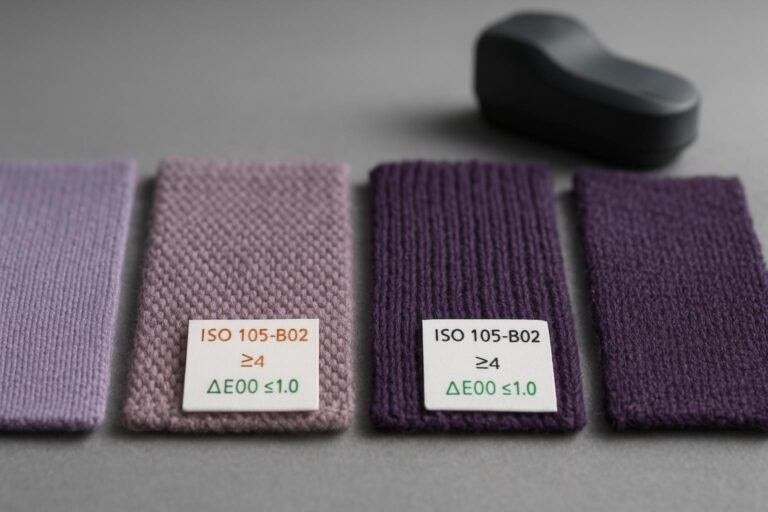
Use buyer baselines for acceptance: pilling ≥ Grade 3–4 at 5,000 rubs; shrinkage ≤ 3% after ISO 6330 washing with ISO 5077 measurement; colorfastness ≥ Grade 3–4 per ISO 105.
For the FOB $25–60 segment, small BOM changes from ratio shifts can swing contribution margin more through pass-rate and returns deltas than through yarn cost alone.
Keep the test method constant when comparing blends; method drift can invalidate KPI comparisons.
How knitwear blend ratios change performance
Blend ratios interact with yarn engineering and knit structure. Think of the ratio as the recipe and the engineering as the cooking technique—both shape the final dish.
Handfeel: Finer fibers and lower surface hairiness feel softer; cashmere in a 70/30 wool/cashmere often reads plush. A 90/10 wool/nylon can feel crisp out of the box but finishes like softening and steaming tune perception.
Pilling: Loose fiber ends and surface fuzz form pills; adding 5–15% nylon to wool strengthens the yarn-fabric system and can reduce pill formation directionally, especially under abrasion. Evidence indicates nylon fractions can raise abrasion resistance and reduce pilling propensity; see the knit-appropriate pilling method overviews in the ISO 12945 series summarized by the testing-equipment publisher Roaches in their explanation of Martindale pilling testing and by TextileInfoHub’s ISO 12945 guide.
Shrinkage: Higher natural-fiber content increases felting or relaxation shrinkage risk; stabilizers like nylon and tighter constructions lower the risk when washed under ISO 6330 programs. ISO 6330 washing and ISO 5077 measurement are summarized clearly in Testex’s shrinkage guide and SDL Atlas’s wash testing primer.
Keep the test method constant: ISO 12945 for pilling, ISO 6330 with ISO 5077 for dimensional change, ISO 105 for colorfastness. Method drift can make apples-to-apples comparisons impossible.
Authoritative context for colorfastness: ISO 105 tests to washing and rubbing are widely used and graded with Grey Scales per ISO 105-A02/A03; see James Heal’s Grey Scales explainer and QIMA’s overview of textile colorfastness methods.
KPI and test-method handbook
KPI | Method reference | Buyer baseline for this guide | Notes |
|---|---|---|---|
Pilling at 5,000 rubs | ISO 12945 knit-appropriate method with 5,000-rub interim grading | ≥ Grade 3–4 | Keep the same variant across comparisons (e.g., ISO 12945-1 pilling box or -3 random tumble). Visual grade 5 to 1. Public method summaries: Roaches; TextileInfoHub. |
Shrinkage after wash | ISO 6330 washing program with ISO 5077 measurement | ≤ 3% length and width | Condition and recondition samples; declare program code and drying method. See Testex; SDL Atlas explainers. |
Colorfastness to washing and rubbing | ISO 105-C06 and ISO 105-X12 using Grey Scales | ≥ Grade 3–4 | State sub-method and temperature; record staining and color change. See James Heal; QIMA guides. |
Abrasion context | ISO 12947 Martindale for knits to first yarn break | Informational | Use to contextualize durability; no universal apparel minimum. Overview examples: TextileInfoHub’s Martindale guide. |
Note on baselines: Many buyers target pilling Grade 3–4 at an interim cycle like 5,000 rubs as an internal threshold. Treat this as a buyer-defined criterion, not a universal standard. Roaches and TextileInfoHub provide the grading context for pilling.
Comparative matrices for common pairings
Note: Where direct ratio-quantified knit data are limited, outcomes are described directionally based on mechanisms and industry practice. Always validate with your own lab tests.
Wool and nylon
Ratio | Handfeel tendency | Pilling at 5k rubs | Shrinkage risk | Durability cue |
|---|---|---|---|---|
Wool/nylon 70/30 | Crisper, less “woolly” halo | Tends higher grade vs lower nylon, other factors constant | Lower than wool-rich | Stronger abrasion resistance |
Wool/nylon 90/10 | Warmer, more wool-forward | Meets Grade 3–4 with correct yarn twist and finish; slightly lower than 70/30 nylon | Moderate; manage with finish and care | Solid for premium everyday wear |
Direction of effect: Adding 5–15% nylon to wool can improve abrasion and reduce pills; higher nylon like 30% amplifies this effect. See Testex’s overview of abrasion mechanisms and nylon’s role in durability.
Wool and cashmere
Ratio | Handfeel tendency | Pilling at 5k rubs | Shrinkage risk | Durability cue |
|---|---|---|---|---|
Wool/cashmere 70/30 | Noticeably softer, plush | Higher pill risk if yarn hairiness not controlled | Higher; finishing and care are critical | Luxury handfeel; monitor returns |
Wool/cashmere 90/10 | More resilient handle | Typically more stable pilling grades than 70/30 | Lower than 70/30 cashmere | Better pass-rate predictability at scale |
Direction of effect: Cashmere’s finer diameter elevates softness but may reduce pill resistance; higher wool share often stabilizes structure.
Cotton and nylon
Ratio | Handfeel tendency | Pilling at 5k rubs | Shrinkage risk | Durability cue |
|---|---|---|---|---|
Cotton/nylon 70/30 | Smoother, cooler touch | Generally higher grade vs 90/10 cotton/nylon | Lower than cotton-dominant | Better abrasion resistance |
Cotton/nylon 90/10 | Cotton-forward hand | Meets baseline with right structure | Moderate | Balanced durability and cost |
For method and context on pilling and abrasion, review the ISO 12945 and Martindale explanations from TextileInfoHub and Roaches, and the shrinkage method summaries by Testex and SDL Atlas.
Cost and margin sensitivity in the FOB $25–60 tier
Here’s a simple way to quantify how a ratio change affects contribution, keeping the retail multiple and test pass risk in view.
Example variables in your model: FOB target ($25–60), retail multiple (5× or 6× common in EU/UK per trade guidance), yarn BOM delta from ratio change, pass-rate and returns impact.
Worked example A: Wool/cashmere 70/30 vs 90/10
Assumptions: Base FOB $40 at 90/10; moving to 70/30 raises yarn BOM by $3. Retail multiple 5× → $200.
Pass-rate sensitivity: If pilling/shrinkage pass rate dips from 96% to 92%, and returns rise by 0.8 pp, the margin hit can exceed the $3 BOM delta once rework, split shipments, and markdown exposure are included.
Anchor: EU/UK apparel pricing guidance indicates FOB commonly represents roughly 12.5–25% of retail, implying 4–8× multiples; see the trade guidance on how to calculate apparel cost price.
Worked example B: Wool or cotton stabilized with nylon 90/10 vs 70/30
Assumptions: Base FOB $38 at 90/10; shifting to 70/30 nylon content adds $0.60 yarn cost but improves abrasion and shrinkage outcomes, cutting returns by ~0.5 pp.
Retail multiple 6× → $228. The small BOM increase can be offset by lower returns and fewer chargebacks, improving contribution.
Practical example using a blend library
Disclosure: AzKnit is our product.
How a category manager can compare two options in practice:
Define the KPI bar using buyer baselines: pilling ≥ Grade 3–4 at 5,000 rubs; shrinkage ≤ 3% after ISO 6330; colorfastness ≥ Grade 3–4.
Pull prior lab-tested entries from a supplier blend library for look‑alike yarns and gauges. Use identical test variants and wash programs.
Shortlist two swatches:
Wool/cashmere 70/30 with dehairing and anti-pilling finish
Wool/nylon 90/10 with medium twist
Run confirmatory tests with the same labs and programs used historically. Compare against pass/fail and estimate returns risk from past cohorts.
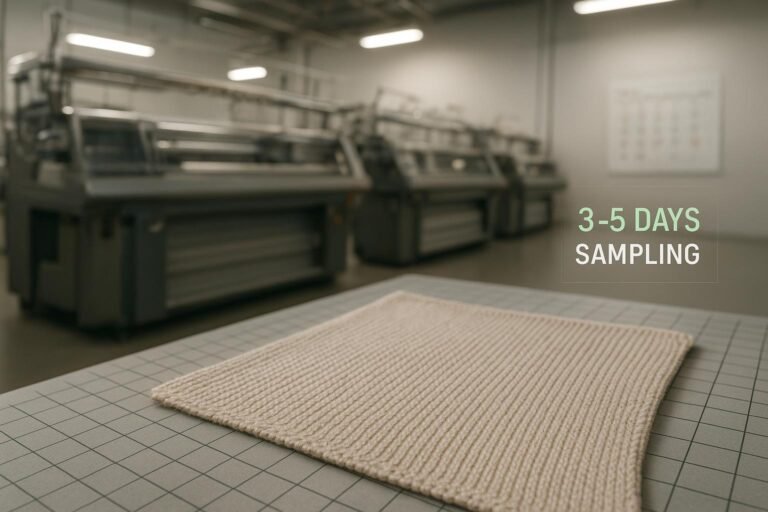
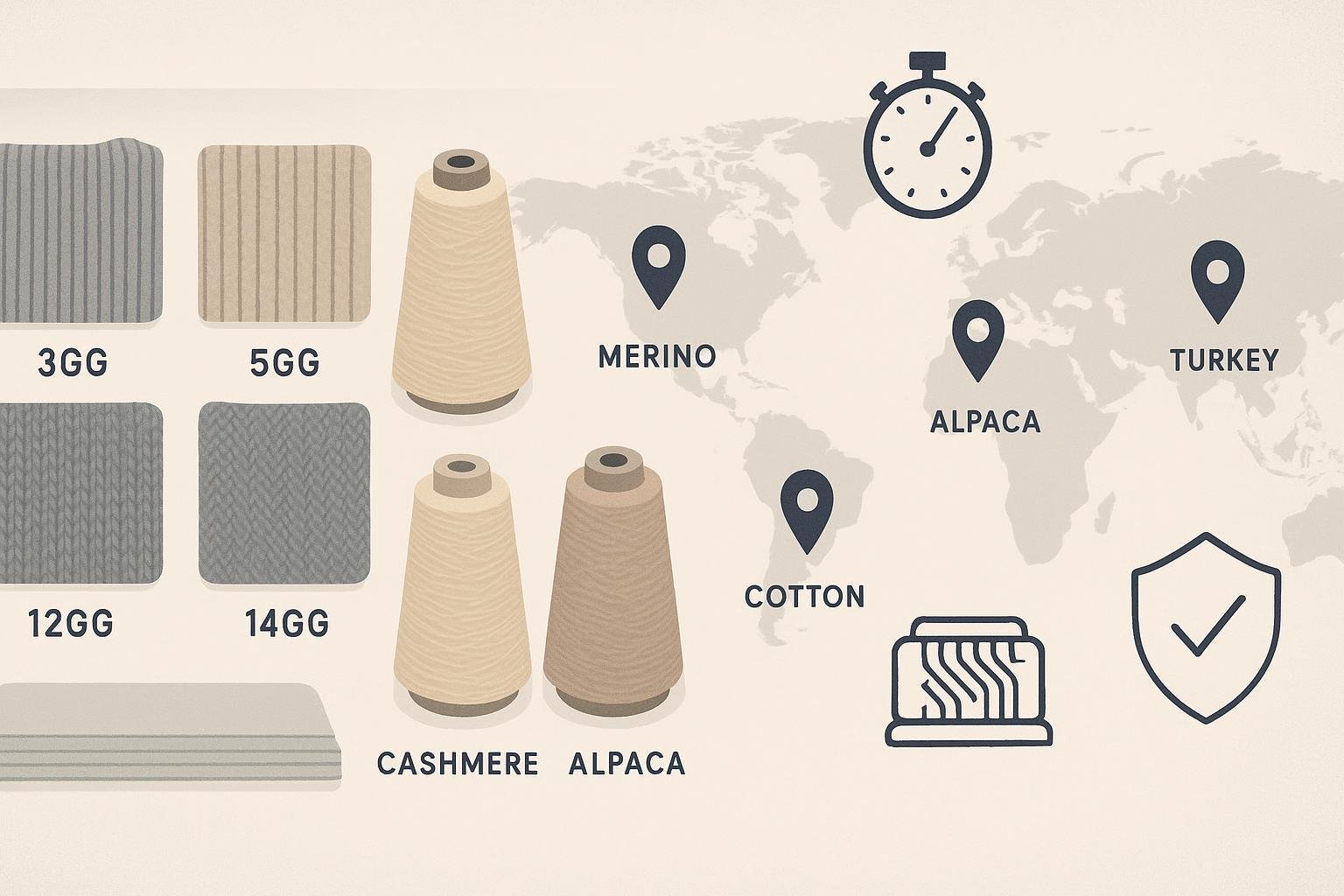
Neutral operations context: Sampling in 3–5 days and typical bulk lead time of about 3 weeks allows a quick A/B pilot before committing to the season’s main buy.
Balanced note: If your supplier lacks a mature library, replicate the approach with any lab-tested supplier portfolio or a third-party lab panel using ISO 12945, ISO 6330/5077, and ISO 105 methods.
Mini case notes (anonymous, interval-style)
Case 1: Upgrading perceived value. A wool/cashmere 90/10 base moved to 70/30 with added dehairing and controlled twist. Pilling grades clustered between 3–4 at 5k; shrinkage stabilized near 2.5–3.0% after tuning wash finish. Sell-through improved in the premium tier; returns held flat.
Case 2: Stabilizing pass rates at scale. A cotton/nylon 90/10 core style that flirted with shrinkage outliers moved to 70/30 nylon. Shrinkage outliers reduced, and abrasion complaints dropped; contribution improved despite a modest yarn cost uptick.
Supplier SOW and QA checklist
State exact methods in the PO and tech pack: ISO 12945 variant, cycle counts, grading protocol; ISO 6330 program and ISO 5077 measurement; ISO 105-C06 wash and X12 rub. Name the lab and include report IDs.
Acceptance thresholds: pilling ≥ Grade 3–4 at 5,000 rubs; shrinkage ≤ 3% length and width; colorfastness ≥ Grade 3–4.
Engineering controls: Specify yarn twist range, dehairing level or singeing, and finishing chemistry; lock gauge and GSM ranges.
Inspection plan: AQL levels for appearance defects; optional Martindale abrasion on elbows and cuffs for wear-prone styles.
Compliance notes: Reference OEKO-TEX Standard 100 where relevant and include REACH SVHC statements from material suppliers.
What to pilot next
Run a two-week A/B with 70/30 and 90/10 in your hero silhouette at your actual gauge and finish, locking test methods.
Track pilling grades at 5k rubs, dimensional change after ISO 6330 wash, and returns by size curve. Pair results with contribution margin by store cluster.
If you need plush handfeel at higher durability, test a 90/10 wool/nylon with a softer finish and a slightly lower twist, or move a wool/cashmere from 70/30 to 85/15 and recheck against the baseline.
Looking for a concise phrase to remember? Think of it this way: Ratio sets the direction; engineering decides the outcome.
Sources and further reading
Pilling methods and grading context: Roaches on Martindale pilling testing; TextileInfoHub’s ISO 12945 guide.
Shrinkage and dimensional change: Testex’s shrinkage guide and SDL Atlas’s wash testing primer covering ISO 6330 and ISO 5077 fundamentals.
Colorfastness overview: James Heal on Grey Scales and QIMA on colorfastness methods.
Retail multiple context for EU/UK apparel: CBI trade guidance on how to calculate apparel cost price.