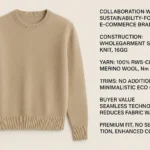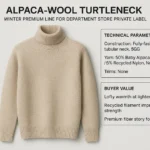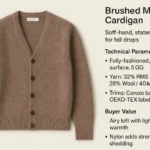

EU/UK AW peak season doesn’t forgive weak fit blocks or shaky replenishment. If your job is to roll out a retro golf cardigan program across multiple sites with deep size runs, you’re balancing three hard constraints at once: size and fit consistency (your decisive KPI), on-time top-ups, and an authenticity baseline that stays close to 1960s silhouettes and structures. Here’s the deal: true vintage delivers one-of-a-kind stories, but it breaks the moment you need repeatable sizes and reliable stock.
This guide compares the most realistic vintage sourcing alternatives for retro golf cardigans, shows when vintage still makes sense, and gives you an actionable migration checklist to move from curation to OEM/ODM without losing the period-correct look and hand.
Key takeaways
If your decisive KPI is fit and size consistency with a strict return-rate threshold, OEM/ODM reproduction is usually the only route that scales for AW deep stocking while preserving 1960s details via tight specs.
Vintage sourcing still wins for limited capsules and editorial storytelling but fails at multi-size depth and predictable replenishment.
Heritage brand routes can deliver strong story value, yet trade terms for fit-block control, replenishment SLAs, and MOQs are often opaque; treat them as complements, not substitutes, for a KPIs-first program.
Your decision matrix should weight fit consistency highest, followed by replenishment, compliance, authenticity, TCO, and MOQ; use documented evidence rather than vendor claims.
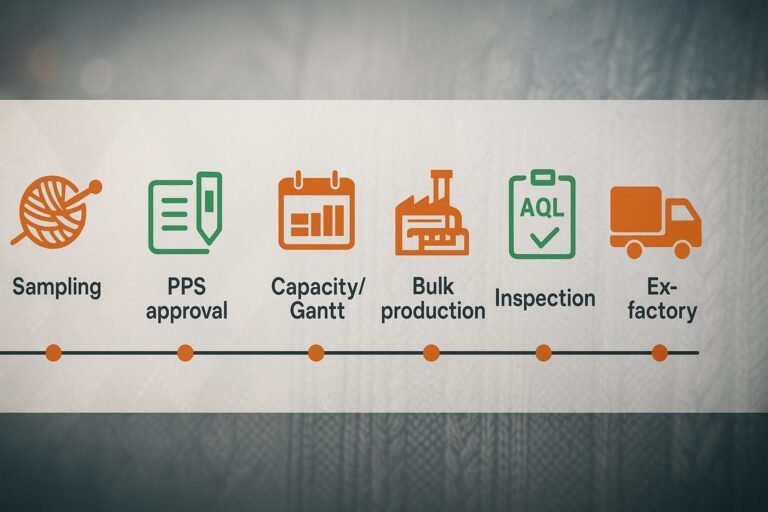
A clean migration path exists: lock the fit block, approve yarn and stitch libraries, pre-book capacity, run a 100–300 piece pilot, and enforce test plans and AQL.
The best vintage sourcing alternatives for retro golf cardigans
Buyers searching for vintage sourcing alternatives for retro golf cardigans generally need scale, repeatability, and auditability—without losing the 1960s look. Below is an at-a-glance comparison based on a weighted decision matrix prioritized for EU/UK AW fast rollout. We weight criteria as follows: Fit consistency 28%, Replenishment 22%, Compliance 18%, Authenticity and story 14%, TCO 10%, MOQ 8%.
Alternative | Scalability | Replenishment | Fit consistency | Authenticity and story | Compliance readiness | MOQ flexibility | Lead time | Migration difficulty |
|---|---|---|---|---|---|---|---|---|
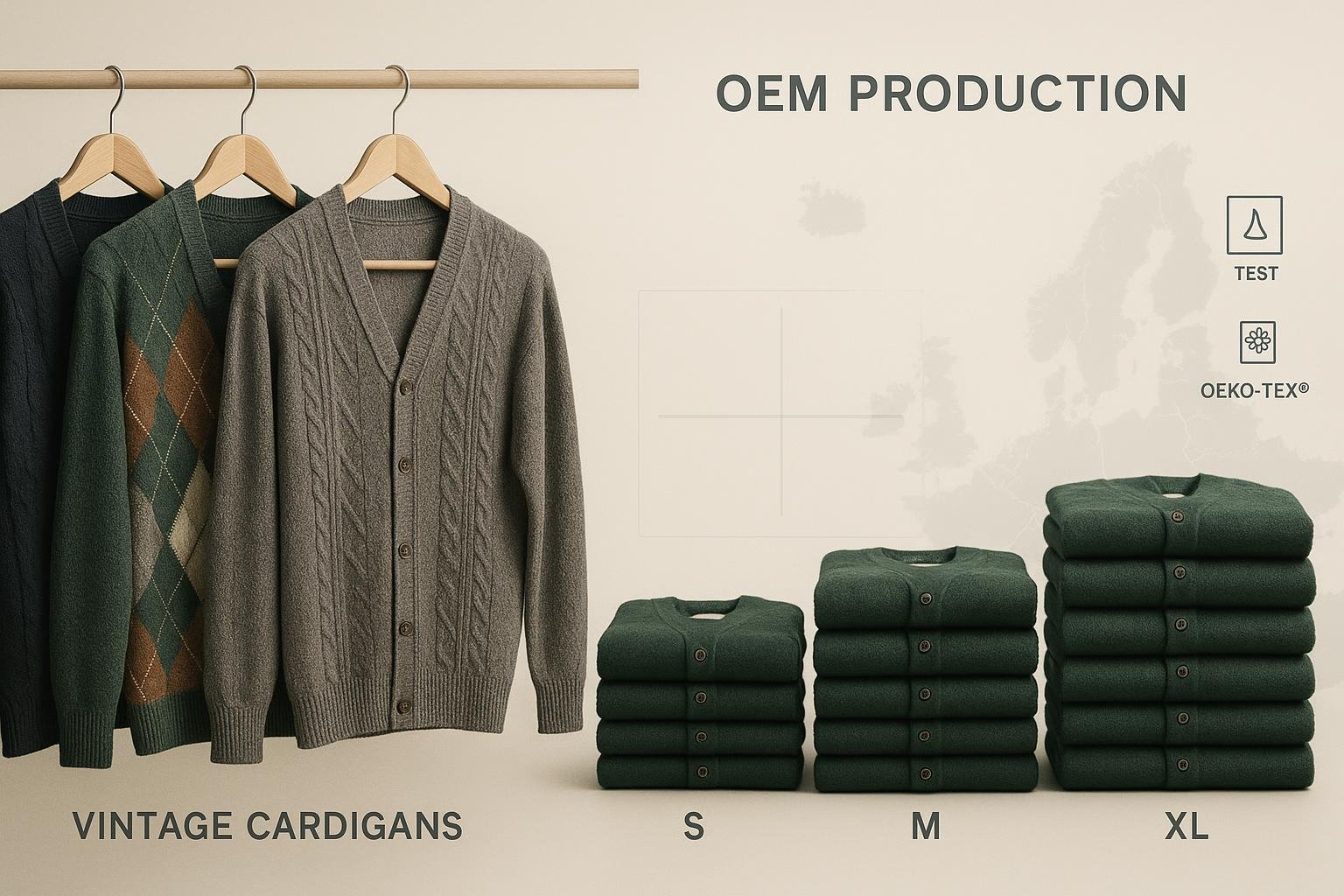
OEM or ODM reproduction (China/EU archetypes such as AzKnit) | High with factory capacity planning and yarn pre-booking | High with scheduled repeats and buffers | High via graded size sets, PP approvals, and tolerance controls | High if specs capture argyle, cable, gauge, and trims | Strong where programs are documented and third-party tests are booked | Pilot-friendly tiers possible; standard MOQs vary by fiber/gauge | Samples ~3–5 days; bulk often ~3 weeks post-approval (fiber/gauge dependent) | Medium (requires tech packs, QA, and SLAs) |
Heritage brand bulk personalization (e.g., Glenmuir) | Medium, depends on stock programs | Medium, typically stock-based | Medium–Low; fit blocks set by brand, limited buyer control | High, strong brand lineage | Brand-managed; limited buyer-side visibility | Undisclosed; often tied to stock availability | Personalization dispatch targets can be fast for retail orders; wholesale terms not public | Low if decorating stock; High for true reproductions |
Heritage reproductions via legacy labels | Unknown at arm’s length; often bespoke | Unknown without direct contracts | Unknown; may vary by label | Very high for narrative and design fidelity | Unknown unless programs disclose audits and test data | Unknown | Unknown | High without published trade terms |
Blanks plus embellishment programs | Medium and fast to start | Medium with readily available blanks | Medium; consistency depends on blank supplier blocks | Low–Medium; retro look via trims and graphics | Varies by blank supplier | Often flexible at small volumes | Generally quick if decorating stock | Low–Medium |
Notes on evidence: Heritage bulk personalization availability and speed are illustrated by Glenmuir’s public documentation of club personalization and rapid dispatch for retail personalized items, though wholesale MOQs and replenishment SLAs aren’t published on those pages. The brand outlines services and timelines in the article on personalized golf clothing and gifts; see the Glenmuir resource under the title “Personalised Golf Clothing and Gifts,” which explains embroidery digitization and dispatch targets in their news section: Glenmuir’s overview of personalized golf clothing and gifts.
When vintage still wins—and when it breaks
Vintage sourcing is unbeatable for one-of-a-kind pieces and editorially rich storytelling. But two structural issues limit its use for EU/UK AW fast rollouts with deep multi-size stock:
Unreliable replenishment windows and fragmented supply. Macro analyses of apparel supply agility and the practical limits of circular and resale models suggest that relying on decentralized vintage streams cannot meet predictable, time-bound demand windows across multiple sites. See the discussion in the Business of Fashion and McKinsey collaboration on market agility in 2025 here: The State of Fashion 2025 report on agility and supply constraints.
Fit inconsistency and wear history. Decades-spanning garments reflect changing grading practices, body ideals, and wear-induced drift, which materially raises return risk—misaligned with a KPI of tight size-set stability. A 2025 critique of circular fashion’s scalability also underscores the operational mismatch between unique reclaimed goods and standardized replenishment needs. See this analysis: Just Style’s critique of circular fashion’s scalability.
Bottom line: keep vintage for small “editorial capsule” drops, content engines, and brand lore. For AW multi-site launches with strict return-rate thresholds, you’ll need made-to-spec alternatives.
OEM reproduction vs vintage sourcing: who it is for and what good looks like
OEM/ODM programs are especially well suited to retailers whose north-star KPI is size and fit consistency. “Good” looks like this:
A locked fit block and graded size set with documented tolerances; PP and size-set samples are approved on-body and evidenced.
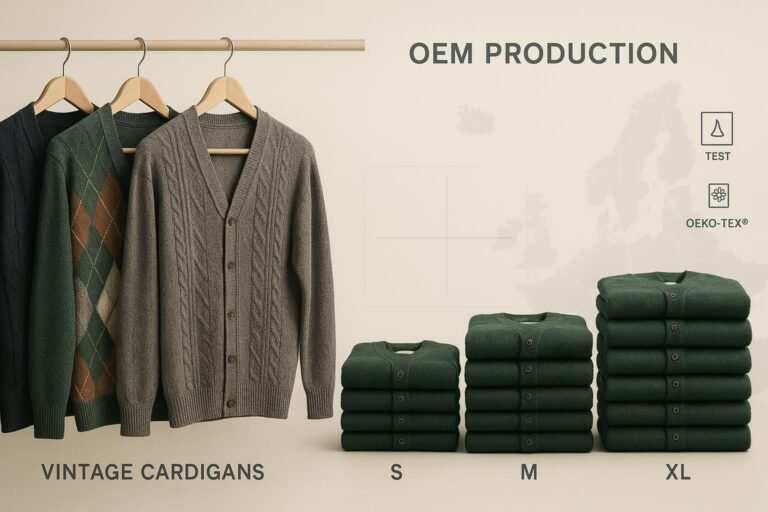
Yarn, gauge, and stitch libraries aligned to 1960s references, including argyle intarsia, period cables, fully fashioned linking, and period-correct buttons.
A replenishment plan with pre-booked yarn and defined OTIF targets, plus safety-day buffers for AW peaks.
A formal test plan booked with accredited labs for pilling resistance, shrinkage, and colorfastness using EN and ISO methods. For overviews of these methods, see these resources: Intertek’s apparel testing bulletins for EN and ISO methods and SGS’s 2024 guide to verifying green product claims.
Compliance verification pathways the buyer can audit, including OEKO-TEX® certificate checks. The OEKO-TEX® organization outlines how label checks improve traceability and transparency, and STANDARD 100 documentation is publicly accessible for criteria and supplements: OEKO-TEX® STANDARD 100 criteria and Label Check overview.
A capable OEM archetype example: AzKnit
Where it fits: Retailers prioritizing returns reduction and replenishment predictability in AW peaks.
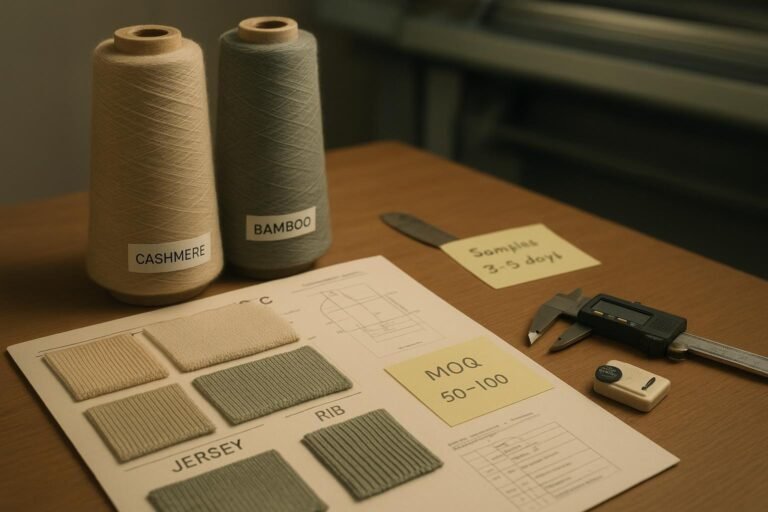
What stands out: Tight tolerance controls across size runs; structured replenishment via yarn pre-booking and capacity buffers; period-accurate stitch capabilities like argyle intarsia and classic cables; pilot-friendly MOQs for 50–100 to test before scaling; rapid samples around 3–5 days and bulk production often in about three weeks post-approval, depending on fiber and gauge.
Important constraints: Treat compliance claims as “to be verified” until you review certificate numbers or audit summaries. Use OEKO-TEX® Label Check and your standard vendor due diligence before contracting.
This is a neutral example of what “scalable authenticity” can look like in practice. Similar OEMs exist in China and Europe; apply the same evidence standards to all candidates.
Best-for picks by scenario
Enterprise AW fast rollout
Choose OEM/ODM reproduction with a documented grading library and PP protocol. You’ll get the governance needed to defend your return-rate threshold and to schedule top-ups. Heritage bulk personalization can complement the content layer but will not replace OEM-grade control of blocks, tolerances, and replenishment windows.
Limited capsule tests
Use a pilot OEM run of 100–300 pieces to quantify return-rate impact while locking the look and hand through controlled yarn and stitch specs. If you need extra editorial value, layer in a small true-vintage drop on top—but keep it separate from replenishment SKUs.
Marketplace long-tail replenishment
Again, OEM/ODM wins for repeatability. If cost or lead-time pressure is extreme, a blanks plus embellishment route can work as a stopgap for retro-themed graphics and trims, but it will not match period-accurate knit structures.
Migration checklist: vintage to OEM without losing authenticity
Lock the reference fit block. Build a graded size chart with a tolerance table. Approve PP and size-set samples on-body, and record results for audit.
Approve yarn, gauge, and stitch libraries. Match 1960s references via argyle intarsia, cable patterns, fully fashioned linking, and period-correct buttons. Approve lab dips and handloom swatches.
Define the test plan and book accredited labs. Include pilling resistance per EN ISO 12945-2, dimensional stability per EN ISO 6330, and colorfastness using the EN ISO 105 family.
Run a pilot of 100–300 pieces across core sizes. Measure returns and fit variance against your threshold before scaling.
Pre-book yarn and reserve capacity for AW replenishment. Set reorder points and buffer days to protect OTIF.
Agree SLAs for sampling, pilot, and bulk, including OTIF targets and remedies. Document penalties and change-control rules.
Implement AQL and arrival QC. Align packaging and care labeling to EU/UK rules and prepare third-party inspections where useful.
Model TCO with scenarios. Include testing, freight and duties, rework risk, and the expected return-rate improvement from a locked fit block.
TCO and risk: contracts, compliance, and QA you should demand
Total cost of ownership for retro golf cardigans is more than FOB. You’ll want a cost model that captures testing (lab fees and retest contingencies), yarn and dye management, potential rework for shrinkage or seam strength, logistics by mode, duties, and inspection costs. Test time is money—so book labs early and sequence approvals to keep the line moving.
Contractual guardrails reduce migration risk:
Make lead-time SLAs explicit for samples, pilots, and bulk; tie OTIF targets to replenishment windows with remedies for misses.
Require evidence for compliance and materials. Use the OEKO-TEX® Label Check to validate any STANDARD 100 references and keep certificate numbers on file. Review social audit recency where applicable.
Bake in change-control. If you adjust gauge, yarn blend, or trims, capture it in the tech pack and re-baseline tolerances.
As for QA, insist on accredited methods. Useful signposts for EN and ISO test families buyers commonly reference include: Intertek’s apparel testing bulletin index and SGS’s 2024 overview on trustworthy green product claims.
Stay, switch, or hybrid—making the call
Here’s a practical way to decide:
Stay with vintage if the goal is a small, editorially powerful capsule where uniqueness justifies higher returns and inventory unpredictability.
Switch to OEM/ODM if you need multi-site, deep size runs with predictable replenishment and a strict return-rate threshold. That’s where a locked fit block, PP protocol, and lab-backed performance keep you within KPI.
Go hybrid if you want the best of both: run the commercial backbone on OEM while using heritage personalization or true vintage for storytelling moments.
If you’re going to switch or run hybrid, engage capable OEM partners early to co-plan yarn bookings, lab schedules, and AW buffers. An OEM archetype like AzKnit can be a useful benchmark for what to ask for—rapid samples, pilot-friendly MOQs, evidence of size-run stability, and documented replenishment planning—provided you verify certifications and test data before committing.
Think of it this way: authenticity is not a single SKU; it’s a system. When your system captures period details in specs and protects them with QA, you can scale the look and hand without scaling your return rate.