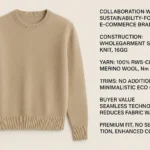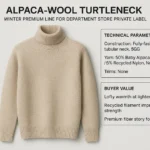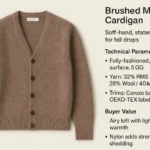

Recycled cashmere can be beautiful and responsible, yet it is often judged against virgin cashmere on pilling and long-term shape retention. The path to dependable wear is not luck—it’s engineering. This guide distills reproducible choices for a 12-gauge minimalist crewneck, focusing on blend ratios, yarn structure, stitch density, machine tension, and finishing, then shows how to validate outcomes with recognized lab methods.
Key takeaways
Start with a reproducible blend strategy that increases mean fiber length and cohesion. Balance recycled cashmere with virgin cashmere or fine wool, and consider small nylon reinforcement only where abrasion is high.
Engineer the fabric at 12 gauge using controlled stitch density and loop length. Tighter structures typically improve pilling and abrasion, but you must re-balance handfeel via yarn twist and finishing.
Validate claims with lab methods. Use ISO 12945-2 for pilling and ISO 12947-2 for abrasion, and control dimensional change with ISO 6330. Define acceptance targets before testing.
Treat finishing as a durability lever. Gentle wet processes and careful drying and steam stabilize dimensions and reduce fuzzing without damaging the hand.
Reproducible blend strategy for recycled cashmere durability
Durability in recycled cashmere depends first on the fiber system. Mechanical recycling often shortens fibers and widens length distribution. That makes cohesion and resistance to fuzzing harder to achieve. Industry guidance on pilling mitigation is consistent across wool-family fibers: longer mean fiber length, higher yarn twist within safe ranges, and a fabric with sufficient cover factor help resist pill formation, as explained by Woolmark’s overview of pilling causes and remedies in its care resources: the Woolmark article What is pilling describes how surface hairiness and abrasion drive pills and how twist and structure reduce them through better fiber entanglement control.
With that mechanism in mind, here is a practical starting framework for a 12GG minimalist crewneck. Use it as a test plan, not as final truth—every mill’s yarn and finishing line will require tuning.
Premium handfeel with improved wear: Blend recycled cashmere with virgin cashmere or fine merino to lift mean fiber length. Begin with a majority share of virgin or merino to stabilize cohesion, then increase recycled content as tests allow. Prefer two-ply yarns to reduce weak points versus singles, and request a slightly higher twist than a pure-virgin control to reduce surface hairiness while staying within the spinner’s safe range for handle. Beware of over-twist, which can feel stringy; recover softness via finishing and stitch density rather than twist alone.
Reinforced abrasion zones: Where sleeve forearms or backpack-contact areas see friction, pilot a small nylon reinforcement share within the yarn blend. The goal is to lift abrasion cycles without a noticeable handfeel penalty. Keep nylon modest and test both full-garment blends and targeted reinforcements via plating or localized structures. Validate by blind wearer trials alongside lab tests to ensure the aesthetic still reads as cashmere.
Price-sensitive lines: A higher recycled share can be feasible when you tighten the structure at 12GG and manage hairiness through twist and finishing. Monitor pilling grades closely as recycled share rises; steer away from loose singles in jersey if early tests show fuzzing. Remember that density for durability can reduce drape; use finishing to restore some softness without raising fuzz.
Why this works: Pilling begins with loose surface fibers forming fuzz; abrasion turns fuzz into pills. Longer fibers and stronger yarn cohesion reduce free ends, and tighter fabric structures make it harder for fibers to migrate to the surface. Woolmark’s explanation of pilling mechanisms provides the technical rationale in accessible language. See Woolmark’s care and pilling resources for the underlying logic on length, twist, and cover factor.
12GG engineering for durability and handfeel
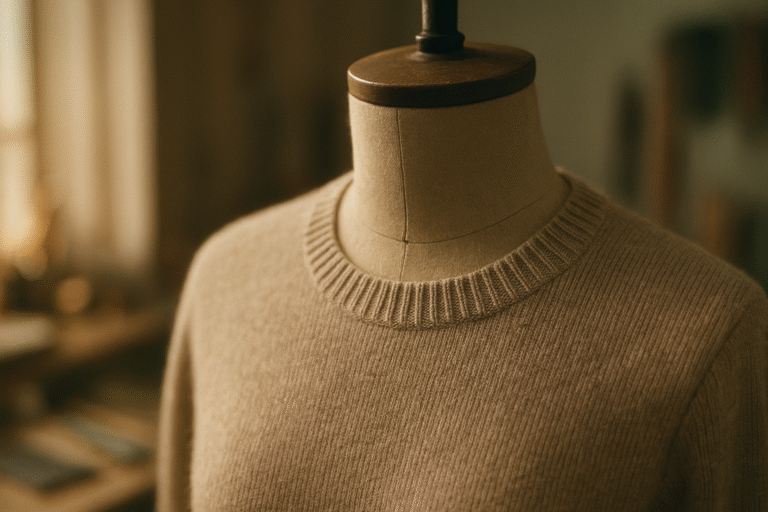
At 12 gauge, most minimalist crewnecks use jersey body with rib trims. Two variables do most of the heavy lifting for recycled cashmere durability: stitch density and loop length. Tighter settings reduce fiber mobility and raise abrasion cycles, while looser settings often feel plusher but pill earlier. The art is to pair a moderate increase in density with yarn twist and gentle finishing so the fabric still reads as soft and refined.
A practical swatch plan: Produce a small matrix of panels that vary stitch density and loop length across two or three yarn twist levels provided by your spinner. Keep everything else constant, then measure lab outcomes and feel. Document machine dials, yarn batch IDs, ambient conditions, and finishing notes directly on a swatch log so you can reproduce the best option at bulk scale.
Below is a simple example of a 12GG swatch matrix you can hand to a knitting room. Values are placeholders for the experiment layout; enter your actual dials and measured results after testing.
Swatch ID | Yarn twist level | Stitch density setting | Loop length target | Expected handfeel note | Lab tests to run |
|---|---|---|---|---|---|
A1 | Lower | Tighter | Short | Crisp surface, less drape | ISO 12945-2 pilling, ISO 12947-2 abrasion, ISO 6330 wash |
A2 | Lower | Medium | Medium | Softer, risk of fuzz | ISO 12945-2 pilling, ISO 12947-2 abrasion, ISO 6330 wash |
B1 | Medium | Tighter | Short | Balanced handfeel | ISO 12945-2 pilling, ISO 12947-2 abrasion, ISO 6330 wash |
B2 | Medium | Medium | Medium | Soft with control | ISO 12945-2 pilling, ISO 12947-2 abrasion, ISO 6330 wash |
C1 | Higher | Tighter | Short | Firmer, durable | ISO 12945-2 pilling, ISO 12947-2 abrasion, ISO 6330 wash |
C2 | Higher | Medium | Medium | May feel stringy if over-twisted | ISO 12945-2 pilling, ISO 12947-2 abrasion, ISO 6330 wash |
How to interpret results: If pilling grades lag at moderate density, tighten one step and retest before pushing twist further. If handfeel suffers at high twist, step back on twist and recover control via stitch density and finishing. For rib trims, run stability checks at a slightly tighter setting than the body, then confirm relaxation and linking tensions so cuffs and hems do not flare.
Finishing that preserves strength and shape
Finishing can either lock in stability or introduce new problems. For cashmere and cashmere blends, gentle wet processing and controlled drying keep fibers from felting and reduce surface fuzzing without destroying the hand. Consumer-facing guidance from Woolmark underscores why low heat, gentle detergents, inside-out washing, and flat drying maintain structure and appearance in wool-family fibers. The same logic applies on industrial lines—only with tighter process control. Woolmark’s guidance on how to wash wool in a machine and its general care pages set the principles that finishing teams translate into SOPs: temperate baths, compatible detergents, measured time, and careful steam to set shape.
Because numeric recipes vary by equipment and chemistry, treat finishing parameters as site-specific. Run 2–3 pilot finishes against your best swatches, then confirm dimensional change via standard wash procedures. If a finish softens the hand but depresses pilling grades, rebalance with slightly tighter structure rather than pushing twist beyond safe feel.
Validate with ISO test methods and clear targets
Durability claims need shared yardsticks. For knitwear, two lab methods cover the core risks and a third controls shrinkage.
Pilling: Use ISO 12945-2, the modified Martindale method for knitted fabrics. It rates pilling on a 1–5 visual scale after defined rub cycles. The official catalogue description of ISO 12945-2 explains the method and reporting requirements and is suitable for referencing in specifications. Link the method in your tech packs by citing ISO 12945-2 and stating the cycle counts and grade target. See the ISO 12945-2 catalogue page for details.
Abrasion resistance: Use ISO 12947-2 to report cycles to specimen breakdown on the Martindale. This provides a comparable measure of how long the fabric resists wear under standardized conditions. See the ISO 12947-2 catalogue page for the method overview.
Dimensional stability after laundering: Use ISO 6330 to standardize domestic washing procedures in the lab and verify length and width change after defined cycles. This helps you tune finishing and care instructions so the crewneck keeps its shape. The ISO index page lists ISO 6330 among standard methods.
Set acceptance targets before testing so teams know what success looks like. For example, a brand may set a minimum pilling grade at a given cycle count for its price point, define a cycle-to-breakdown minimum on abrasion, and cap length or width change after several wash cycles. Your test lab will run the methods and provide grades, cycle counts, and dimensional change values as standard outputs.
For production control, many apparel brands use AQL sampling based on ANSI ASQ Z1.4 or ISO 2859-1 when inspecting softlines. SGS describes this approach in its note on selective inspections, which clarifies how lot sampling and acceptance work in the field.
Composite anonymized client case
Disclosure: The scenario below is an illustrative composite that mirrors common brand objectives and factory practices. It shows how blend and structure changes can improve recycled cashmere durability in a 12GG crewneck when validated by independent labs. Treat the numbers as directional ranges to plan your own testing.
Context: A 12GG minimalist crewneck in jersey body with 1×1 rib trims experienced early pilling complaints and minor hem flare after repeated wears.
Interventions: The team shifted from a high recycled share toward a balanced blend with additional long-staple virgin cashmere to lift cohesion; a separate pilot added modest nylon reinforcement for abrasion-prone zones. Structure was increased one notch at 12GG with a matched loop length adjustment; yarn stayed two-ply, and twist was moderated to avoid a stringy feel. Finishing was tuned for a softer hand without raising fuzzing, and steam set was controlled for shape retention.
Validation approach: The brand ordered ISO 12945-2 pilling tests at defined cycles and ISO 12947-2 abrasion cycles to breakdown, plus ISO 6330 laundering for dimensional change. All tests were performed by an accredited lab, with targets set before testing.
Observed outcomes: Pilling grades improved by one to two steps at the same cycle count versus the original recipe, with the balanced-blend route outperforming the nylon pilot on handfeel at equal density. Abrasion cycles increased materially relative to the starting point, with the denser structure carrying most of the gain. Dimensional change after repeated wash cycles stayed within the brand’s tolerance once the finishing and steam set were tuned; hem flare was eliminated through tighter rib settings and careful linking tension.
Trade-offs and learnings: Excessive twist hurt handfeel more than it improved pills, so structure and finishing were the better levers after a moderate twist increase. Nylon reinforcement is most useful in targeted applications; full-garment use can change the aesthetic if overdone.
How a factory tunes gauge and tension in practice
Disclosure: AzKnit is an OEM and ODM knitwear manufacturer. The example below shows a neutral, non-promotional view of how a factory team might iterate settings on a 12GG minimalist crewneck to balance softness and recycled cashmere durability.
Process snapshot: Baseline swatch A used a medium stitch density and loop length with a two-ply yarn at the spinner’s standard twist. Handfeel was soft but early pilling grades were below the target. Adjustment 1 increased stitch density by one step while keeping loop length short to limit hairiness; pilling grades rose with a minor loss in drape. Adjustment 2 backed off twist slightly to recover hand, then compensated with a controlled wet finish; this preserved the improved pilling results while restoring a softer hand. Adjustment 3 tightened rib trims relative to the body and verified linking tensions to prevent flare and maintain a clean line at cuffs and hem.
Documentation: Each iteration was logged in a swatch report with machine dials, yarn batch IDs, and finishing notes. The final recipe was handed to bulk with the lab reports attached and a monitoring plan that tied first-lot inspections to the same acceptance targets.
Next steps for your sampling and lab work
Draft a 12GG swatch matrix that varies stitch density and loop length across two or three twist levels using your intended blends. Run ISO 12945-2, ISO 12947-2, and ISO 6330 on the top candidates at an accredited lab. Define acceptance targets in your tech pack before testing, and keep a concise log that connects machine settings to lab results so the winning recipe is reproducible from sample to bulk. If you need a factory partner to run controlled swatches and prepare lab-ready samples, AzKnit offers rapid prototyping with documented gauge and tension settings.
References and further reading
Pilling mechanisms and mitigation for wool-family fibers: Woolmark What is pilling — https://www.woolmark.com/care/what-is-pilling/
Machine washing guidance and general care principles that inform finishing logic: Woolmark — https://www.woolmark.com/care/can-i-wash-wool-in-the-washing-machine/ and https://www.woolmark.com/care/general-care/
ISO 12945-2 catalogue entry for pilling assessment on knitted fabrics — https://www.iso.org/standard/75373.html
ISO 12947-2 catalogue entry for abrasion cycles to breakdown — https://www.iso.org/standard/68287.html
ISO index listing for ISO 6330 domestic washing procedures — https://www.iso.org
SGS note referencing ANSI ASQ Z1.4 AQL sampling for textile inspections — https://www.sgs.com/en-kz/news/2023/11/sgs-offers-final-selective-inspections-of-textile-products