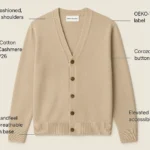

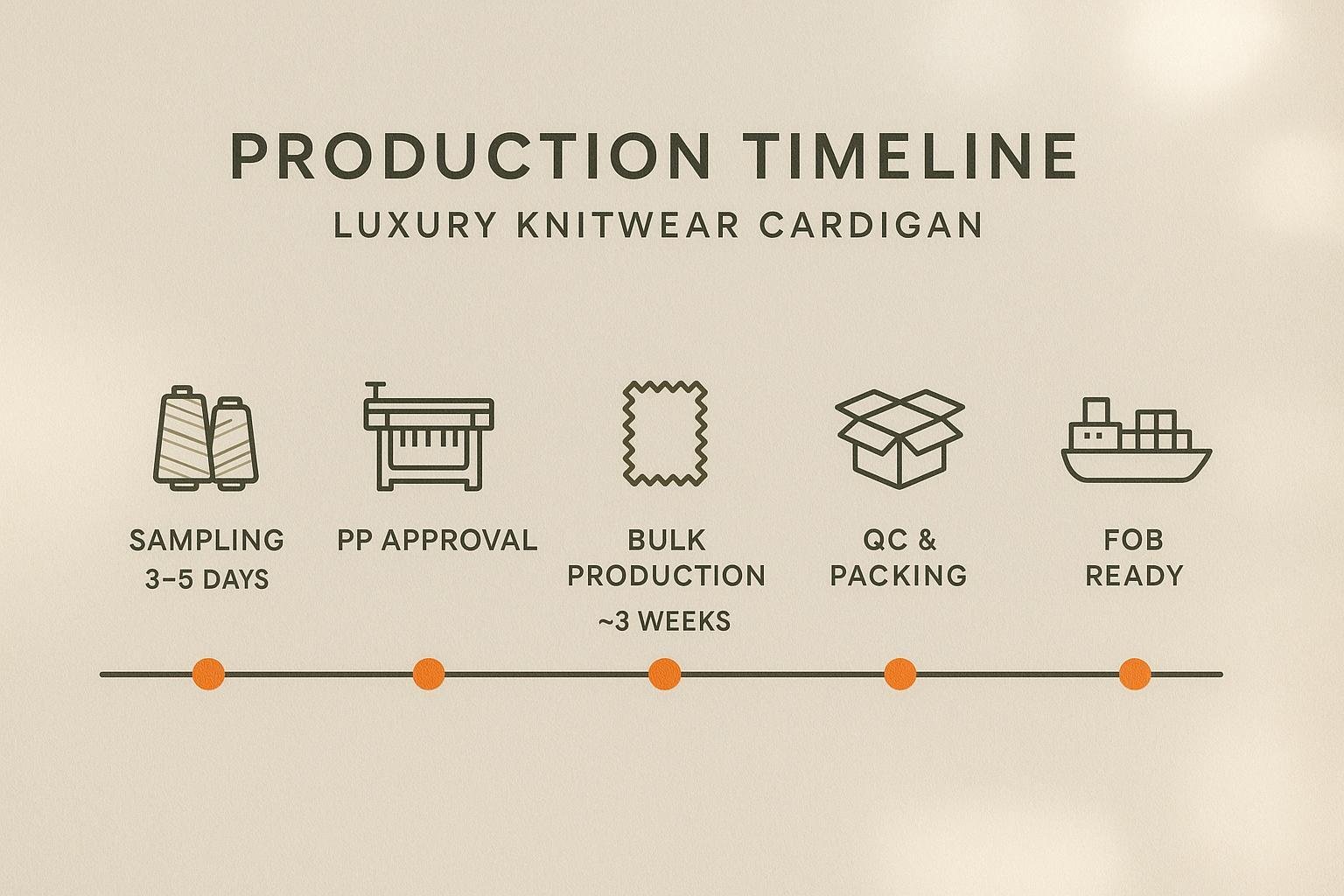
Getting a firm date for a luxury knit isn’t guesswork. Here’s the deal: under our defined Option 1A scope, 2–3‑ply cashmere cardigan samples ship in 3–5 working days, and bulk production is typically ready for FOB hand‑off in about 3 weeks after final approvals—assuming in‑stock yarn shades and standard trims.
Key takeaways
Sampling SLA: 3–5 working days once your tech pack, gauge, and an in‑stock color‑card shade are confirmed.
Bulk SLA: ~3 weeks from PP/final sample approval and PO confirmation, provided production materials and trims are on hand.
Scope (Option 1A): Uses in‑stock yarn library and in‑stock color‑card shades, standard molds, and general trims—no custom dyeing, no special crafts.
Primary delay drivers: custom dyeing/lab dips and late materials/trim arrivals (including certificate checks).
Logistics: FOB China is the baseline; DDP door‑to‑door quotes with landed‑cost components (duties/clearance) are available.
MOQs: From 50 pieces under Option 1A.
What does the 3–5‑day sampling SLA include?
Short answer: sample knitting and finishing within 3–5 working days begin once we lock your tech pack, machine gauge, 2–3‑ply cashmere spec, and an in‑stock shade code from the color card. Photos are shared for quick approval before dispatch. For process context, see the sampling workflow on the official page in Samples & Swatches & Mockups at AzKnit’s site in the article titled “Samples, Swatches & Mockups.”
Reference: See the sampling overview in the AzKnit knowledge base: sampling and swatches process.
What’s inside the SLA window:
Scheduling on appropriate gauge machines for 2–3‑ply.
Knitting, linking, washing/finishing to target hand‑feel.
Basic labels/packaging for sample shipment.
What’s outside (adds time):
New color development (lab dips/custom dyeing).
Special crafts (e.g., complex jacquard, full‑fashioning with unusual panels, heavy washes, hand‑sewn details).
Customer‑supplied trims that haven’t arrived yet.
When does the ~3‑week bulk clock start, and what’s inside it?
Short answer: the ~3‑week timer starts after your PP or final sample is approved, the PO is confirmed, and all production materials and general trims are physically on hand. That span includes knitting, finishing, in‑process checks, final inspection, packing, and FOB readiness.
Inside the ~3 weeks (typical flow):
Inline knitting and finishing for the approved density and hand‑feel.
PP/size‑set cadence aligned with your approvals calendar.
Final inspection, packing, and documentation for FOB.
For an overview of custom production steps, see: custom knitwear production summary.
Practical example (neutral brand mention)
Disclosure: AzKnit is our factory partner.
A 200‑piece, 2‑color 2–3‑ply cashmere cardigan using in‑stock shades and general trims:
Day 0: PP approval + PO confirmed; trims verified in‑house.
Days 1–14: Bulk knitting and finishing.
Days 15–19: Final inspection, packing, export docs.
Days 20–21: FOB ready; forwarder collects per booking.
What MOQs apply under Option 1A?
Under Option 1A, minimum order quantities start from 50 pieces for 2–3‑ply cashmere cardigans. Per‑color splits are feasible when shades come from the in‑stock color card and machine changeovers remain efficient. If a shade or trim is not in stock, or if special crafts are requested, MOQs and timeline may need adjustment.
What usually extends cashmere cardigan production lead time?
Two drivers create the largest extensions:
Custom dyeing and lab dips: New colors require lab dips and buyer approvals. Each lab‑dip round commonly adds about 10–15 working days before bulk materials are ready, and multiple rounds are not unusual. For background on lab‑dip procedures and why they take time, see the industry explainers on dye‑lab workflows by Testex and TextileLearner: working process of dyeing labs and lab dip calculation and procedures.
Materials and trims readiness (including certificate checks): Bulk cannot proceed until all production‑intended materials and trims are on hand. Late customer‑supplied labels/zippers/hangtags or pending certificate verifications pause the start clock for bulk. General pre‑production guides show that approvals and material alignment are common timeline gates; see overviews from product‑development platforms: pre‑production processes for apparel manufacturing and apparel production stages primer.
Secondary contributors (context only):
The cadence of PP and size‑set approvals on the buyer side.
Third‑party testing or inspections scheduled pre‑shipment.
Peak‑season capacity or holidays (Lunar New Year, Golden Week) that strain factory and logistics slots; carriers advise planning buffers around those periods. See the DHL Golden Week advisory for impact patterns.
FOB vs DDP—how do timelines and landed cost change?
FOB China: Seller readies goods for loading at the named port; risk transfers once onboard. Buyers arrange main carriage, insurance (optional), import clearance, duties, and taxes. ICC clarifies risk transfer and responsibilities under Incoterms 2020; see the FOB guidance from ICC Academy.
DDP (Delivered Duty Paid): Seller arranges end‑to‑end transport and handles import clearance, duties, and taxes to the named destination; risk transfers on delivery ready for unloading. ICC outlines obligations here: DDP responsibilities under Incoterms 2020.
Transit windows vary with market conditions and routes; confirm with your forwarder at booking time. For US/EU duty lookups on knitted cashmere apparel (typically HTS/CN 6110 family, exact code depends on construction and gender), consult the official portals: USITC HTS search and the EU Access2Markets tool.
For AzKnit’s standard shipping and documents, carriers, and optional insurance, see the policy overview: shipping and payment options.
Day‑0 checklist to hit the SLA
Have these items ready before the clock starts:
Complete tech pack or approved reference with measurements, construction notes, finishing targets, labels/packaging.
Confirm 2–3‑ply cashmere spec, machine gauge, and an in‑stock shade from the color card (no lab dips).
Confirm general trims are in stock or confirm arrival dates for any customer‑supplied components.
Approvals calendar (PP, size set) and target ship window.
Incoterm selection (FOB baseline; request DDP quote if you need a landed‑cost view).
Example timelines (Option 1A vs with lab dip)
Below is an illustrative comparison of typical paths. Actual dates depend on approvals cadence and booking confirmations.
Scenario | Sampling | Approvals | Bulk + QC/Pack | Ship Readiness |
|---|---|---|---|---|
Option 1A (in‑stock shade; general trims) | 3–5 working days | PP/final approvals per your calendar | ~14–19 working days | ~Day 20–21 FOB ready |
With lab dip/custom dye | 3–5 working days | +10–15 working days per lab‑dip round | ~14–19 working days after materials ready | Add lab‑dip time before FOB readiness |
After‑sales and quality assurance
We use standard quality concepts to gate shipments:
AQL (e.g., Level II / 2.5 for major defects under ISO 2859/ANSI/ASQ Z1.4) determines sample sizes and accept/reject numbers at final inspection. See QIMA’s AQL explainer for methodology.
DHU (Defects per Hundred Units) and RFT (Right First Time) are tracked to maintain consistent outcomes. When post‑delivery issues are verified as manufacturing defects, remediation options typically include replacement, partial credit, or rework depending on severity and timing. Response and resolution SLAs can be aligned to your program needs during contracting.
What to do next
Share your tech pack and target window to receive a precise schedule and, if needed, a DDP landed‑cost quote alongside the FOB plan.