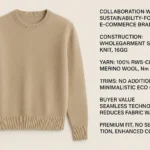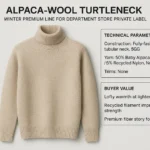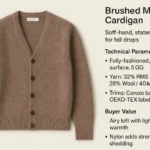

Thick, sculptural cables are the soul of a fisherman sweater. But turning that aesthetic into a reliable, scalable product at 3–5GG within an FOB €18–28 target demands more than taste—it requires the right yarn route, defensible testing, and tight sampling-to-bulk control. If your KPI is fewer returns from pilling and wash shrinkage, what’s the most dependable path?
This guide answers that question with a bias toward RWS Merino (18.5–21.5 μ) and a secondary cotton/wool option for shoulder-season capsules. We’ll keep the tone auditable, cite standards where relevant, and focus on decisions that protect margin and on-time launch.
Key takeaways
For deep cable relief at 3–5GG with soft hand and traceability, RWS Merino is the primary route; use superwash variants to reduce shrinkage-related returns, guided by care advice from the Woolmark organization.
To hit durability targets and lower pill complaints, consider wool/nylon blends engineered with appropriate twist and ply, then validate with ISO 12945 pilling and ISO 12947 abrasion screening.
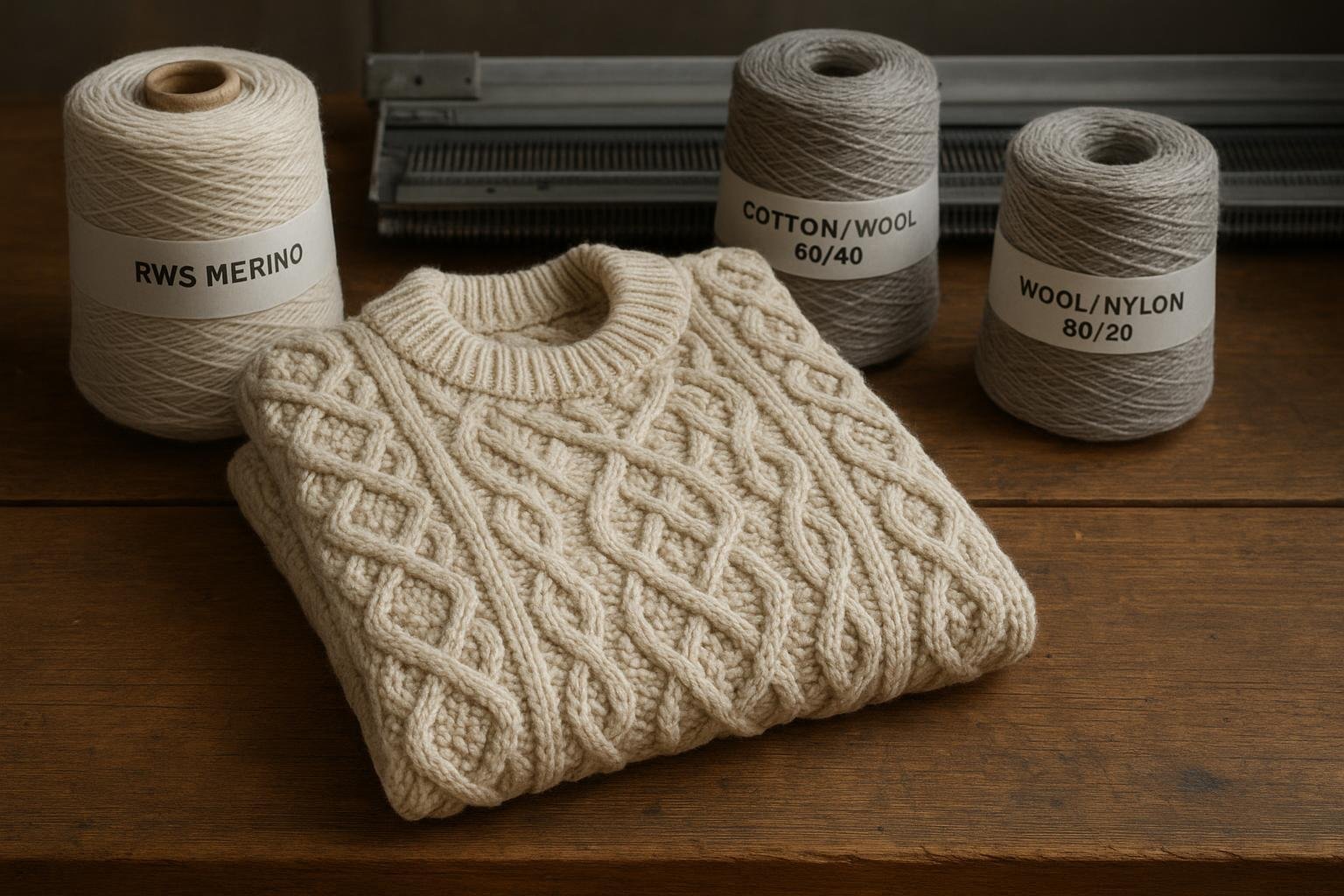
Cotton/wool ≈60/40 supports low-sensitivity positioning and shoulder-season wear but will soften cable “pop”; counter with tighter structures at 5GG and smaller repeats.
Keep compliance verifiable: use RWS chain-of-custody, OEKO-TEX Standard 100 for harmful substances, and, where relevant, GRS documentation for recycled inputs.
Lock a sampling SOP that includes method-defined test targets, pre- and post-wash swatch checks, and certificate verification before approving bulk lots.
Quick decision matrix for 3–5GG fisherman sweaters
Yarn route | Cable loft and hand | Durability tendency | Wash care expectation | Compliance notes | Typical use case |
|---|---|---|---|---|---|
RWS Merino 18.5–21.5 μ (superwash optional) | Excellent loft and soft, substantial hand; strong cable definition at 3–5GG | Moderate; construction controls needed to manage pilling | Machine wash feasible with superwash treatment per wool care guidance | Traceable animal welfare via RWS; verify scope and TCs | Core range with sculptural cables and skin-friendly comfort |
Wool/Nylon 90/10 or 80/20 | Very good relief; slightly firmer hand; nylon reinforces stress points | Stronger abrasion/seam strength; watch visible pill retention | Standard wool care; confirm label claims via laundering tests | Use OEKO-TEX Standard 100 for chemical safety on yarn/garment | Durability-led SKUs and higher-wear silhouettes |
Cotton/Wool ≈60/40 | Softer cable “pop,” cooler touch; reduced thermal loft | Moderate; cotton moderates fuzz but can reduce recovery | Easier care perception; verify shrinkage and dimensional change | OEKO-TEX Standard 100 for dyestuffs/auxiliaries | Low-sensitivity, shoulder-season capsules |
Recycled wool blends with GRS | Authentic wool hand; potential variability in handle/loft | Variable due to staple length; strict validation required | Standard wool care; confirm appearance after wash | GRS chain-of-custody and claims policy | Value tiers with sustainability emphasis |
Why RWS Merino is the primary route for commercial Aran cables
If your mandate is the best yarn for fisherman knit sweater outcomes—thick, high-relief cables that photograph beautifully and feel premium—RWS-certified Merino in the 18.5–21.5 μ band is the most balanced choice. Its fine diameter and natural crimp trap air, giving you both loft and elasticity. That elasticity helps cables spring back after wear, keeping the sweater’s sculptural lines intact.
Traceability and animal welfare: The Responsible Wool Standard provides verified chain-of-custody and animal welfare requirements across the supply chain. See the standard overview from Textile Exchange in the official resource on the Responsible Wool Standard for details on scope and claims language: Textile Exchange’s Responsible Wool Standard page.
Wash-care confidence: To reduce returns from shrinkage and distortion, pair Merino with superwash treatments and set laundering instructions in line with Woolmark’s care guidance for detergents and cycles. Practical care principles are summarized by Woolmark’s consumer and industry resources; start with this care hub: Woolmark care guidance on washing wool.
Risk to manage: very fine fibers can show surface fuzz if yarn construction is too relaxed. Specify appropriate twist and ply and validate on swatches using ISO pilling tests (see the testing section below). Think of twist as the “binding energy” that keeps fibers from migrating to the surface when those big cables move.
Alternatives by objective
Wool/nylon blends for durability
When return-rate pressure is driven by abrasion at elbows and high-wear seams, a 90/10 or 80/20 wool/nylon yarn can lift robustness without sacrificing the wool-forward hand on the outside. Nylon increases abrasion resistance and seam strength, though any pills that do form may cling longer because nylon filaments are tougher. Counter that with firmer twist, appropriate ply, and a finishing route tuned to your target hand. Validate with ISO pilling and Martindale abrasion screening before locking bulk.
Cotton/wool around 60/40 for low-sensitivity and shoulder-season
If your range needs a lower-itch perception and a cooler touch for spring drops, cotton/wool ≈60/40 is pragmatic. Expect slightly flatter cables and lower thermal loft versus 100% wool, because cotton’s smoother fiber lacks the springy crimp that pushes cables outward. Preserve form with smaller cable repeats or by biasing toward 5GG with tighter structures. Lab-test for dimensional change and colorfastness under the wash regimen you plan to claim.
Recycled wool with GRS for sustainability and value tiers
GRS-backed recycled wool blends deliver a credible sustainability story, but mechanically recycled inputs often have shorter staples that can influence yarn count options and pilling behavior. Set realistic cable widths to avoid transfer stress at 3–5GG, and validate with the same pilling/abrasion methods you use for virgin routes. Ensure your claims and chain-of-custody documentation align with Textile Exchange’s guidance for recycled materials.
Manufacturability at 3–5GG for deep cable relief
Coarse gauges are your friend for Aran aesthetics, but don’t rely on handknit heuristics alone. Industrial flat knitting at 3–5GG requires swatching to tune cable height, transfer integrity, and post-wash stability. In generalized practice for deep cables, thicker yarns and 2–4 ply constructions help sustain transfer stresses and hold relief. Avoid publishing or accepting vendor-specific machine settings as gospel; instead, demand physical swatches at both 3GG and 5GG, measure cable height before and after laundering, and record any needle-stress artifacts.
Here’s the deal: the same “best yarn for fisherman knit sweater” on paper can behave very differently across machines and finishing routes. Swatches are your truth source—treat them like mini field trials.
Testing and compliance you can audit
Anchor your quality thresholds to recognized methods and verifiable certificates. That way, your claims survive procurement and QA scrutiny across the EU/UK.
Pilling and fuzzing (ISO 12945): Define the method (Part 1 Pilling Box or Part 2 Modified Martindale), exposure time or cycles, and a target visual grade on the 1–5 scale. Present the method name on reports, not just “pilling grade,” and keep pre- and post-wash notes. See the method family overview as cataloged by BSI: BSI summary page for EN ISO 12945 visual assessment.
Abrasion (ISO 12947 Martindale): Use a screening level appropriate for sweaters and state the part you’re using (e.g., Part 2 breakdown). Ensure specimen pressure and endpoint definitions are consistent across trials. A publisher index of the series is available for method scope and parts: ISO textiles index for abrasion methods.
Harmful substances (OEKO-TEX Standard 100): For yarns and finished garments, confirm product class (Class II for adult sweaters is common) and verify certificates via the official Label Check. Keep certificate numbers live and on file. Learn how the program scopes components and classes here: OEKO-TEX Standard 100 overview.
Animal welfare and traceability (RWS): When you cite RWS in product copy, follow the standard language (“contains RWS certified wool”) and maintain chain-of-custody using transaction certificates from certified sites. Program scope and intent are described on the official page: Responsible Wool Standard by Textile Exchange.
Keep external link density reasonable on public pages; your internal QA docs can carry the full lab detail and parameterization.
How to choose the best yarn for fisherman knit sweater at 3–5GG
Make the primary route your default unless your objective demands otherwise. Start with RWS Merino at 18.5–21.5 μ, consider superwash for machine-wash claims, and predefine pilling and abrasion targets by method. If you need higher abrasion strength, evaluate a wool/nylon variant. For low-sensitivity positioning or shoulder-season launches, run cotton/wool ≈60/40. For value tiers with a sustainability story, trial GRS recycled blends with careful validation.
Sampling to bulk in five steps
Define the yarn route and test plan. Pick up to two candidates aligned to the range objective. Pre-commit to methods and targets: ISO 12945 method and grade range; ISO 12947 part and cycles; wash-care regimen aligned to Woolmark-style guidance.
Swatch at 3GG and 5GG. Knit cable panels with the actual construction and finishing you intend to use. Measure cable height before and after laundering; document transfer integrity and any needle-stress marks. Adjust twist/ply if needed.
Verify compliance documents. Collect RWS scope and transaction certificates for Merino routes; OEKO-TEX Standard 100 certificates for yarn and, later, for the garment; for recycled inputs, GRS scope and transaction certificates. Record certificate numbers and validity dates.
Pilot run and PP tests. Approve a pilot batch on bulk-representative yarn lots. Repeat the pilling/abrasion screen and laundered appearance check. Only then lock colorways and cable maps.
Freeze label claims and bulk schedule. Confirm care-label language and ensure any “machine washable” claim is supported by your laundered swatch results. Lock the knitting and finishing calendar with buffer for in-line QC.
Example, not a pitch: a manufacturer like AzKnit can support this SOP by turning 3–5 day swatches on 3–5GG, sourcing RWS Merino and alternatives from nearby hubs, and scheduling ~3-week bulk once PP is approved. The value is procedural—fast swatching, documented tests, and predictable bulk timing—rather than brand-specific magic.
Costing and KPI guardrails for FOB €18–28
Hitting an FOB of €18–28 depends on yarn consumption, cable complexity, and finishing. Coarse gauges with heavy cables increase grams per unit and knitting time, so protect margin by:
Defaulting to RWS Merino with construction tuned for pilling resistance; it lowers return risk while delivering the sought-after hand and relief. Superwash adds processing cost but can reduce shrinkage-related returns and customer service load.
Using wool/nylon where abrasion complaints are common; a slightly lower yarn cost or longer wear life can stabilize margin via fewer replacements.
Deploying cotton/wool ≈60/40 for shoulder-season capsules to broaden size and color depth without overinvesting in heavy winter inventory. Expect a different aesthetic and communicate it clearly.
Think of gauge and cable map as a cost dial: larger, deeper cables at 3GG look dramatic but consume more yarn; smaller repeats at 5GG keep silhouette and budget in balance. Track test outcomes alongside costing so the “best yarn for fisherman knit sweater” isn’t just poetic—it’s measurable in lower return rates and consistent reviews.
Troubleshooting quick wins
Seeing pills after wear-tests? Raise twist slightly or shift to a firmer ply while holding micron and handle steady, then re-run ISO 12945 at the same duration. Losing cable pop on a cotton/wool blend? Tighten structure or reduce cable width and increase frequency. Experiencing post-wash growth on superwash Merino? Recalibrate finishing and confirm laundering parameters match the care label you intend to claim.
Next steps
Select your primary and secondary yarn routes, set method-defined test targets, and commission 3–5GG swatches you can launder and grade—once those numbers look right, everything else falls into place.