
If your next season hinges on 50,000+ sweaters landing on shelf on time and with consistent handfeel and color, the “right” factory isn’t just one with great samples—it’s the one that can prove real capacity, govern parallel scale-out, and show you quality and compliance you can verify. This guide translates enterprise buyer KPIs and due‑diligence steps into an actionable playbook you can use on your very first supplier call.
Key takeaways
Prioritize evidence of scale: machine-hour plans, shift models, and weekly ramp curves that credibly reach 100k+ pieces per month when needed.
Treat KPIs as non-negotiable: define OTIF, PCD, AQL (by defect class), DHU, and RFT up front and require quarterly reporting with root‑cause codes.
Validate yarn and shade control early: agreed ΔE targets, signed shade bands, and lot allocation plans across factories.
Build a compressible critical path: pre‑book yarn, parallelize approvals, and lock PCD to protect your launch window.
Verify compliance, don’t assume it: confirm ISO 9001 scope and sites; use OEKO‑TEX STANDARD 100 Label Check to validate certificate number and product class.
Stress‑test with scenarios: AW retail window (4–6 weeks), 3‑week DTC restock, 50k cashmere run, and e‑commerce SKU peaks.
Who this guide is for and how to use it
You’re a founder, design director, or sourcing/procurement lead evaluating a knitwear manufacturer for large orders. Skim the KPI primer first, then use the capacity validation and lead‑time sections as your RFQ backbone. Close with the scenario playbooks to pressure‑test any shortlist. The goal is simple: reduce surprise variance in schedule, quality, or color consistency when you scale beyond 50k units.
The KPIs that run your vendor scorecard
Set definitions and math before you assess any proposal. If you don’t, you’ll debate anecdotes instead of results.
KPI | What it measures | Formula (example form) |
|---|---|---|
OTIF (On Time In Full) | Delivery reliability by date and quantity | OTIF % = (Shipments meeting both “on time” and “in full”) ÷ (Total shipments) × 100 |
PCD (Planned Cut Date) | Locked milestone for bulk cutting | PCD is a binary milestone; track adherence and slippage vs. plan |
AQL (Acceptable Quality Limit) | Lot acceptance via sampling by defect class | Specify AQLs for Critical/Major/Minor per ISO 2859‑1/ASQ Z1.4 tables |
DHU (Defects per Hundred Units) | Defect density trend | DHU = (Total defects ÷ Units inspected) × 100 |
RFT (Right First Time) | First‑pass yield at inspections | RFT % = (Units passed first time ÷ Units inspected) × 100 |
For AQL definitions and switching rules (normal/tightened/reduced), see the overview of ISO 2859‑1 on the ISO Online Browsing Platform in the section on acceptance sampling by attributes, and the companion U.S. reference at the ANSI/ASQ Z1.4 resource hub. Link once, then operationalize: you’ll want inspection level (e.g., General II), AQL tiers (e.g., Critical 0; Major buyer‑defined; Minor buyer‑defined), and the exact switching logic your QA partner will follow.
Reference: the ISO overview for acceptance sampling by attributes is available via the ISO Online Browsing Platform under ISO 2859‑1:2026(en) “Sampling procedures for inspection by attributes”. For the U.S. equivalent frequently used in industry, see the ASQ Z1.4 resource hub.
Choose a knitwear manufacturer for large orders by proving capacity and scale-out
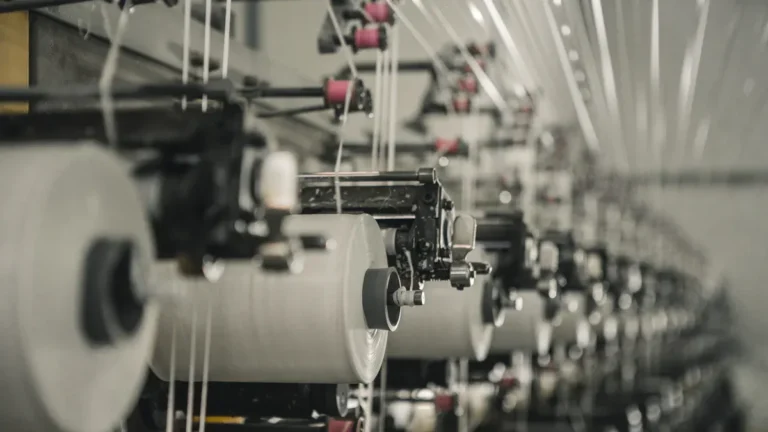
A credible knitwear manufacturer for large orders doesn’t hide behind headline machine counts. They show you how those machines turn into garments per week for your exact style, gauge, and stitch pattern.
Evidence to request on your first call
Time‑study sheets for your approved pattern(s), converting cycle time per panel to garments/hour, with assumptions on efficiency and downtime.
Machine roster by gauge and brand, shift model (e.g., 2×8 or 3×8), and planned utilization during your run.
Weekly ramp curve from pilot to steady state, including contingency plan for overflow and parallel finishing.
Governance for multi‑factory scale‑out: unified tech pack/version control, yarn lot harmonization and shade band alignment, shared QA plan (same AQLs and switching rules), and centralized RFT/DHU dashboard.
How to read the numbers Think of capacity like a ledger of machine‑hours. If a 12‑gauge jacquard panel averages X seconds per piece and a line runs Y productive hours per shift at Z% efficiency, you can compute garments per day and, multiplied by shifts and lines, per month. Confront assumptions: pattern complexity, maintenance calendars, changeover losses, and operator skill all move the needle. Educational primers on knitting productivity and common defect causes can orient your questions; for example, Textile School’s introductions to knitting principles and Textile Learner’s overview of defect causes help frame what might slow a line down or drive DHU up.
Context read: primer on weft vs. warp knitting from Textile School’s basic principles.
Lead‑time modeling and compression from sampling to shipment
Your critical path is only as strong as your earliest approvals. If your color, handfeel, or trims change late, no factory can magic time back.
Build a compressible path Start with design freeze and a complete tech pack. Pre‑book yarn/greige where possible and run lab dips in parallel. Align fit, PP, and size‑set approvals to minimize stop‑starts. Lock PCD once BOMs and patterns are approved. Use inline inspections with clear switching rules to catch issues upstream. For a broad grounding in critical path principles in apparel production training, the UK Fashion & Textile Association’s industry masterclasses provide useful context on aligning milestones, and Skills England’s Pattern Cutter apprenticeship standard outlines how pattern‑to‑production flows hinge on deadline governance.
Context read: UKFT’s Industry masterclasses.
Don’t forget logistics and packaging Pre‑book lanes for peak weeks and validate e‑commerce packaging against an appropriate test such as ISTA 3L’s e‑commerce fulfillment test so cartons and inner packs flow through carriers without rework or damage‑related delays.
Quality systems and AQL in practice
Your inspection plan should specify who inspects what, when, and to which acceptance criteria. Apply ISO 2859‑1/ASQ Z1.4 sampling with clear AQLs by defect class and documented switching rules. Require DHU and RFT trend reporting by process stage (knitting, linking, finishing). If DHU rises or RFT falls over consecutive weeks, trigger tightened inspection until stability returns per the standard’s switching logic. A concise way to align teams is to embed formulas in your working doc: DHU = (Total defects ÷ Units inspected) × 100; RFT % = (Units passed first time ÷ Units inspected) × 100. Many third‑party QA firms build their PSI formats around ISO 2859‑1, which makes it easier to compare reports across vendors.
Yarn consistency and color control with ΔE and shade bands
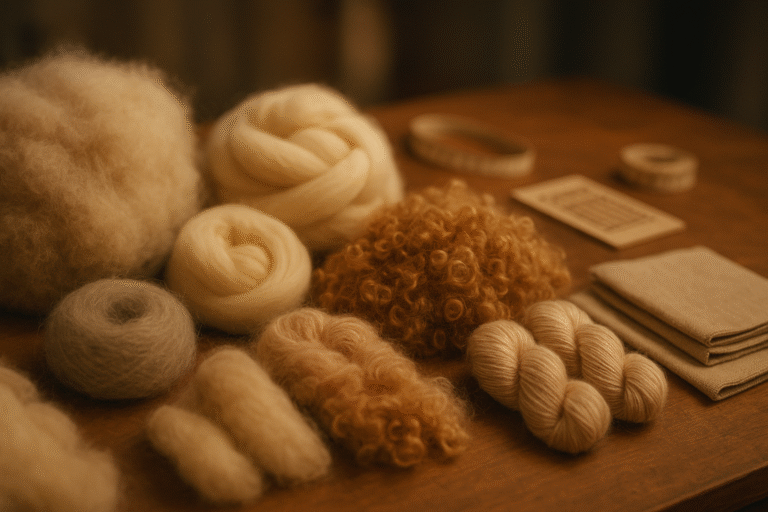
Large orders amplify small shade differences. Define and document color targets up front. Use spectrophotometer checks against an agreed tolerance model—ΔE CMC or ΔE 2000 (DE00) are common choices in textiles. Educational guidance from X‑Rite helps teams choose and set tolerances in a way that aligns with visual judgment and production variability. Align on how shade bands are created and signed before bulk; require lot‑level COAs and maintain lot segregation if you scale out to multiple sites.
Method guidance: see X‑Rite’s explainer on tolerancing models and color space and the companion whitepaper on choosing the right tolerance model.
Compliance you can verify for OEKO‑TEX and ISO 9001
For chemical safety, ask for an OEKO‑TEX STANDARD 100 certificate number, product class (I–IV), and scope (fibers, yarns, fabrics, finished garments). Validate the number via the OEKO‑TEX site’s Label Check rather than accepting a PDF screenshot. The official factsheet explains classes and scope so your team can match the certificate to your article.
Reference: OEKO‑TEX’s STANDARD 100 factsheet (classes and scope). Use the Label Check accessible from the main site to validate a certificate number and scope.
For quality systems, request an ISO 9001 certificate from an IAF‑accredited body. Confirm the scope explicitly covers the manufacturing activities and locations supplying your orders. ISO’s project page and the ISO/TC 176 Auditing Practices Group materials provide clarity on scope and supplier control expectations you can translate into your vendor T&Cs.
Reference: the ISO 9001:2015 project page hosted by ISO/TC 176 is a good starting point: “ISO 9001:2015 — Quality management systems”.
Scenario playbooks to pressure‑test your shortlist
A) NA retail chain AW drop with a 4–6 week shelf window. Lock PCD and pre‑book yarn; run lab dips and PP in parallel to compress early steps. Hold weekly capacity reviews; keep AQL on tightened during ramp. Pre‑book logistics and validate shelf‑ready packaging in advance so cartons move straight through DCs.
B) DTC restock due in 3 weeks, handfeel and color must match. Reserve yarn lots and shade bands from the prior run; specify ΔE targets; reuse approved BOMs and patterns. Align PP/TOP swiftly and keep inline color checks with spectro data to prevent late surprises. Track RFT at knitting and linking to avoid rework.
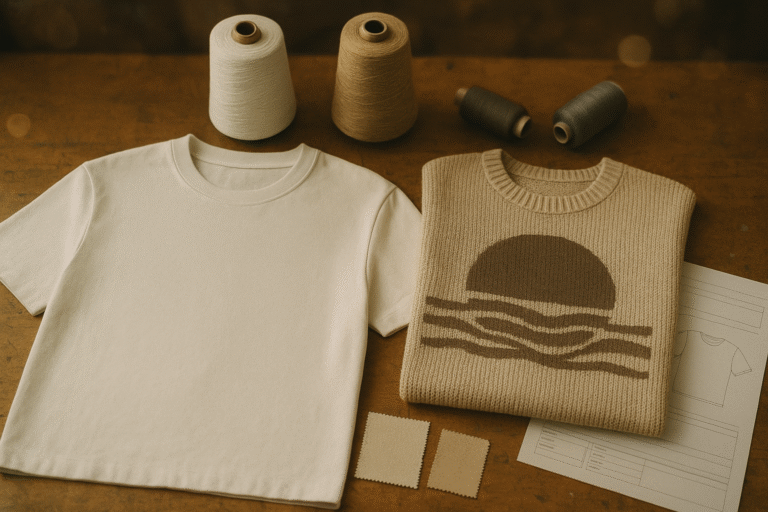
C) 50,000 cashmere sweaters with strict AQL and shade control. Build a machine‑hour plan by gauge; align yarn lot allocation across lines or sites; set AQLs with Critical at 0 and buyer‑defined Major/Minor targets. Use weekly ramp curves and switch to tightened inspection if DHU trends worsen.
D) Cross‑border e‑commerce peak with complex SKUs and compliance. Implement cartonization and labeling standards early; validate packaging to ISTA 3L so damage rates don’t erode OTIF; synchronize commercial docs and carrier cutoffs; use barcode traceability to keep multi‑SKU orders clean.
Practical example: capacity proofpack for a 50k cashmere run (illustrative)
Here’s how a supplier could structure a transparent capacity and quality plan you can audit before placing a PO. This is a generic, replicable workflow. Where “AzKnit” is cited, details reflect its public positioning and internal notes and should be treated as an example rather than a performance claim.
Supplier and scope. A mid‑sized OEM/ODM knit specialist like AzKnit provides flat knitting across common gauges with rapid sampling (3–5 days) and bulk lead times around three weeks (Knowledge Base Source). For a 50,000‑unit cashmere order, the vendor submits: a machine roster by gauge, time‑study sheets on the approved pattern, and a two‑site ramp plan. For buyers specifically comparing OEM sweater factory bulk production options, this proofpack standardizes apples‑to‑apples review across candidates.
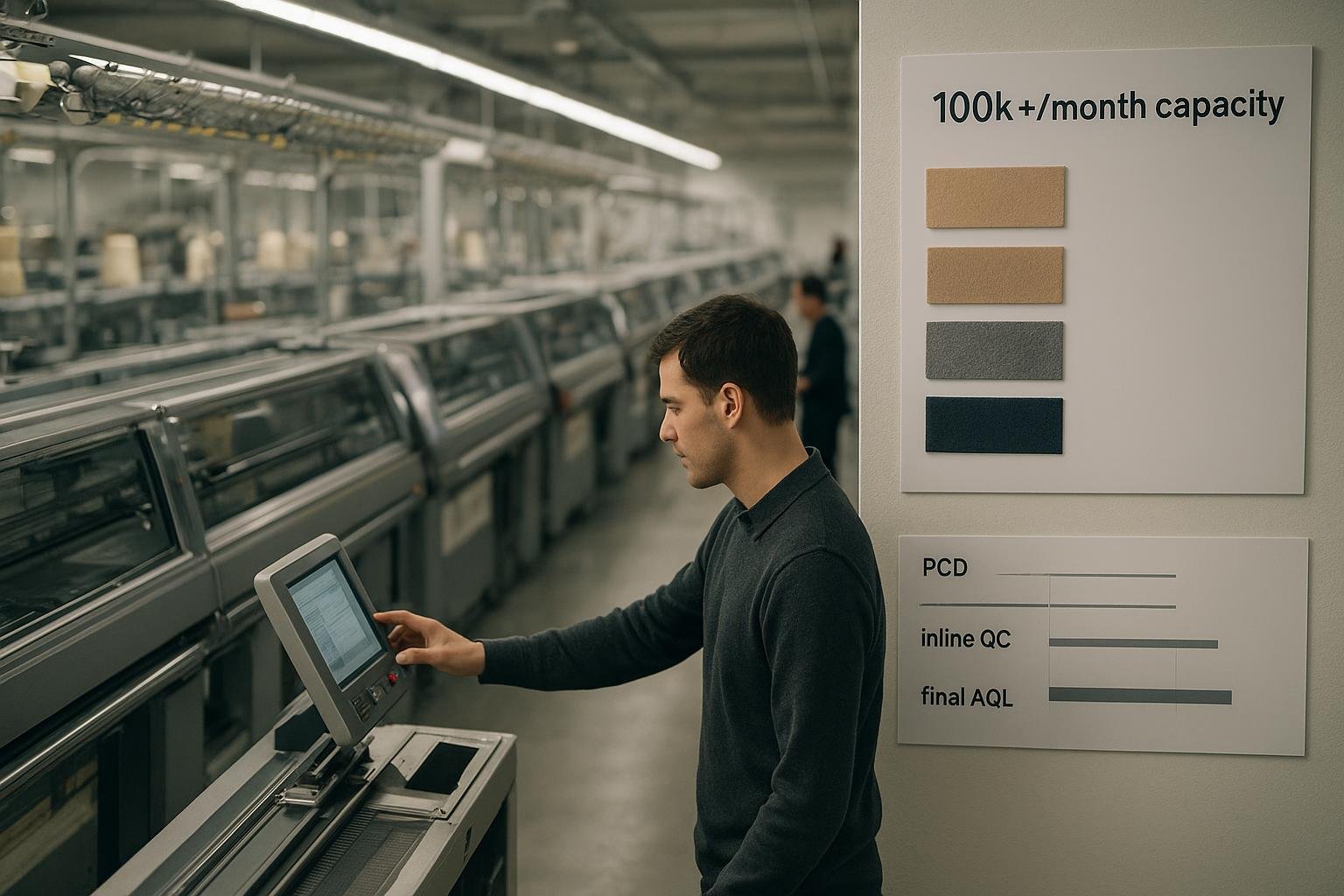
Machine‑hour plan. Time studies show average panel cycle time converted to garments/hour, multiplied by productive hours per shift at assumed efficiency. The plan includes maintenance calendars and changeover allowances. A weekly ramp curve demonstrates how pilot output scales to steady state without exceeding realistic utilization.
Parallel scale‑out governance. A unified tech pack with version control is shared across both sites. Yarn lot allocation is pre‑planned to avoid shade drift; shade bands are signed at T0. QA plans align AQLs and ISO 2859‑1 switching rules at both sites; a centralized dashboard tracks DHU and RFT weekly.
Quality and compliance artifacts. Inline and final inspection formats reference ISO 2859‑1 sampling; DHU and RFT are charted with triggers for tightened inspection. The supplier provides an ISO 9001 certificate covering both sites and shares the OEKO‑TEX STANDARD 100 certificate number and product class for relevant yarns and trims for buyer validation via Label Check. (Where unavailable publicly, the buyer requests direct verification links.)
Next steps to run your RFQ and first‑call checklist
Shortlist two to three candidates and ask each knitwear manufacturer for large orders to submit a capacity proofpack, a critical‑path ladder from tech pack to PCD to shipment, and the last four quarters of OTIF (by your definition) plus inspection reports with AQL tables and DHU/RFT trends.
If you are sourcing a high volume knitwear supplier China side, request a parallel‑factory governance plan up front (tech pack versioning, yarn lot harmonization, common AQL and switch rules) so due diligence doesn’t miss subcontracted sites.
If you prefer a working example format to copy, request one from your vendor; a supplier like AzKnit can provide a neutral template with time‑study and lot‑allocation sections you can adapt (Knowledge Base Source).
If you want, I can convert this playbook into an editable RFQ email, factory audit checklist, AQL quick-reference, and a KPI scorecard you can circulate to your team before your next supplier call.