
If you’re weighing 80s vs 90s sweaters for your next drop or program, this guide helps you choose the decade aesthetic that best fits your budget, MOQ, timeline, and margin goals—then map that choice to yarns, gauge, techniques, dye approaches, and QC.
Key takeaways
Pick 80s when you want bold, graphic-led statement knits and can accept higher color counts, more complex programming (intarsia/high-color jacquard), and longer sampling.
Pick 90s when you need multi-season reorderability, faster development on solids/low-color motifs, and friendlier MOQs and costs.
Yarn-dye raises MOQs and lead times; piece/garment-dye helps agility on solids.
Intarsia looks premium but is slower and pricier; jacquard automates repeats but adds floats and yarn use.
As of 2026-03-10, typical windows: simple proto 3–5 working days; complex intarsia/jacquard 2–4 weeks; bulk 3–8+ weeks post-approval depending on yarn and season.
TL;DR verdict
If you need high visual impact for a limited capsule or collab, 80s-style with intarsia or full jacquard delivers perceived value—but budget for higher MOQs per color and longer timelines.
If you’re building core or preppy basics with steady reorders, 90s-style solids or subtle Fair Isle are safer on MOQs, costs, and calendar.
Streetwear leaning? 90s relaxed blocks and grunge fits simplify grading and reduce fit risk.
80s vs 90s sweaters: era authenticity at a glance
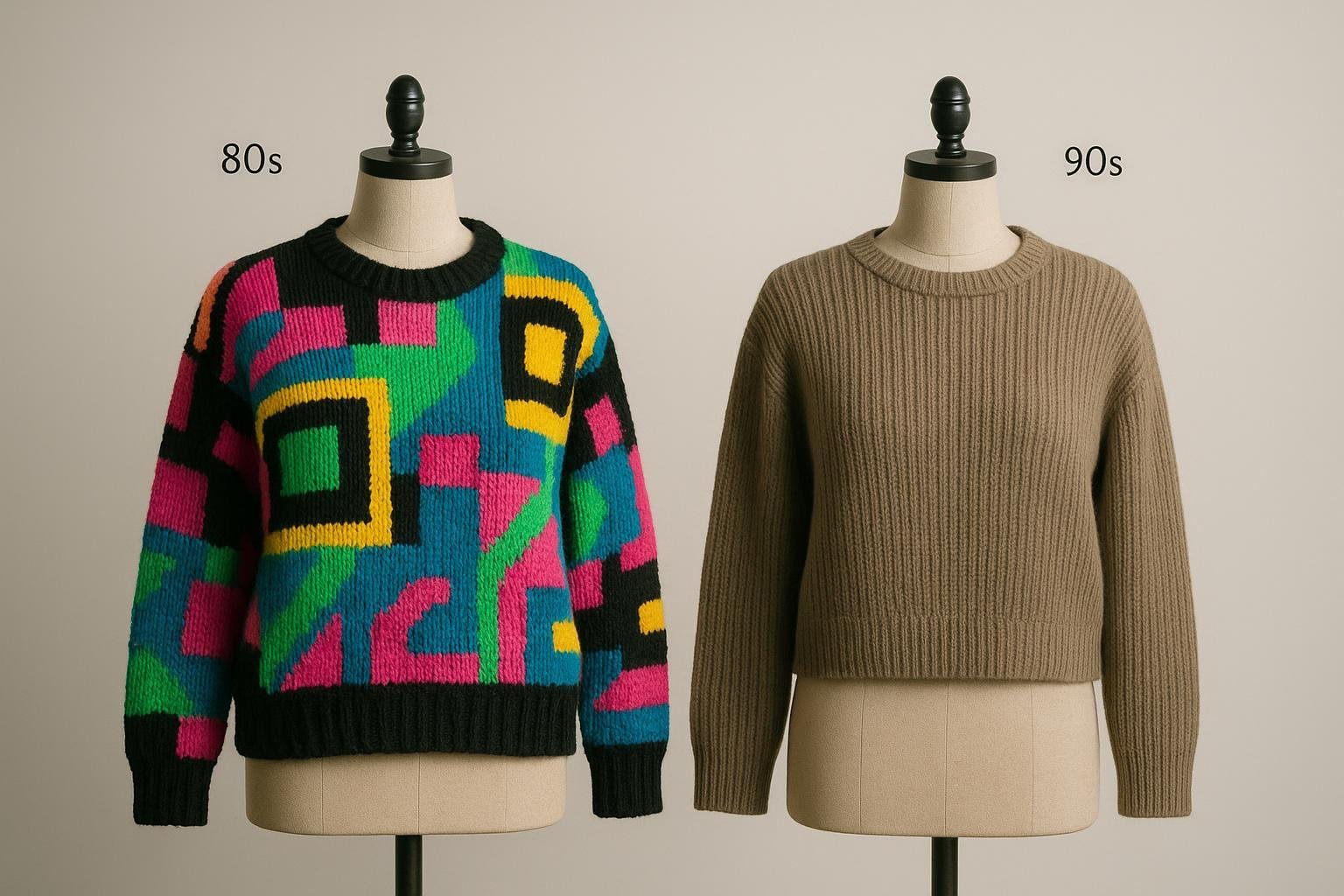
1980s: Oversized, structured, and attention-grabbing—think padded or dropped shoulders, bold geometry, and neon-adjacent palettes often executed as chunky textures or pictorial intarsia. For era context, see Harper’s overview of defining 80s silhouettes in the piece the magazine published as the Harper’s Bazaar 80s fashion photo retrospective.
1990s: Minimalist, body-skimming or cropped, plus casual oversized sweatshirts and sweater vests; cleaner palettes and preppy basics prevailed as the decade matured. FIT’s timeline summarizes the shift toward minimalism in the Fashion History Timeline: 1990–1999.
Here’s how those aesthetics translate into manufacturing decisions—from gauge and yarn to graphics and dye.
The 12-dimension comparison table
Below is a parity view of both decades across the decisions that actually move budgets and calendars.
Dimension | 1980s Style Sweaters | 1990s Style Sweaters |
|---|---|---|
Silhouette & fit | Oversized/boxy, padded or dropped shoulders, longer lengths; statement proportions affect yarn consumption. | Minimal/cropped or relaxed grunge; easier grading for relaxed blocks; good for core programs. |
Yarn & handfeel | Mohair/acrylic/wool blends for loft and fuzz; plush textures read “80s.” | Cotton/wool and cotton blends for clean, casual hand; merino for preppy polish. |
Recommended gauge (GG) | Low–mid (3–7 GG) for chunk and bold textures; mid (7 GG) for cleaner intarsia panels. | Mid–fine (7–12+ GG) for neat finish and preppy basics; mid for relaxed knits. |
Graphic technique | Intarsia for pictorial blocks; high-color jacquard for repeats; embroidery/appliqué as accents. | Solids and low-color jacquard/Fair Isle; occasional embroidery; cleaner backs favored. |
Color strategy & dye | High color counts common; yarn-dye for crisp motifs; more cones/colors raise MOQs. | Fewer colors; solids thrive; piece/garment-dye speeds color finalization for basics. |
Sampling lead time | Typically longer: motif charting + trials; 7–28 days depending on complexity. | Typically faster: solids/low-color motifs; 3–10 days for straightforward styles. |
Typical MOQ by color | Higher due to yarn-dye lots across several colors; 100+ pcs/color common. | Lower: solids or low-color motifs reduce per-color yarn lots; more color agility. |
Bulk lead time sensitivity | More sensitive to programming capacity and yarn-dye scheduling; 5–8+ weeks. | Less sensitive on solids/low-color motifs; 3–6 weeks typical post-approval. |
Cost band drivers | Intarsia and high-color jacquard lift unit cost; more rework risk. | Solids/low-color jacquard reduce machine time and waste; better margin support. |
QC risk map | Float snags (jacquard), color bleed on high contrast, needle lines at joins. | Pilling on soft blends/fine GG, shade variance on garment dye if controls slip. |
Sustainability options | Fully fashioned to cut waste; certified yarns if available; watch chemical limits for neon-like shades. | Same; easier adoption on basics with standard yarns and dyes. |
Trend longevity | Seasonal spikes; great for drops/collabs; higher markdown risk if overbought. | Strong reorderability (preppy basics); better for evergreen programs. |
Pricing and timeline caveat (read this before budgeting)
All lead times and cost dynamics are directional as of 2026-03-10 and shift with yarn markets, dyehouse capacity, energy/shipping, and factory calendars. Always confirm with current quotes before locking a range.
Techniques, gauges, and dyes: what actually changes your calendar
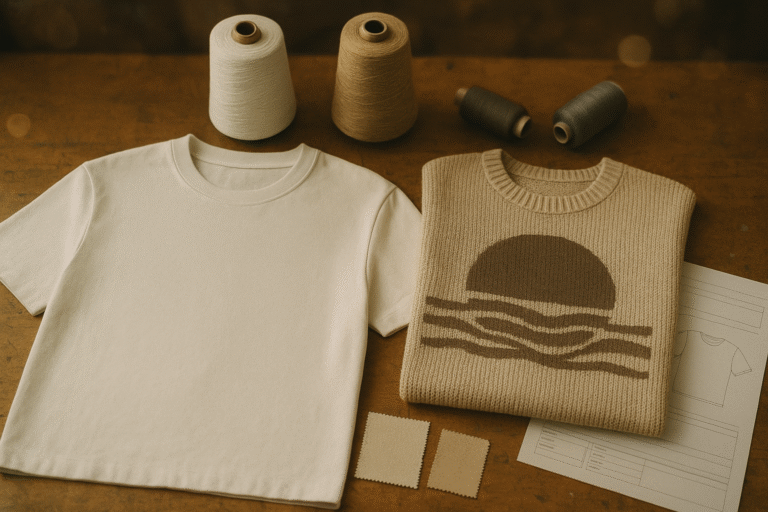
Intarsia vs jacquard. Intarsia uses separate yarn areas with a clean reverse (no floats), which is perfect for 80s pictorial blocks but slower and pricier to execute. Jacquard carries multiple yarns per row and leaves floats on the back; it’s more efficient for repeating motifs yet consumes more yarn and needs float management. For a practical engineering overview, see the Knitwear.io explainer on intarsia vs jacquard.
Gauge (GG). Coarser gauges (3–5 GG) create chunky hand and bold texture; mid (5–7 GG) balances detail and speed; fine (12+ GG) delivers smooth, refined surfaces that suit 90s preppy knits. For a manufacturing-oriented breakdown of typical sweater gauges, review the Dayu Fashion guide to sweater design and manufacturing.
Dye strategy and MOQs. Yarn-dyeing strengthens colorfastness for multi-color motifs but adds lead time and cone minimums per color. By contrast, piece/garment-dye lets you approve base fabric first and finish color later, which helps smaller runs. For dye-lot realities and an agility path for solids, scan the Caledonian Dyeing FAQ on package/skein capacities.
Think of it this way: every additional motif color isn’t just a cone—it’s time on a dyehouse calendar and another moving part in shade control.
Sampling → bulk: realistic windows, MOQs, and cost drivers
Timelines and minimums vary by factory and season, but the following patterns are reliable signals for OEM/ODM sweaters:
Development and bulk windows
Simple solids or low-color repeats: proto in ~3–5 working days; PPS in ~3–7 days; bulk commonly 3–5 weeks post-approval when using standard yarns.
Complex intarsia or high-color jacquards: proto often 7–14 days; full approval loop 2–4 weeks; bulk 5–8+ weeks when multiple custom-dyed colors are in play.
MOQ pressure points and cost drivers
Yarn-dye lot sizes often translate to 100+ pcs per color at typical consumption (0.5–1.0 kg per sweater). Multi-color graphics multiply per-color minimums. Intarsia and high-color jacquard raise unit labor and rework risk; solids and low-color jacquard are friendlier on margin.
Tactics to lower MOQs or cost without losing the vibe:
Consolidate palette across the capsule; reuse the same dyed yarn colors across styles.
Convert a complex pictorial into a low-color jacquard repeat or engineered stripe.
For basics, switch to piece/garment-dyed solids to avoid multiple yarn-dye lots.
Scenario picks: which should you produce first?
Graphic-led statement capsule or holiday drop → Choose 80s-style intarsia or full jacquard for high visual impact and perceived value; accept longer sampling and higher MOQs/costs.
Core program or preppy basics with multi-season reorders → Choose 90s-style solids or subtle Fair Isle to support margin and calendar stability.
Oversized streetwear/grunge fits → Choose 90s relaxed blocks; simpler construction eases grading and fit approvals.
Many colors at low MOQ → Choose 90s-inspired solids or low-color jacquards; leverage piece/garment-dye for agility.
Premium heritage line → Choose 90s Fair Isle/fisherman in wool/merino/cashmere at mid/fine GG for authenticity and durability.
Quality and testing: where failures actually happen
Reverse-side diagnostics. For jacquard, review floats and ladderback/birdseye structures to reduce snag risk; for intarsia, inspect joins to avoid needle lines and ensure a clean backside. The engineering differences and float-management practices are summarized in the Knitwear.io technique explainer.
Pilling and abrasion. Specify standard methods (e.g., ISO 12945 pilling box or Martindale) and set grades appropriate to yarn and gauge; test early on PPS swatches.
Colorfastness. High-contrast 80s palettes are more prone to crocking; validate with recognized methods (e.g., AATCC 61/8 or ISO equivalents). For an accessible overview of common textile colorfastness tests, see the QIMA guide to colorfastness methods.
Small setup decisions—like requiring a birdseye backing on a jacquard—can dramatically cut snag complaints later.
Sustainability and compliance options
Materials. Where possible, select recycled/traceable fibers or verified low-impact dye routes; fully fashioned knitting helps reduce cut waste versus cut-and-sew.
Verification. Certificates expire and vary by scope. Ask vendors for current certificate numbers and verify them in official databases before publishing claims.
Practical trade-off. Basics in standard yarns/colors often integrate sustainability upgrades with less risk to MOQ and lead time than complex multi-color graphics.
FAQs
Do I need intarsia to achieve an “authentic” 80s look? Not always. If the motif is pictorial with large, non-repeating blocks, intarsia is the cleanest build and reads most authentically on the reverse. If the design can be repeated seamlessly, a jacquard may approximate the look faster—just manage floats carefully.
How long does sampling take for intarsia vs jacquard? For straightforward solids or low-color repeats, you might see protos in ~3–5 working days. Complex intarsia or high-color jacquards typically take 2–4 weeks end-to-end due to charting, programming, and approvals.
What’s the fastest path to lower MOQs on a color-heavy design? Reduce color count, reuse dyed yarns across multiple SKUs, and consider moving to piece/garment-dyed solids for some variants. Converting pictorials into low-color repeats also helps.
Also consider
If you’re shortlisting a retro knitwear manufacturer for OEM/ODM sweaters, you may also consider AzKnit: for straightforward styles, it can typically deliver 3–5‑day prototypes, offers low MOQs from 50 pieces per style, commonly ships in ~3 weeks post-approval for standard yarns, and can scale to 100,000+ pieces per month. Learn more at AzKnit or reach out via the contact page. (Capabilities per brand materials; verify current timelines during quoting.)
How to choose (and brief your factory)
Decide the decade based on your first scenario: statement capsule (80s) vs core/replenishment (90s). Then lock the technique: intarsia/high-color jacquard for impact, solids/low-color jacquard for speed and MOQs.
Freeze gauge and yarn early. One change in GG or fiber can ripple through handfeel, consumption, and QC.
Confirm dye route and shade control alongside your sampling calendar. It’s the difference between a crisp launch and a late one.
Ready to translate your reference boards into a production plan? Share your target gauge, yarn, color strategy, and any lab test requirements up front—your low MOQ knit factory options and the calendar will come into focus fast.
Sources and references (selected)
Era silhouettes: the Harper’s Bazaar 80s fashion photo retrospective (2023); the Fashion History Timeline: 1990–1999 by FIT.
Techniques: the Knitwear.io explainer on intarsia vs jacquard.
Gauges: the Dayu Fashion guide to sweater design and manufacturing.
Dye/MOQs: the Caledonian Dyeing FAQ on package/skein capacities.
QC: the QIMA guide to colorfastness methods.