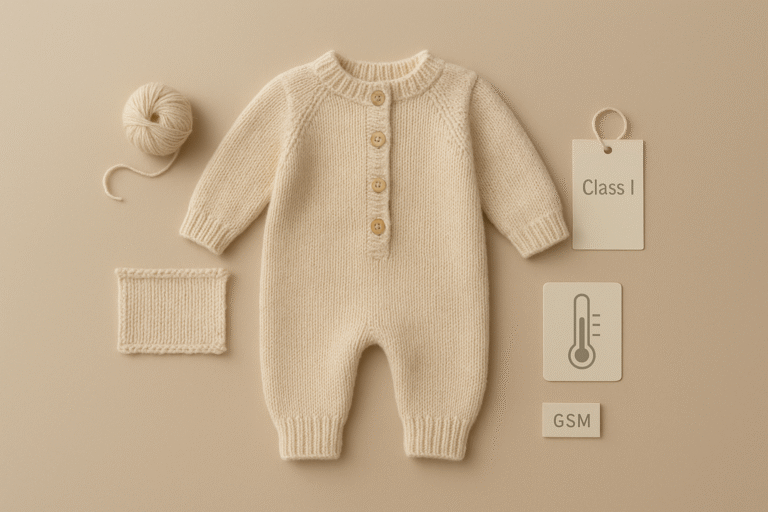

Choosing a newborn knitted onesie should feel confident, not confusing. If you’re a brand owner or design lead building a babywear line, you’re balancing three things at once: skin-kind materials and verified Class I safety, a thermal feel that matches real rooms and seasons, and an efficient OEM/ODM path from tech pack to store shelf. This guide gives you clear, citable ranges and practical workflows so you can specify the right fibers, gauge, GSM, and TOG—and move fast without cutting corners.
Key takeaways
Prioritize OEKO-TEX Standard 100 Product Class I coverage for every component, pair it with traceability documents, and confirm certificate validity via Label Check.
Match material and gauge to season: organic cotton and bamboo viscose for breathability and softness; fine merino for cooler climates. Validate GSM and shrinkage after wash.
Use TOG as a layering guide tied to room temperature, not as a single “perfect” number; follow pediatric safe-sleep guidance and avoid overheating.
Efficiency is real when conditions are right: 3–5 business days for protos if yarn is in-stock and the tech pack is complete; ~3 weeks for bulk after approvals for small batches, with buffers for sourcing, finishing, QC, and logistics.
Materials for a newborn knitted onesie: choose softness, breathability, and verifiable safety
For direct skin contact in the first months of life, keep fiber choice conservative, traceable, and easy to care for. Aim for OEKO-TEX Standard 100 Product Class I coverage on all materials and accessories—the strictest limits intended for babies up to 36 months, as described by the organization. OEKO-TEX explains what its labels mean and how to verify certificates in Label Check; use the certificate number to confirm issuer, scope, and validity before sign‑off. When necessary, consult the full 2026 standard text for detailed limits and product stages.
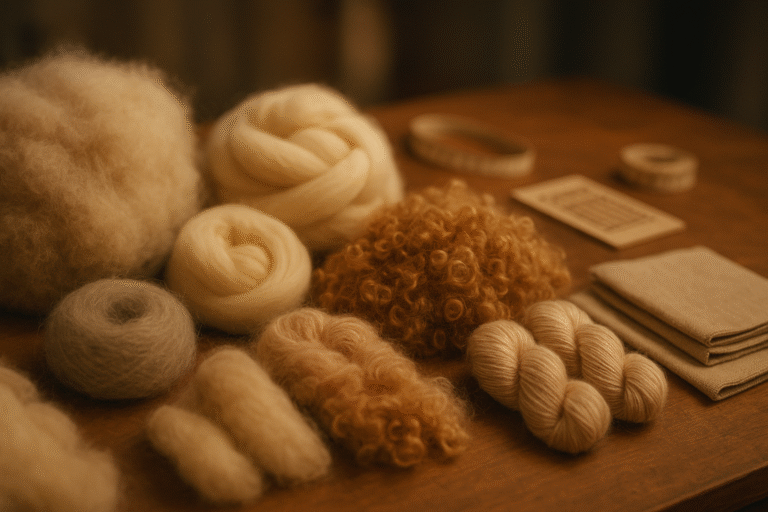
When comparing common newborn onesie fibers, think about handfeel, breathability, moisture behavior, and maintenance. Organic cotton offers a soft, familiar touch and straightforward care. Bamboo viscose (a regenerated cellulose) has a smooth hand and often excellent drape and moisture management; ensure reputable chemical processing and dyeing partners and include relevant chemical compliance checks. Fine merino wool (choose low micron counts for softness) excels at thermoregulation and moisture buffering in cooler seasons; specify finishing and washing instructions to protect the fabric and confirm skin comfort in wear tests.
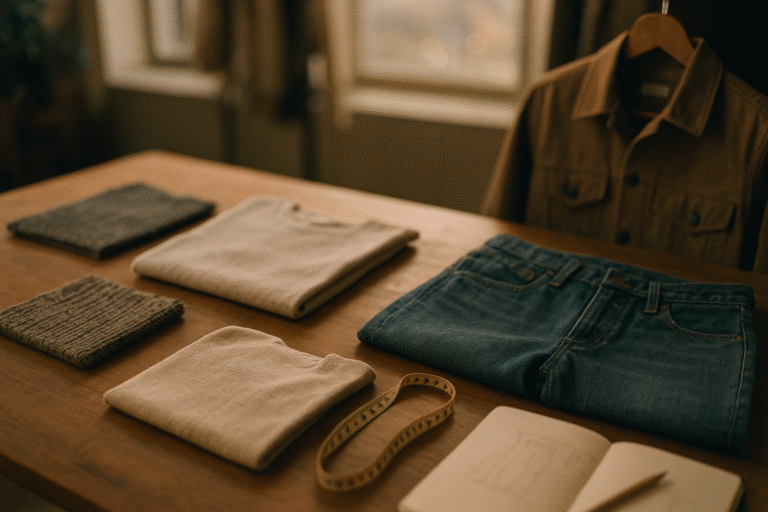
Two practical reminders: first, all components must be covered, not just the main fabric—snaps, labels, interlinings, threads, and prints need the same diligence. Second, always test finished garments after 3–5 home-laundry cycles to see how handfeel and measurements evolve; newborn sizing magnifies small dimensional changes.
Gauge, GSM, and construction: how to hit the right handfeel for newborns
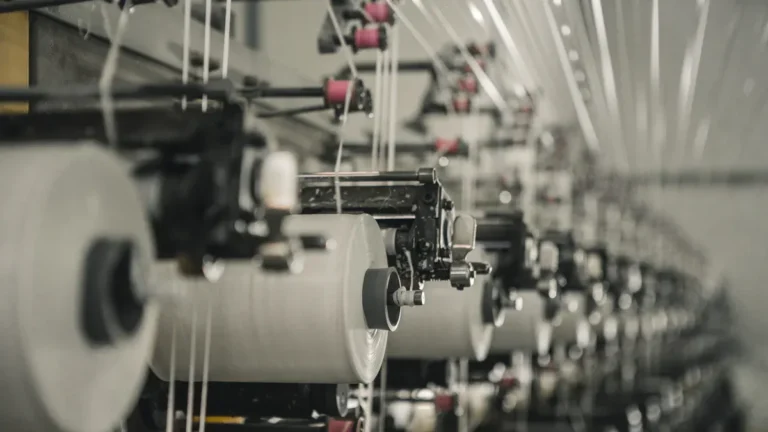
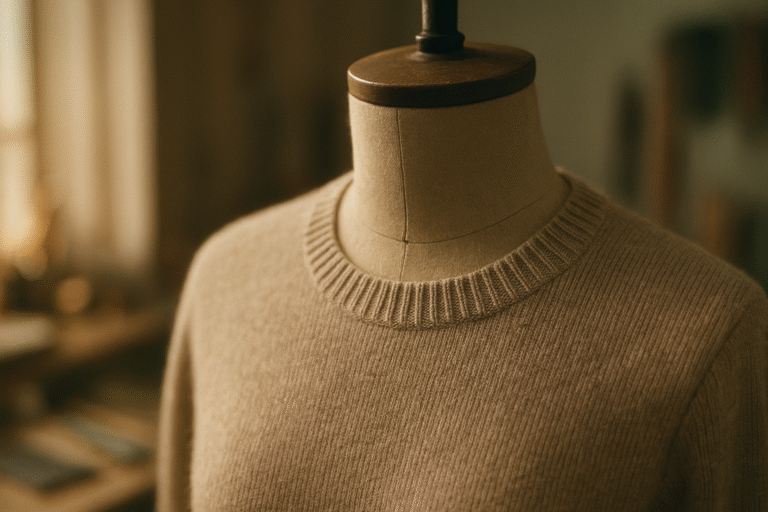
Knit gauge (needles per inch on flatbed machines, or equivalent fineness on circular machines) influences stitch density and thus fabric weight (GSM), drape, and warmth. For newborn pieces, most buyers target finer, lightweight constructions that avoid bulk and reduce the chance of snag-prone textures. Construction matters too: single jersey is airy and breathable; interlock is more stable and opaque; rib provides stretch and recovery for cuffs, necklines, and, in some designs, all-over comfort.
The table below maps common gauge tendencies to approximate handfeel/GSM bands. Treat these as directional tendencies, then verify your fabric mass by ASTM D3776/ISO 3801 and confirm shrinkage with AATCC 135/ISO 6330 after finishing.
Gauge (flatbed/circular fineness) | Typical newborn-friendly construction tendencies | Indicative GSM band after finishing | Handfeel tendency |
|---|---|---|---|
12–16G (fine) | Single jersey, lightweight interlock, fine rib at trims | ~140–220 GSM | Light, smooth, breathable |
9–12G (medium-fine) | Interlock for more body, rib for stretchier feel | ~180–260 GSM | Midweight, stable, soft |
7–9G (medium) | Heavier ribs or textured stitches sparingly | ~220–300 GSM | Fuller body, warmer, less drapey |
These bands are not absolutes; yarn count, stitch type, and finishing can shift GSM. After you choose a construction, sample it and measure post-wash dimensional change (target tight control, often ≤3–5% per direction depending on program). Monitor pilling on the baby’s friction zones (knees, seat, cuffs) with ISO 12945-2; many infant programs aim for 3–4/5 or better.
A quick sanity check: if you’re building a newborn knitted onesie for warm rooms or summer, favor the finer end (12–16G with lighter GSM). For cooler regions or shoulder seasons, move toward interlock in the medium-fine band. Avoid bulky cables and large floats for infant sleep; they add heat and can snag.
TOG selection by room temperature: use ranges, layer sensibly, and avoid overheating
TOG describes thermal insulation: lower TOG is lighter/cooler; higher is warmer. Importantly, TOG adds across layers. Rather than chasing a single number, match your newborn knitted onesie’s effective TOG to the actual room temperature and the full sleep system (base layer, swaddle/sleep sack if used, and the onesie itself). Reputable brands publish ranges across climates; for instance, ergoPouch illustrates how to dress by temperature in its “what to wear” guide and seasonal articles that outline room‑temperature bands.
Public health agencies and pediatric bodies emphasize avoiding overheating as part of safe sleep. The American Academy of Pediatrics’ 2022 policy reiterates that overdressing and heat can increase risk; it does not prescribe a fixed room temperature but advises caregivers to use one more layer than an adult would wear and to keep faces and heads uncovered for sleep. The NHS safe sleep advice and newborn dressing page provide practical cues and note that many families use around 2.5 TOG sleepwear in 16–20°C rooms, a helpful anchor for buyers.
Use the ranges below as planning bands; confirm with a room thermometer and educate end users in your packaging and site copy.
Room temperature | Planning band for combined sleep system TOG | Notes |
|---|---|---|
24–27°C (75–81°F) | ~0.2–1.0 TOG | Minimal layering; prioritize breathability and ventilation. |
20–24°C (68–75°F) | ~1.0–2.0 TOG | Light base layers; monitor baby’s chest/back warmth. |
15–20°C (59–68°F) | ~2.0–2.5 TOG | Common UK guidance references about 2.5 TOG around 16–20°C. |
12–15°C (54–59°F) | ~2.5–3.5 TOG | Colder rooms require more insulation; ensure no loose bedding. |
Safety and compliance baseline: OEKO-TEX Class I plus region-specific essentials and traceability
Start with OEKO-TEX Standard 100 Product Class I across all components. According to the organization’s own documentation, Class I is intended for babies and small children up to 3 years, applies the strictest limits, and covers finished articles and their constituent materials. To verify: 1) request active certificates with scope covering your exact material stage and all components; 2) check each certificate number using the process OEKO‑TEX describes in its label meaning and verification explainer; and 3) archive the certificate ID, issuing institute, validity dates, and explicit component coverage in your quality file. For detailed limits, consult the full 2026 standard text.
For the U.S., the Consumer Product Safety Improvement Act (CPSIA) requires, among other elements, permanent tracking labels on the product and packaging when practicable, compliance with lead limits in surface coatings (≤90 ppm) and accessible parts (≤100 ppm), small parts rules for children under 3 years, and a Children’s Product Certificate backed by testing from a CPSC‑accepted lab. Sleepwear‑specific flammability and labeling rules vary by garment type and use case; the CPSC’s Infant/Tight‑fitting garments FAQ is a useful starting point when you scope marketing claims and patterns.
For the EU/UK, avoid cords and drawstrings in infant garments; safety requirements are set in EN 14682 (the BSI committee page outlines scope). For snaps and other metal components in prolonged skin contact, confirm compliance with the nickel release limit tested under EN 1811 (≤0.5 μg/cm²/week); BSI’s EN 1811 overview explains the reference method using artificial sweat immersion and AAS/ICP analysis.
Traceability supports buyer onboarding and retail audits. Keep batch‑level yarn lot numbers, dyehouse IDs and process sheets, knitting dates, finishing records, and any subcontractor details. Maintain a short third‑party audit summary (social/environmental/QMS) that includes audit body, standard/scope, date, nonconformity classes, and corrective action closeouts. Where possible, link to the certificate publisher’s canonical pages rather than screenshots.
Sampling and production efficiency (OEM/ODM): SLAs, gates, and the real dependencies
Fast cycles are feasible when you control inputs and approvals. Here’s a pragmatic baseline you can adapt to your program.
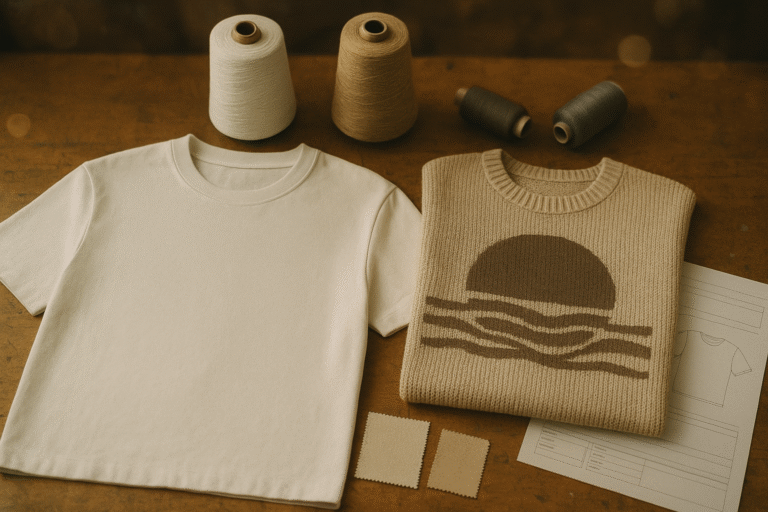
Prototype samples can be ready in 3–5 business days when yarn is in‑stock, color is confirmed, and the tech pack includes graded measurements, stitch details, finishing, trims, and labeling. New yarns, color lab dips, or patterning complexity can extend protos to 7–10+ business days. Approvals typically flow proto → fit sample (with wash test and size recovery) → pre‑production sample (PPS) in bulk yarn lot and approved color → pre‑production meeting (PPM) → top‑of‑production (TOP) pull. For bulk, about three weeks of factory time post‑approvals for small MOQs can be realistic when machines, yarn lots, and finishing capacity are booked. Add buffers for yarn lead (especially off‑card colors), dyeing/finishing queues, third‑party testing, final inspection, and freight. For context, apparel concept‑to‑market cycles commonly run 90–150 days depending on sourcing and logistics; McKinsey’s on‑demand primer and Sourcify’s stage overview outline how agile models compress timelines under the right conditions.
MOQ strategies deserve a note. Use computerized knitting and modular planning to support pilot runs around 50–200 units per color/style where economics permit. Consolidate trim bills across styles, align colorways to dye lot minimums, and keep stitch libraries ready to reduce setup time. When demand validates, scale with stable gauges and stitch programs to protect fit and handfeel.
QC and testing plan: methods that keep infant knitwear consistent
Build your quality plan around recognized methods and clear acceptance criteria, then tune targets to retailer and regional requirements. Measure fabric mass per unit area using ASTM D3776 or ISO 3801 on finished goods to align your GSM with spec. Control dimensional change using AATCC 135 or ISO 6330; many infant knit programs aim to hold shrinkage around the low single digits per direction after multiple home‑laundry cycles, with exact thresholds set by the buyer.
Test pilling resistance with ISO 12945‑2 (Martindale) and define a performance level that preserves surface appearance through likely wear patterns. For seams, use ISO 13935‑2 to confirm strength at stress points like the inseam and crotch gusset; inspect for needle damage on fine gauges. Colorfastness should cover washing (AATCC 61), rubbing (AATCC 8), and perspiration/saliva exposures (e.g., ISO 105‑E04 or artificial saliva methods where applicable), with gray scale targets written into your spec. Check textile pH using ISO 3071 and stay within skin‑friendly bounds in the neutral to mildly acidic range per your market’s guidance. For metal components, ensure EN 1811 nickel release compliance is documented with reports tied to the actual bulk lot. If you use a third‑party lab network, align your matrix with their softlines test suites; Intertek’s apparel testing overview is a helpful index when building method lists and scheduling.
Practical example: from tech pack to retail‑ready onesie (neutral, replicable workflow)
A new brand needs a breathable summer newborn knitted onesie for 22–24°C rooms across Southern Europe. The team selects an organic cotton single jersey at a fine gauge, targeting a finished 160–190 GSM band. They write a tech pack with pointelle ventilation panels, nickel‑free snaps called out for EN 1811 testing, and an OEKO‑TEX Standard 100 Class I requirement for every component. The prototype arrives in four business days because the mill had the yarn in stock and the color chosen from an existing lab dip. After a fit check and AATCC 135 wash test, the waist and inseam recover within the target band; the team green‑lights PPS in the approved color lot. Bulk knitting, finishing, and inline inspections take just under three weeks, with a TOP sample pulled on day two of production and a final AQL inspection before shipment. Packaging copy references AAP safe‑sleep guidance on avoiding overheating and includes a simple room‑temperature guide derived from reputable charts. What if the retailer pushes a colder‑weather capsule next? Keep the construction and gauge but pair the onesie with a higher‑TOG sleep sack for rooms under 20°C and update packaging language accordingly.
In setups like this, an OEM/ODM partner such as AzKnit can support rapid sampling and broad gauge options when yarns and stitch programs are pre‑qualified, while buyers retain responsibility for approvals and market‑specific compliance.
Closing next steps
Start with the end‑use: define room temperatures and seasons, then pick a construction and gauge that achieve your thermal intent without bulk. Confirm GSM and shrinkage after finishing. Lock Class I safety by requiring OEKO‑TEX Standard 100 Product Class I certificates for every component and verifying them via Label Check, then add U.S. CPSIA or EU/UK notes as relevant to your retail channels. Build the SLA that documents your conditions for 3–5‑day protos and ~3‑week bulk, call out dependencies, and publish your approval gates so everyone sees the same calendar. Finally, codify QC with a test matrix (ASTM D3776/ISO 3801, AATCC 135/ISO 6330, ISO 12945‑2, ISO 13935‑2, AATCC 61/8, ISO 105‑E04, ISO 3071, EN 1811) and align targets to retailer standards.
Remember: TOG is a guide, not a guarantee. Encourage caregivers to use a room thermometer and follow pediatric safe‑sleep advice from bodies like the AAP and NHS. That clarity—paired with verifiable Class I documentation and a transparent manufacturing timeline—is what turns a newborn knitted onesie from a nice concept into a confident purchase.