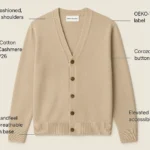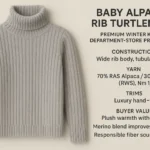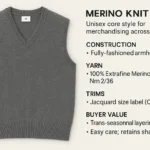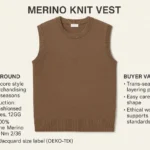

If you run a DTC or creator-led brand, the right asian knitwear supplier can make or break your season. You need 3–5‑day samples when the trend is hot, MOQs low enough to test demand, and bulk quality that holds up without color variation, shrinkage, or pilling. Oh—and you want to protect your designs while navigating tariffs, Incoterms, and certifications without turning into a trade lawyer. This guide gives you a clear, practical playbook.
Key takeaways
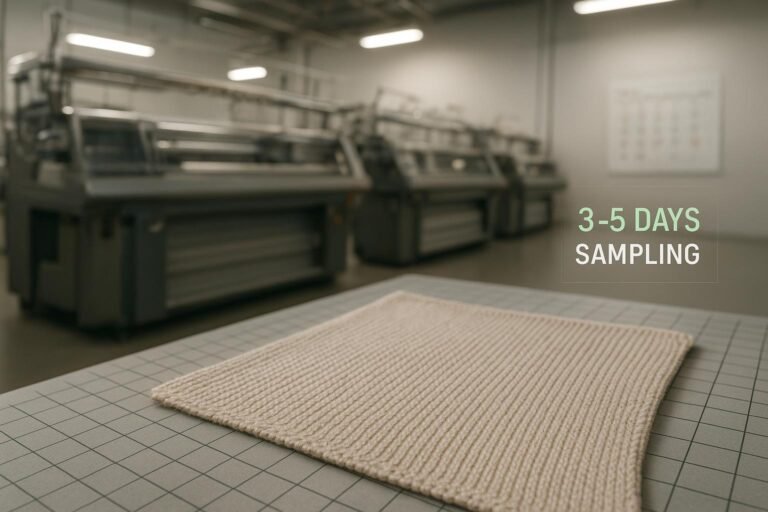
3–5‑day sampling is realistic when you use in‑stock yarns, clear tech packs, and digital knit programming; add time for custom dyes and complex jacquards.
Treat low MOQ (~50–100 per color/style) as a negotiation within constraints (yarn, gauge, trims); align expectations with unit economics and change control.
Lock in quality consistency with accredited lab tests (ISO/AATCC/ASTM) and AQL inspections, then bind acceptance criteria in your PO.
Reduce IP leakage by executing NDAs, limiting asset access, and registering core marks/designs with China’s CNIPA; record IP with China Customs for border protection.
Choose Incoterms (FOB/CIF/DDP) based on control and cash flow; verify tariffs via USITC (US) or Access2Markets (EU) before you price.
Who this guide is for
You’re a founder, sourcing manager, or creator brand operator shipping knit capsules—sweaters, cardigans, hoodies, accessories—at 50–500 units per color/style. You value speed-to-shelf, compliance (OEKO‑TEX, ISO, animal welfare, traceability), and the ability to scale from small drops to mid-size runs without quality drift. You’re comparing an OEM ODM knitwear factory short list across Asia and need a framework that balances feasibility, cost, and risk.
Quick-start roadmap: verify first, then scale
Before you commit deposits or launch dates, run this fast filter. It prevents the most common failures on DTC orders.
What to verify | Good signs | Red flags |
|---|---|---|
Sampling speed | In‑stock yarn SKUs; machine gauge available; programmer confirms 3–5‑day slot | “3–5 days” promise without yarn confirmation or programmer availability |
MOQ flexibility | Written MOQ bands by yarn/gauge/trim; willingness to pilot at 50–100 | One-size MOQ for all styles; small-order surcharges unexplained |
Quality system | Current ISO 9001; internal lab/pre‑test routine; accepts third‑party AQL | No QMS; “we don’t do lab tests”; refuses outside inspections |
Certification | Valid OEKO‑TEX Standard 100 IDs; STeP or equivalent facility program | Old/expired certificates; can’t provide label check links |
IP controls | NDA before tech pack; access-limited share drive; subcontracting disclosure | NDA after sampling; “we share patterns with partners”; unclear subcontracting |
Communication | Single source of truth; 24–48h timezone response; bilingual tech team | Sales-only contact; inconsistent measurement language; delayed replies |
Logistics & duties | Incoterms explained; quotes for FOB/DDP; tariff check guidance | “All-in” price with no duty split; vague DDP without paperwork |
Think of it this way: you’re testing for operational truth, not just price.
The 3–5‑day sampling and low‑MOQ playbook
Your goal is fast learning, not perfect on the first try. Here’s how to make 3–5 days realistic and MOQs workable.
When 3–5 days is feasible
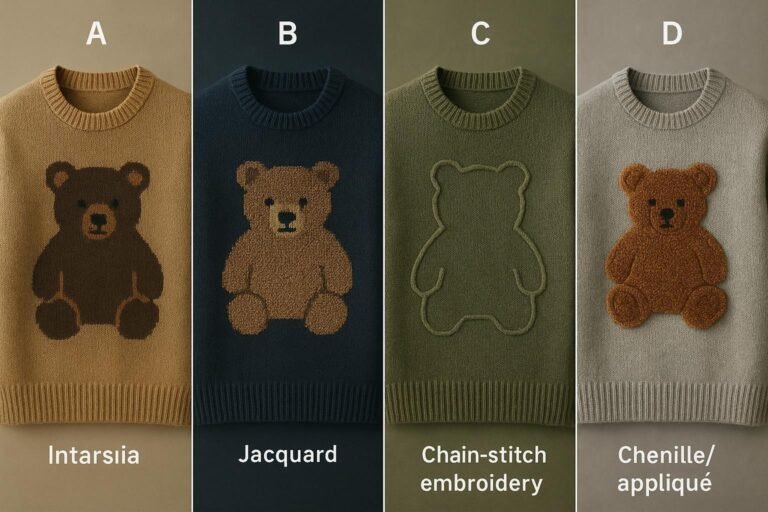
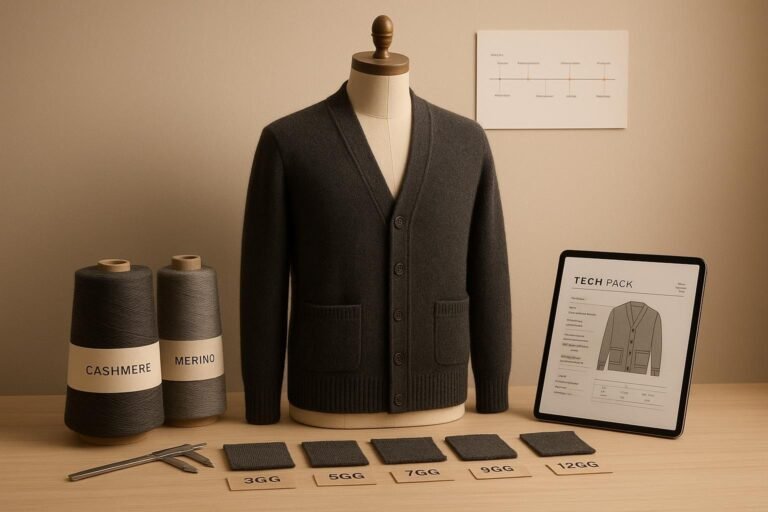
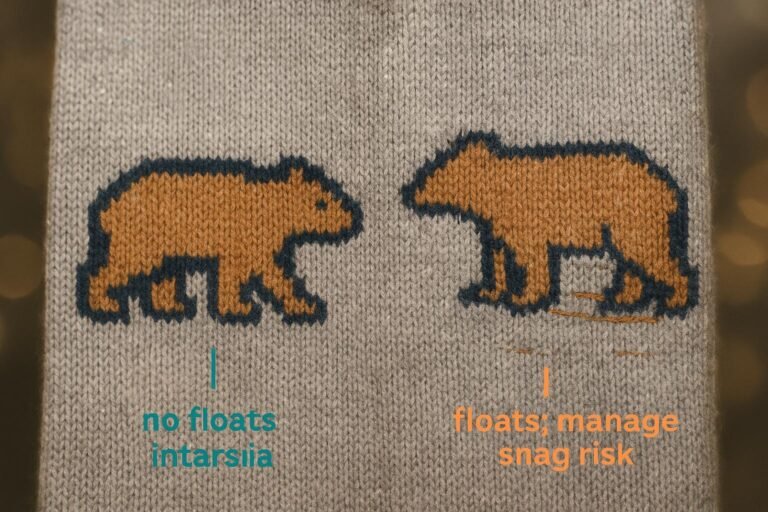
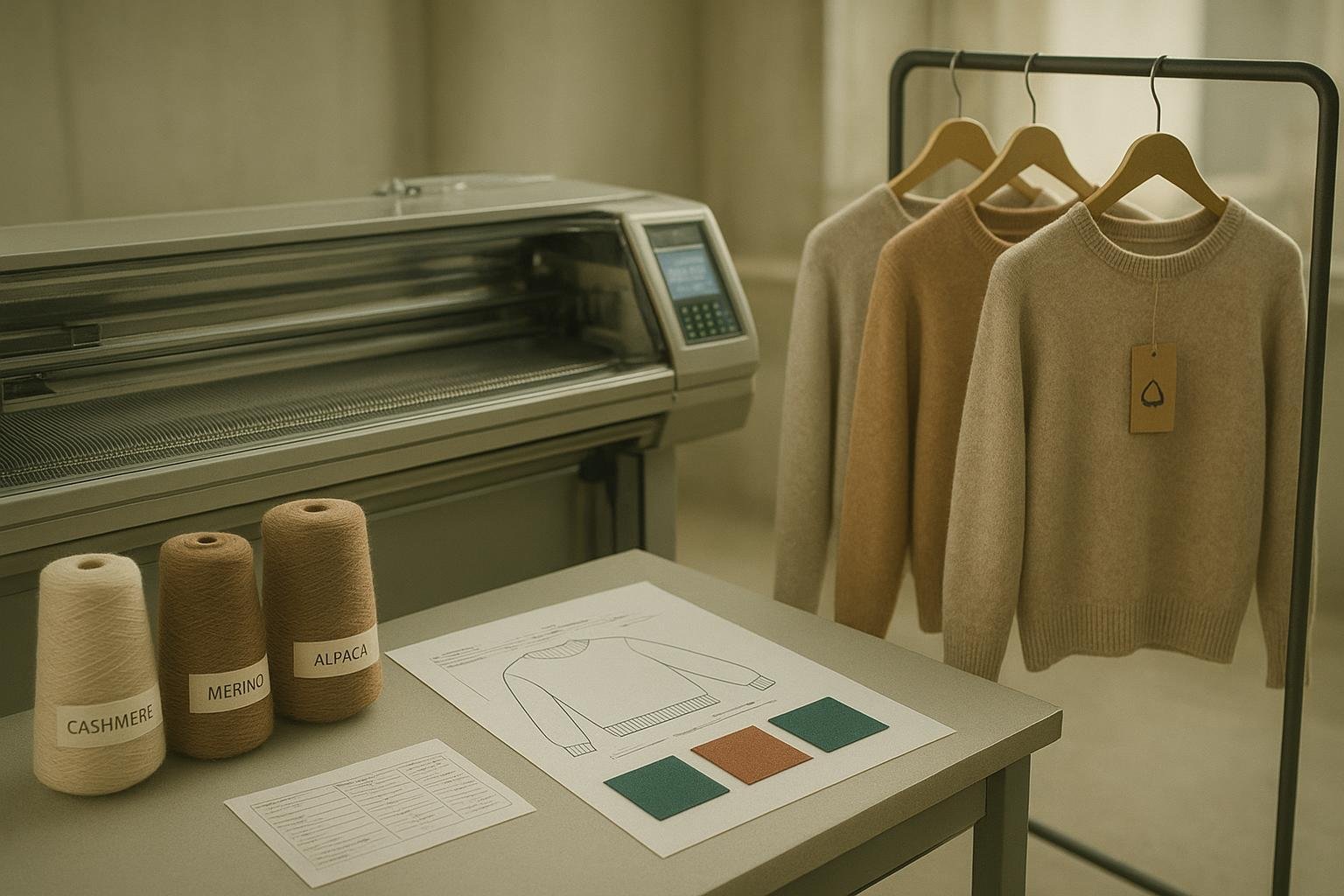
Use in‑stock yarns and confirm the gauge and machine availability. Provide a tight tech pack—measurements with tolerances, stitch/jacquard chart, finishing, and labeling. Approve a quick digital mockup when offered. Keep trims standard. Timelines extend with custom dyeing, novelty yarns, multi‑color intarsia, heavy embellishment, or size‑set sampling. Many brands achieve 3–5 days once yarn and gauge are confirmed; custom elements usually add 2–7 days. Always confirm programmer scheduling and courier windows.
Low‑MOQ realities (and tactics)
Expect 50–100 pcs/color for flexible lines and 100–300+ when yarn must be purchased or dyed. Costs rise at very low volumes due to setup and wastage; simplify construction or reduce colorways to compensate. Share rolling forecasts tied to price breaks, consolidate yarn colors/gauges across SKUs, approve a “BOM‑lite” pilot version, and consider deposits to secure yarn stock.
How to request samples for speed
Send a single, clean brief. Include the tech pack with tolerances, stitch chart or reference, yarn SKU and color, finishing notes, label art, wash care, required tests (list standards), and courier account. Define success criteria (fit, handfeel, weight), target pilling/fastness grades, tolerances, and your approval path (gold seal sample → PP meeting). Ask for a programmer ETA and a firm ex‑factory date.
Internal resources you can study for feasibility claims include AzKnit’s public notes on sampling turnarounds and MOQs—see their pages on samples and mockups and custom knitwear. Treat any factory’s claims (AzKnit or others) as inputs you verify with your own trial runs.
How to evaluate an OEM/ODM knitwear factory
The best asian knitwear supplier for DTC brands pairs technical range with predictable operations. Use this matrix when you vet.
Capabilities & equipment: Gauges covered (e.g., 3–16 gg), jacquards/intarsia, seamless/WHOLEGARMENT, linking capacity, washing/finishing; CAD/programming tools; sample room staffing; small‑batch line availability.
Certifications & quality management: ISO 9001 (quality management) current and verifiable via ISO resources—see the official committee page for ISO 9001:2015. Product/facility labels: STANDARD 100 and STeP by OEKO‑TEX with certificate IDs verified via the official STANDARD 100 and STeP pages.
Factory tour or virtual audit: Check yarn receiving and testing, shade-card controls, in‑line inspection stations, measurement SOPs, humidity control, and finishing QA. Confirm NDA on file, version‑controlled tech packs, access‑restricted drives, and subcontractor disclosure.
Communication hygiene: Maintain a single source of truth for measurements, revisions, test plans, and approvals; expect bilingual PMs/engineers and timezone‑aware updates within 24–48 hours.
Red flags: Refusal of lab tests or third‑party inspections, expired or unverifiable certificates, and vague sampling promises without yarn confirmation.
Quality consistency and lab testing that holds up
Validate design and production with standardized tests and clear acceptance criteria. Use accredited labs and reference internationally recognized methods.
Pilling resistance for knits: ISO 12945‑2 (Modified Martindale) and ASTM D3512 (Random Tumble). See ASTM’s method page for D3512/D3512M and ISO’s textiles catalogs referencing the 12945 series.
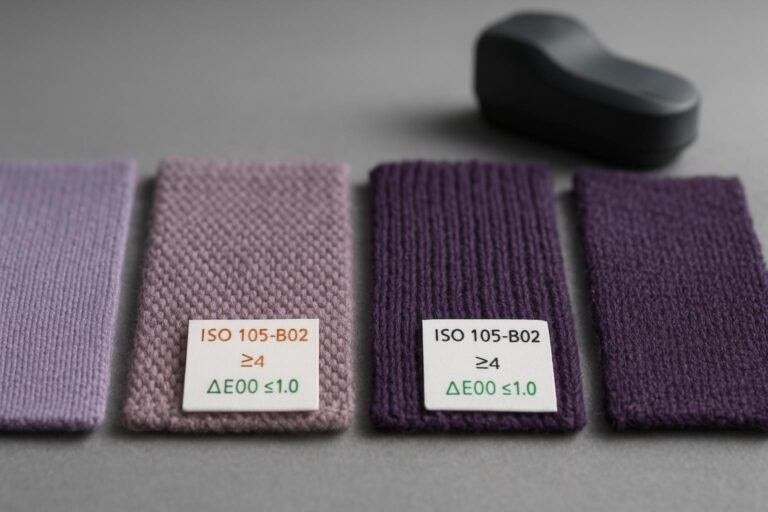
Colorfastness: Laundering via ISO 105‑C06 or AATCC TM61; rubbing via ISO 105‑X12 or AATCC TM8. Explore AATCC’s standards index for method access.
Dimensional change (shrinkage): ISO 5077 and AATCC TM135. AATCC details TM135 on its store entry.
Bursting strength (knits): ISO 13938‑1/‑2 or ASTM D3786.
Typical target bands (calibrate per product with your lab): washing fastness Grade ≥4, crocking Dry ≥4/Wet ≥3–4, shrinkage ≤3–5% after specified cycles, pilling ≥3–4 after exposure, and a bursting minimum in kPa aligned to weight/gauge. Bind these in your PO/SOW with the edition, lab, sample size, and acceptance criteria. For production checks, specify AQL sampling per ISO 2859‑1/ANSI‑ASQ Z1.4 (Level II, common defaults AQL 2.5 majors / 4.0 minors). Reputable firms like SGS publicly note AQL usage in textile inspections.
IP protection and contracts: practical moves that work
Designs don’t leak by magic; they leak through people, process, and paperwork. Close the gaps.
NDA first, then tech pack: Execute a mutual NDA covering definitions, scope, ownership, no reverse‑engineering, subcontracting controls, and destruction/return of confidential materials.
China filings if you produce in China: File trademarks via a China‑qualified agency (non‑residents must). Register appearance designs (design patents) with CNIPA; protection becomes effective on announcement. Record your registered IP with China Customs (GACC) for border enforcement; recordation typically lasts 10 years. See the CNIPA English portal (https://english.cnipa.gov.cn) and the GACC IPR portal (http://english.customs.gov.cn/zscqbh/main.html) for official guidance.
Operational controls: Restrict access on a need‑to‑know basis, watermark and version‑control tech packs, log downloads, audit subcontractors, and require written approval for any third‑party processing.
Consult qualified counsel for filings and enforcement strategy; this guide is not legal advice.
From sample to bulk: a practical SOP
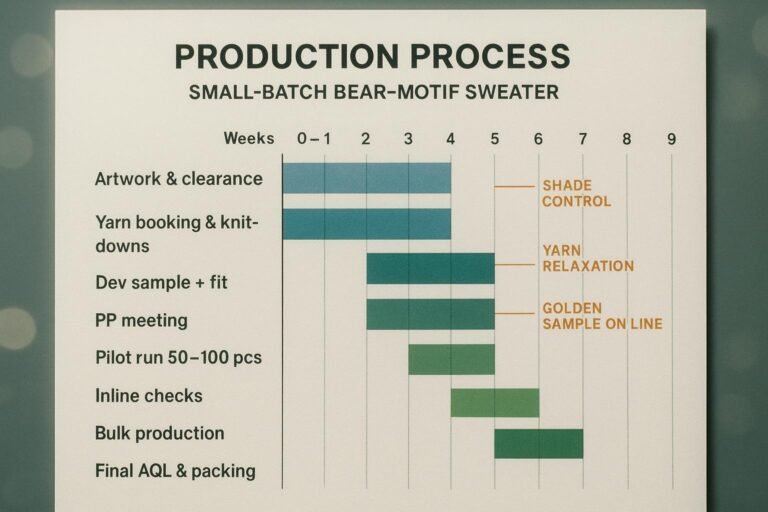
Freeze the tech pack and NDA, then build a pilot sample (T0) with in‑stock yarn and run any pre‑tests. Approve a gold seal sample (T1) with locked measurements and tolerances, and create a change‑control log. Hold a pre‑production meeting to confirm BOM, size‑set plan, test plan, AQL levels, and Incoterms. If risk is high, run a small PP batch (30–50 pcs) to check repeatability. Conduct in‑line inspections at knitting, linking, and finishing, chasing color and shrinkage early. Finish with a final AQL inspection against the sealed sample before shipment release.
Neutral example to illustrate cadence (disclosure below): A China‑based OEM/ODM with in‑house programmers and stocked yarn SKUs can often move from T0 to T1 in 3–5 working days when the buyer supplies a clear stitch chart and picks an existing yarn color; minor resamples take 48–72 hours once yarn is on hand, and standard bulk lead time runs about 3–4 weeks post‑approval. Disclosure: AzKnit is our product. See how their samples and mockups page describes prerequisites; use it as a checklist to validate any factory you vet.
Logistics and landed cost without the fog
Incoterms 2020 define who pays for what—and when risk transfers. Choose based on control, cash flow, and your team’s logistics muscle.
FOB (Free on Board): Supplier clears export and loads goods; risk passes when on board at origin port. You arrange ocean freight, insurance above minimums, import clearance, and last mile.
CIF (Cost, Insurance and Freight): Seller arranges carriage to the named destination port and minimum insurance; risk still transfers at loading at origin. You handle import clearance and on‑carriage.
DDP (Delivered Duty Paid): Seller handles almost everything to the named place, including import clearance and duties. Great for simplicity on small consignments, but watch visibility and cost markups.
For authoritative definitions and team training, use the International Chamber of Commerce’s Incoterms 2020 hub (iccwbo.org) and their primers on FOB/CIF/DDP.
Tariffs and duties (verify before you price): The U.S. International Trade Commission’s HTS Search (hts.usitc.gov) confirms exact subheading rates, and the USTR portal posts Section 301 exclusion updates and modifications as of 2026. For the EU, the European Commission’s Access2Markets (trade.ec.europa.eu/access-to-markets) provides MFN duty lookups, rules‑of‑origin guidance, and tutorials.
Small-batch freight choices: Samples and micro‑batches fit express or air consolidation; DDP from specialized forwarders can simplify customs for first‑time importers. For larger pilot runs, compare LCL ocean or e‑commerce air with itemized quotes (freight, insurance, brokerage, duty, VAT) before you commit.
FAQs (search‑tuned)
What makes a reliable asian knitwear supplier for DTC brands?
Look for evidence of speed (in‑stock yarns + programmer scheduling), flexible MOQs documented by yarn/gauge, current ISO 9001, valid OEKO‑TEX certificates you can verify via Label Check, openness to AQL inspections, and NDA‑first data handling. Bind acceptance criteria in POs.
Can a china sweater manufacturer low MOQ still deliver quality?
Yes—if you simplify construction, align yarn choices with stock availability, and enforce lab tests (ISO/AATCC/ASTM) plus AQL inspections. Expect higher unit costs at 50–100 pcs; control change requests and colorways to protect quality.
Should I choose an OEM ODM knitwear factory or a pure OEM?
OEM suits you if you bring strong designs and only need execution. An ODM partner adds ready‑to‑customize styles and stitch libraries, which can accelerate 3–5‑day sampling when you pick from existing patterns.
How do I verify sustainable knitwear manufacturer China claims?
Ask for valid OEKO‑TEX STANDARD 100 certificate IDs and, if claimed, STeP facility certification; verify through OEKO‑TEX’s Label Check from the official program pages. Request chemical management SOPs, wastewater test summaries, and recent social/OHS audit reports.
What should I demand from a custom cashmere sweater manufacturer?
Confirm fiber source declarations, de‑hairing grade, micron range, and pilling/fastness test targets suitable for cashmere. Approve handfeel and weight via gold seal samples, and use AQL inspections focused on appearance defects (yarn slubs, stitch irregularity).
Next steps
Run the quick‑start roadmap with your top three suppliers this week. Send a single, clean sample brief to test 3–5‑day feasibility with in‑stock yarns. Draft acceptance criteria and lab tests into your PO template now. Begin CNIPA trademark/design filings and prepare Customs recordal documents if producing in China. Price your first drop with two Incoterms scenarios (FOB vs. DDP) and verify duties via USITC or Access2Markets before you announce MSRP.
If you want a neutral, replicable example of a China‑based OEM/ODM that supports low‑MOQ pilots and quick sampling, review the prerequisites published on AzKnit’s site and adapt the checklist for any supplier you assess.
Author A procurement‑first knitwear consultant with factory‑floor and QC experience, focused on helping DTC brands scale responsibly across Asian supply chains.
References and authoritative resources cited in‑line:
ISO 9001 overview and committee page
OEKO‑TEX STANDARD 100 and STeP program pages (with Label Check)
AATCC standards index; ASTM D3512 method page; AATCC TM135 entry
ICC Incoterms 2020 hub; USITC HTS Search; USTR portal; Access2Markets tutorials