
Published as AzKnit FW26 policy (Feb 2026). This checklist translates seasonal SLAs into concrete actions you can follow from planning through shipment. It focuses on knitwear manufacturing lead time, capacity reservation, yarn booking, and how late-delivery penalties are applied. Each item specifies the owner, deadline relative to ETD, required evidence, and the acceptance threshold you can audit.
Key takeaways
Hero quality KPI (FW26 policy): Right First Time (RFT) ≥ 95% and Defects per Hundred Units (DHU) ≤ 1.5%.
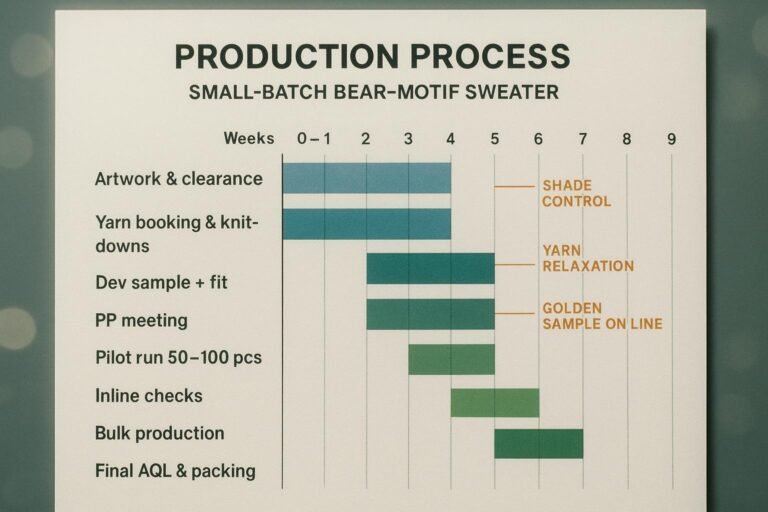
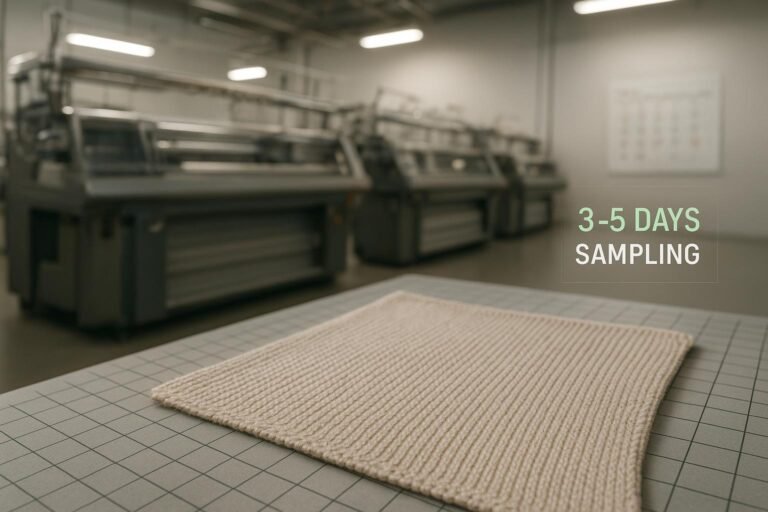
Baseline lead-time ladder (policy): samples 3–5 days; bulk production about 3 weeks, with buffers for custom-dyed/animal fibers and complex gauges.
Capacity & yarn booking (policy): 10% deposit locks both yarn and production lines for 21 days; refundable prior to the ETD-based cutoff.
Late delivery penalty (policy): fixed per-style, per-day deduction, capped at 10 days; exclusions for buyer-caused holds and force majeure.
Evidence-first: every step requires artifacts (e.g., deposit receipts, line allocation tickets, AQL reports) to keep the SLA auditable end-to-end.
How FW26 knitwear manufacturing lead time is structured
FW26 timelines are set as policy commitments and measured against ETD. The primary driver is material readiness (especially custom-dyed animal fibers), followed by gauge-specific productivity and finishing/shrinkage control. The term knitwear manufacturing lead time refers to the entire critical path from material booking through bulk completion, inspection, and ship readiness.
Policy baseline for FW26:
Samples: 3–5 days (Knowledge Base Source).
Bulk production: approximately 3 weeks (Knowledge Base Source), assuming yarn is on hand and PP approvals are locked.
Add buffers for: custom dyeing, fine-gauge complexity, and any rework triggered by shrinkage deviations.
For inspection, use AQL-indexed sampling plans (ANSI/ASQ Z1.4 / ISO 2859-1) commonly applied by inspection firms; for example guidance, see the QIMA overview and calculator in the AQL acceptable quality limit guide and the ASQ Z1.4 resource page.
Pre‑Season Checklist (ETD‑12w to ‑9w)
☐ Firm PO with SKU/size ratio matrix — Owner: Buyer — Deadline: ETD‑12w — Artifact: Signed PO & SKU matrix — Acceptance: PO aligns with forecast; change-freeze window agreed.
☐ Pay 10% deposit to lock yarn & lines (FW26 policy) — Owner: Buyer — Deadline: ETD‑12w — Artifact: Deposit receipt; reservation confirmation — Acceptance: Reservation valid 21 days; refundable before ETD cutoff.
☐ Yarn availability confirmation or custom-dye initiation — Owner: Factory/Buyer — Deadline: ETD‑11w — Artifact: Yarn booking confirmation; mill ETA — Acceptance: Booked quantities cover PO plus agreed waste allowance.
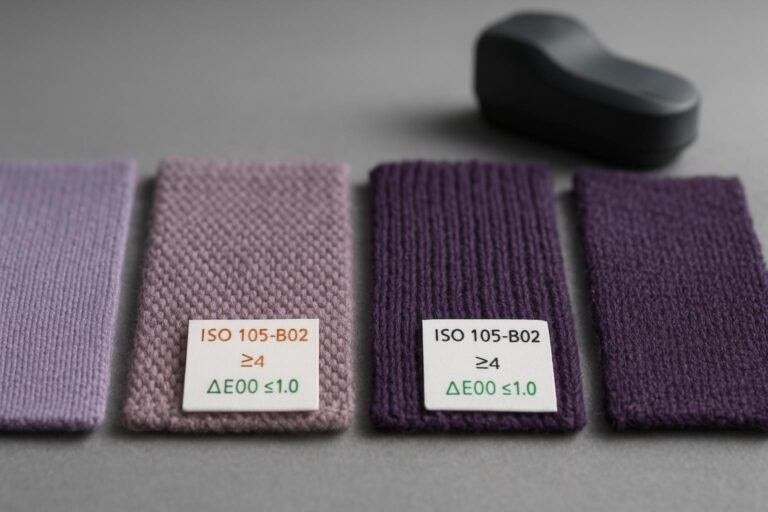
☐ Lab dip submits/approvals (if custom dye) — Owner: Factory/Buyer — Deadline: ETD‑11w to ‑9w — Artifact: Lab dip swatches; approval log — Acceptance: Color within agreed tolerance; approvals on time.
☐ Gauge & line allocation plan — Owner: Factory — Deadline: ETD‑10w — Artifact: Capacity chart excerpt; line allocation tickets — Acceptance: Reserved machine‑days by gauge meet PO volumes.
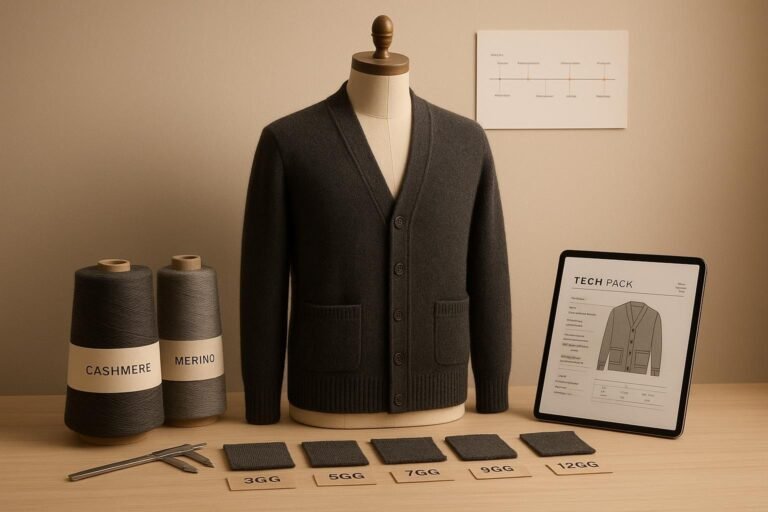
☐ Tech pack finalization & change-freeze — Owner: Buyer — Deadline: ETD‑10w — Artifact: Final tech pack; revision log — Acceptance: No critical changes after freeze without re-baselining timeline.
☐ Shrinkage test method agreement — Owner: Buyer/Factory — Deadline: ETD‑9w — Artifact: Test method (AATCC TM135 or ISO 5077) — Acceptance: Tolerance bands defined and documented. See AATCC TM135 standard overview and ISO 5077 portal for method context.
In‑Season Checklist (ETD‑9w to ‑3w)
☐ PP sample signoff & size set approval — Owner: Buyer — Deadline: ETD‑9w — Artifact: PP approval email; size-set report — Acceptance: No critical comments pending.
☐ Inline quality checkpoints scheduled — Owner: Buyer/Factory — Deadline: ETD‑6w — Artifact: Inline inspection plan — Acceptance: Scope covers knitting, linking, and finishing.
☐ Line start confirmation & throughput plan — Owner: Factory — Deadline: ETD‑6w — Artifact: Daily output plan by gauge — Acceptance: Throughput meets ETD with buffer for rework.
☐ Yarn inbound verification — Owner: Factory — Deadline: ETD‑6w — Artifact: Yarn receiving note; lot numbers — Acceptance: Lots match booking; dye lots traceable.
☐ Inline DHU tracking commenced — Owner: Factory — Deadline: ETD‑6w — Artifact: DHU log — Acceptance: Trend line consistent with DHU ≤ 1.5% policy.
☐ Shrinkage/finishing pilot run — Owner: Factory — Deadline: ETD‑5w — Artifact: Pilot shrinkage report — Acceptance: Within tolerance per agreed method.
☐ Inspection booking for PSI — Owner: Buyer/Factory — Deadline: ETD‑4w — Artifact: Booking ID — Acceptance: Slot confirmed with scope at AQL 2.5, Level II. See SGS final random inspection overview.
Pre‑Shipment Checklist (ETD‑3w to 0)
☐ Bulk completion & rework closure — Owner: Factory — Deadline: ETD‑2w — Artifact: Production report; rework log — Acceptance: RFT on last pass ≥ 95% (policy).
☐ Final measurement & shrinkage verification — Owner: Factory — Deadline: ETD‑10d — Artifact: Measurement sheets; shrinkage retests — Acceptance: All sizes within tolerance; retests passed using agreed method (AATCC/ISO).
☐ Final inspection (AQL 2.5, General Level II) — Owner: Buyer/Factory — Deadline: ETD‑5d to ‑2d — Artifact: PSI report — Acceptance: Pass per plan (e.g., lot size 4,000 → sample n≈200; accept ≤10). Reference methodology in QIMA’s AQL guide.
☐ Carton QA, packing list, and labeling checks — Owner: Factory — Deadline: ETD‑4d — Artifact: Packing list; label verification — Acceptance: No critical label/carton defects.
☐ Advanced Shipping Notice (ASN) & handoff booking — Owner: Factory — Deadline: ETD‑3d — Artifact: ASN; booking confirmation — Acceptance: Complete and accurate documents.
Post‑Shipment Checklist (Receipt to +30d)
☐ DHU & RFT season closeout — Owner: Factory/Buyer — Deadline: +7d from warehouse receipt — Artifact: DHU/RFT report — Acceptance: Meets FW26 hero KPI (RFT ≥ 95%, DHU ≤ 1.5%). For context on RFT/DHU usage in apparel, see Apparel Resources on quality measurement tools.
☐ Late-delivery penalty window (if applicable) — Owner: Buyer — Deadline: +30d from receipt — Artifact: Claim notice; evidence log — Acceptance: Claim filed with timestamps and exclusions documented.
☐ Lessons learned & forecast update — Owner: Buyer/Factory — Deadline: +30d — Artifact: Retro log; 12‑week rolling forecast — Acceptance: Updates reflected in next booking cycle.
Evidence matrix (compact)
Phase | Checklist item | Owner | Deadline (ETD‑relative) | Required artifact | Acceptance threshold |
|---|---|---|---|---|---|
Pre‑Season | Deposit 10% to lock yarn & lines | Buyer | ETD‑12w; 21‑day reservation | Deposit receipt; reservation confirmation | Reservation valid 21 days; refundable before ETD cutoff (policy) |
Pre‑Season | Lab dip submits/approval (if custom dye) | Factory/Buyer | ETD‑11w to ‑9w | Lab dips; approval log | Color within tolerance; approvals on time |
In‑Season | PP signoff & size set | Buyer | ETD‑9w | PP approval; size-set report | No critical comments pending |
In‑Season | Line allocation confirmation | Factory | ETD‑8w | Capacity chart excerpt; line tickets | Reserved machine‑days by gauge confirmed |
In‑Season | Inline inspection booked | Buyer/Factory | ETD‑4w | Booking ID | Slot confirmed; AQL 2.5 Level II scope |
Pre‑Shipment | Final inspection | Buyer/Factory | ETD‑5d to ‑2d | PSI report | Pass per AQL plan |
Pre‑Shipment | ASN & packing confirmation | Factory | ETD‑3d | ASN; packing list | Complete & accurate |
Post‑Shipment | DHU & RFT final report | Factory/Buyer | +7d after receipt | DHU/RFT report | Meets FW26 hero KPI |
Post‑Shipment | Penalty claim window | Buyer | +30d after receipt | Claim notice; evidence log | Applied per clause; exceptions documented |
Practical example — Reservation & deposit flow (FW26 policy)
Disclosure: AzKnit is our product. Example only; figures are policy mechanics, not past performance.
A buyer targets ETD‑12w for a core sweater. On ETD‑12w, the buyer pays a 10% deposit, which locks both yarn and production lines for a 21‑day window. The factory issues a yarn booking receipt with dye-lot ETAs and line allocation tickets by gauge. Lab dips are submitted within the first week and approved by ETD‑11w. PP and size set are signed at ETD‑9w, triggering line start planning. If the buyer cancels before the ETD-based cutoff, the deposit is refundable per policy; after the cutoff, the deposit is applied to incurred material/line commitments. Inline checks track DHU, and finishing pilots verify shrinkage. Final inspection is booked for ETD‑4d at AQL 2.5, Level II. Assuming pass, ASN and packing confirm at ETD‑3d, keeping the knitwear manufacturing lead time inside the planned window.
Late‑delivery penalty clause — mechanics & evidence (FW26 policy)
Model: Fixed per-style, per-day deduction; capped at 10 days.
Scope: Applies when shipment is later than the agreed ETD/window for supplier-caused reasons. Buyer‑caused holds, post‑freeze spec changes, and force majeure are excluded.
Formula: Deduction = Daily amount per style × min(actual late days, 10).
Evidence to include with claims: production logs, yarn booking confirmations, inspection bookings, handoff/ETD timestamps, 3PL arrival proofs, and email trails documenting any buyer holds.
Dispute window: 7–10 days from claim notice; parties may agree to cure via split shipments if “In Full” can be maintained.
Note: OTIF definitions vary across retailers; align penalty measurement points explicitly with your ETD window. For broader context on OTIF usage and variability, see McKinsey’s primer on defining OTIF.
Quality acceptance — RFT, DHU, and AQL references
RFT (Right First Time): percentage of units passing without rework at each gate. FW26 policy target ≥ 95%.
DHU (Defects per Hundred Units): total defects per 100 inspected units. FW26 policy target ≤ 1.5%.
AQL (Attribute sampling): Use ANSI/ASQ Z1.4 (ISO 2859‑1) plans; for example, a lot size of 4,000 at AQL 2.5 and General Level II yields a sample around n=200 with acceptance number Ac≈10. See AQL guidance and simulator and the ASQ overview of Z1.4 for methodology context.
Shrinkage standards: Agree methods up front (e.g., AATCC TM135 or ISO 5077) and verify at size-set and PSI to protect knitwear manufacturing lead time from rework loops.
Next steps (FW26)
If you need the FW26 capacity chart by gauge and a copy‑paste‑ready SLA clause, request the files and we’ll share the current season templates and booking forms. AzKnit can provide the FW26 capacity overview and SLA template upon request.