
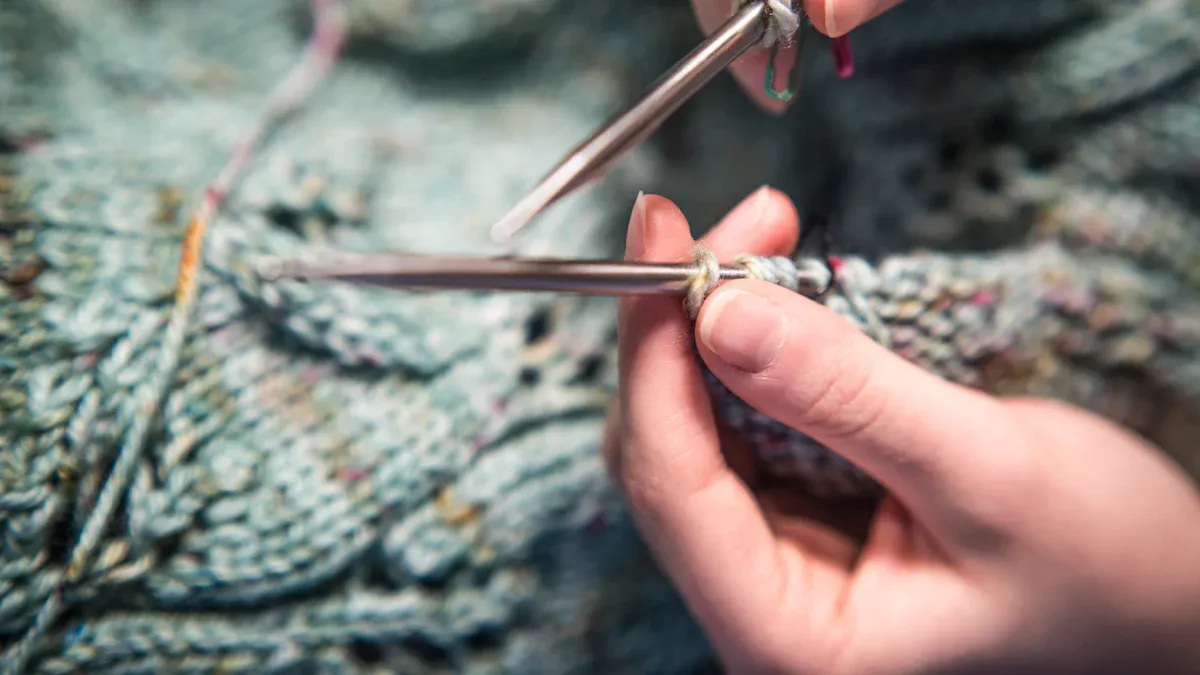
You might notice that each knitting style feels different in your hands. English and Continental knitting stand out because most knitters use them worldwide. Over 60% of knitters choose English style, while about 30% prefer Continental. The way you hold the yarn, move your needles, and sit with your project changes with each method. Some styles use quick wrist flicks, others rely on steady hand motions. When you look at a Knitting Styles Comparison, you see how comfort and speed can shift with technique. Try a few styles and see what feels right for you.
Key Takeaways
Try different knitting styles to see what feels best for you. Each style has its own way to help you knit better.
Think about how fast and easy each style is. Continental and Shetland styles are usually quicker. English style is simpler for people just starting.
Watch how your body feels when you knit. Continental and Portuguese styles need less hand movement. This can help your hands and shoulders feel less tired.
You can use different styles for different parts of your project. Try one style for knit stitches and another for purl stitches. This can help your hands stay comfortable.
Start with small projects to try new things safely. This helps you learn new ways to knit without getting stressed.
Knitting Styles Comparison
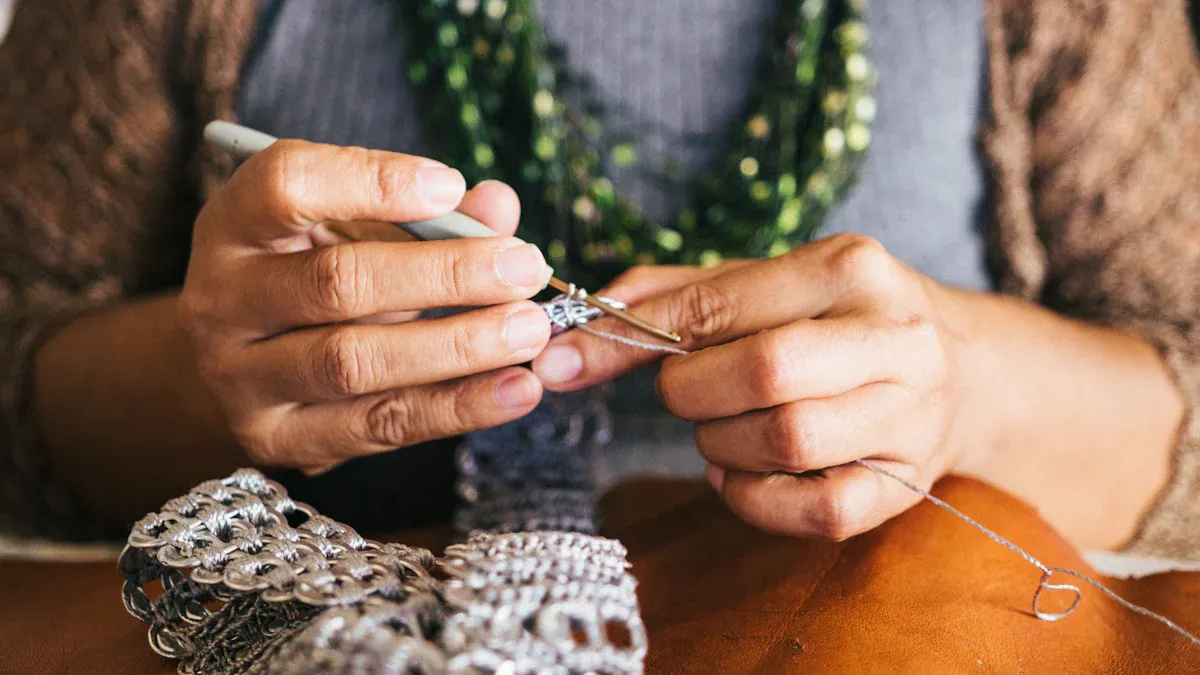
Overview Table
You may want to know how these five knitting styles compare. The table below shows the main ways they are different. It lists technique, speed, ergonomics, learning curve, and what each style is best for. This Knitting Styles Comparison lets you see all the facts quickly.
Style | Yarn Handling | Needle Handling | Speed | Ergonomics | Learning Curve | Suitability |
|---|---|---|---|---|---|---|
English | Yarn in right hand, thrown over | Personal tension, right hand throws | Slower | More movement, possible strain | Easier for beginners | Widely taught, many resources |
Continental | Yarn in left hand, picked | Right needle picks yarn | Faster | Less movement, less strain | Harder for beginners | Fast knitting, colorwork |
Lever | Yarn flicked with dominant hand | Hand near needle, quick flicks | Fast | Efficient, less strain | Moderate | Speed knitting, production |
Portuguese | Yarn around neck, minimal hand use | Less tensioning by hand | Moderate | Very gentle on joints | Moderate | Good for purl-heavy projects |
Shetland | Needle held against body | Dominant hand controls needle | Very fast | Stable, less tension | Moderate | Speed, traditional knitting |
Similarities and Differences
Let’s look at what is the same and what is different in each style. This Knitting Styles Comparison helps you spot these things fast.
Similarities:
All styles use two needles and yarn to make stitches.
You can knit flat or in the round with any style.
Each style lets you do basic stitches like knit and purl.
You can try new styles if you want to switch.
Differences:
Yarn Handling: English style uses your right hand to move the yarn. Continental style uses your left hand to pick the yarn. Lever style flicks the yarn with your hand. Portuguese style wraps the yarn around your neck. Shetland style holds the needle against your body.
Speed: Continental and Shetland styles are usually the fastest. English style is slower, but some people knit fast with it. Lever style is quick too. Portuguese style is in the middle.
Ergonomics: Continental and Portuguese styles use less movement. This can help if your hands or shoulders get tired. English style uses more arm and shoulder movement. This might make you feel sore. Lever and Shetland styles keep your hands close to the needles. This can be comfy for long knitting times.
Learning Curve: English style is often easier for beginners. The moves are simple to learn. Continental style can be hard at first, especially if you know English style. Lever, Portuguese, and Shetland styles need practice. Many knitters like them after they learn.
Suitability: If you want to knit fast or do colorwork, try Continental or Shetland styles. English style is popular in English-speaking places and has lots of guides. Portuguese style is good for projects with lots of purl stitches. Lever style is great if you want to knit for a long time without getting tired.
Tip: Try holding your yarn and needles in new ways. You might find a style that feels better or helps you knit faster.
This Knitting Styles Comparison can help you pick the best way to knit. Maybe you want to go fast, or maybe you want to be comfortable. Each style has something special for you.
English Style
Technique
You might hear people call English style “throwing.” You hold the yarn in your right hand and use it to wrap around the needle. Here’s how you do it:
Gather your yarn, needles, and pattern.
Hold the yarn in your right hand and cast on your stitches.
To knit, insert the right needle into the next stitch, wrap the yarn around the needle, and pull it through.
To purl, insert the right needle into the front of the stitch, wrap the yarn, and pull it through.
For ribbing, switch between knit and purl stitches, like 2×2 or 1×1 rib.
If you want to try colorwork, hold one yarn in each hand and keep the floats loose.
This method feels natural if you are right-handed. You control the yarn tension with your right hand.
Pros and Cons
Let’s look at what makes English style great and what can be tricky:
Pros:
Lets you focus on wrapping the yarn.
Gives you good control over yarn tension.
Feels natural for many right-handed knitters.
Cons:
Can be slower than other styles.
Switching between knit and purl can feel awkward.
Ribbing might get tedious.
If you don’t watch your posture, your hands and back might get sore.
Tip: Take breaks and check your posture. This helps you avoid soreness and keeps knitting fun.
Ergonomics
English style uses a “throwing” motion. You move your right hand and wrist a lot to wrap the yarn. This can lead to wrist strain if you knit for a long time without breaks. Some knitters feel finger cramps or even back pain if they hunch over. Try to keep your hands relaxed and your shoulders down. If you notice pain, stop and stretch. Every style, including English, can cause strain if you don’t pay attention to comfort.
Best For
You might like English style if you are just starting out. It works well if you want to follow along with most beginner guides. Many people find it easy to control the yarn and keep even tension. If you want to compare it with other methods, check the Knitting Styles Comparison section. English style is a solid choice for simple projects, learning new stitches, or when you want lots of resources and support.
Continental Style
Technique
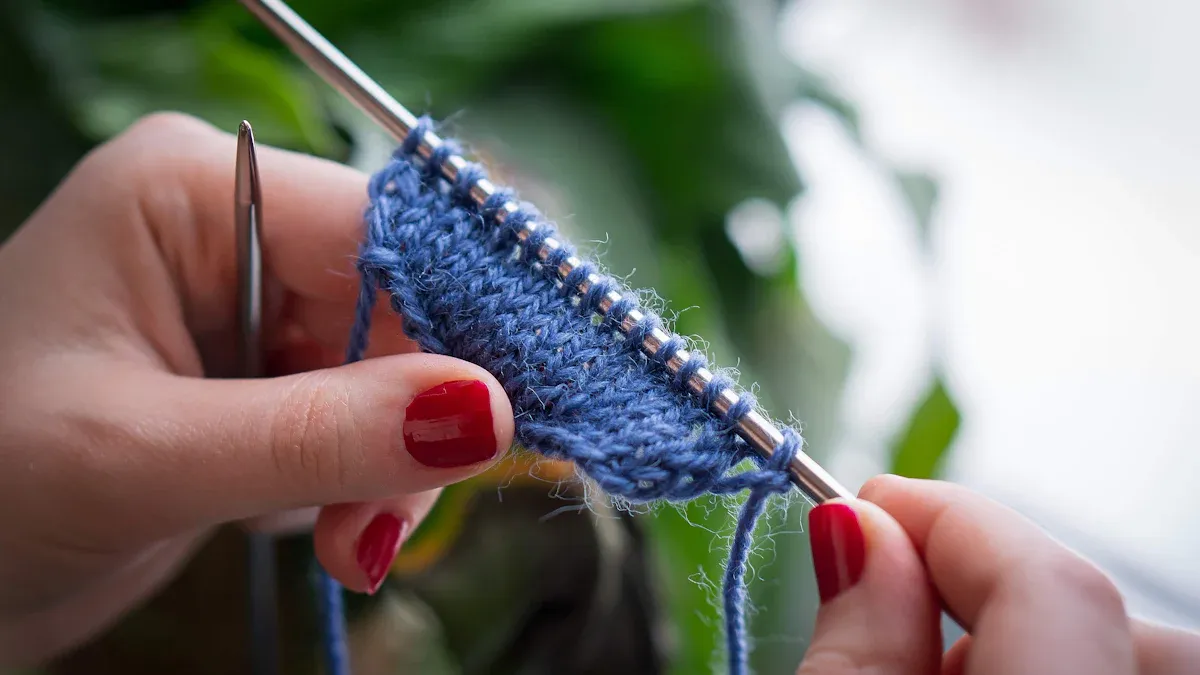
When you knit Continental style, you hold the yarn in your left hand. You use your left index finger to control the yarn tension. To make a stitch, you insert the right needle into the loop, then use the tip to pick up the yarn from your left hand. This motion is called “picking.” Many people who crochet find this style familiar because the yarn stays in the left hand. You move your hands less than in English style, which can make your knitting faster and smoother.
Tip: If you want to try Continental, practice holding the yarn in your left hand and use your finger to guide the yarn over the needle. It might feel strange at first, but it gets easier with practice.
Pros and Cons
Continental knitting has some clear benefits, but it also comes with a few challenges. Here’s a quick look:
Pros:
You use less hand movement, which can help you knit faster.
Many knitters say it feels more efficient, especially for long rows.
If you already crochet, you might pick up this style quickly.
Some people find it easier for colorwork.
Cons:
Some knitters feel more tension in their hands or fingers.
The learning curve can be steep if you start with English style.
Not everyone finds it comfortable, especially at first.
You might get a looser gauge until you master tension.
Some knitters say Continental style helps avoid repetitive motion injuries, but others notice more strain in their hands. Switching between styles can help if you feel discomfort.
Ergonomics
You move your hands less in Continental knitting. Most of the action happens with your fingers and wrists. This can make it easier on your shoulders and elbows. If you have joint pain, you might find this style more comfortable. Still, some people feel finger fatigue, especially when learning. Take breaks and stretch your hands to stay comfortable.
Best For
Continental style works well if you want to knit quickly or do lots of colorwork. If you already crochet, you might find it easy to learn. This style is popular in many European countries. You might like it if you want to try a new way to knit or if you want to compare it with other methods in the Knitting Styles Comparison. Give it a try and see if it fits your hands and your projects.
Lever Style
Technique
Lever knitting might surprise you with how smooth and quick it feels. You hold the yarn in your right hand, just like in English style. Instead of moving your whole hand to wrap the yarn, you use your index finger as a lever. This finger flicks the yarn to the needle point. One needle stays almost still, often anchored under your arm or pressed against your body. You create stitches with tiny, efficient movements. Many knitters in Britain’s old knitting mills used this method to knit for hours without getting tired. They sometimes used a knitting belt to keep the needle steady and their rhythm strong.
Tip: Try anchoring one needle under your arm or against your side. You might notice your hands move less, and your stitches fly off the needles!
Here’s how Lever knitting stands out:
You hold the yarn in your right hand.
Your index finger acts as a lever, bringing the yarn to the needle.
You minimize movement, which helps you knit faster.
Pros and Cons
Lever style brings some cool advantages, but you might find a few challenges too.
Pros:
Your hands move less, which can help prevent strain.
Great for long knitting sessions or big projects.
The technique works well for both knit and purl stitches.
Cons:
Learning the finger flick can feel awkward at first.
You may need to practice anchoring the needle.
Fewer video tutorials exist compared to English or Continental styles.
Ergonomics
Lever knitting keeps your hands close to the needles. You use small motions, so your wrists and shoulders get a break. Many knitters say this style helps them avoid pain, even after hours of knitting. If you worry about repetitive strain injuries, Lever style could be a good choice. You can compare how your body feels with Lever style and other methods in the Knitting Styles Comparison.
Best For
You might love Lever style if you want to knit quickly and comfortably. This method shines for speed knitting, production work, or marathon crafting sessions. If you plan to knit for hours or want a style that’s gentle on your joints, Lever knitting could be your new favorite.
Portuguese Style
Technique
You might find Portuguese knitting very different from other styles. You wrap the yarn around your neck or use a special pin on your shirt. This keeps the yarn tension steady and lets you use small, quick movements. When you knit, you hold the right needle at the first stitch with the yarn coming from the left needle, over the right needle, and around your neck. You insert the right needle through the stitch from front to back, then use your left thumb to flick the yarn over the needle-tip. You rotate the needle to catch the yarn and pull it through. For purl stitches, the yarn sits below the right needle. You insert the needle from back to front and flick the yarn with your thumb. These steps make purling very easy and fast.
Tip: Try wrapping the yarn around your neck or using a knitting pin. You might notice your hands feel less tired after a long knitting session.
Pros and Cons
Portuguese knitting has some unique benefits and a few challenges. Here’s a quick look:
| Pros — Cons | |— —| | Easier to learn and requires less hand movement. — Adapting to patterns written for other styles can be tricky. | | Purling is the easiest and fastest stitch. — You might end up with more purl stitches in your projects. | | Easy to switch between purling and knitting. — Getting advice from knitters using other styles may be harder. | | Carrying multiple yarn ends for colorwork is simple. — | | Flexibility in using both styles improves your skills. — |
Ergonomics
You use small, gentle motions in Portuguese knitting. Many knitters say this style helps reduce hand strain. If you have arthritis or sore joints, you might find Portuguese knitting much easier. Some people even say it saved them from giving up knitting because it uses less movement and keeps your hands relaxed. You keep your posture upright, and the yarn tension stays steady, which helps you knit for longer without pain.
Many knitters with arthritis switch to Portuguese style to avoid discomfort.
Wrapping the yarn around your neck or using a pin reduces hand fatigue.
You might notice less strain in your fingers and wrists compared to other styles.
Best For
Portuguese knitting works well if you want to knit for long periods without getting tired. If you love projects with lots of purl stitches, this style makes them much easier. You might enjoy it if you want to try colorwork or carry multiple yarns. If you compare it with other methods in the Knitting Styles Comparison, you’ll see how gentle and efficient it can be. Give Portuguese knitting a try if you want comfort and speed.
Shetland Style
Technique
Shetland knitting comes from the Shetland Isles. People there use yarn from Shetland sheep. The yarn is very fine and soft. Knitters often make patterns that show the island’s culture. Many use a knitting belt or sheath. This tool holds one needle against your body. It helps you knit fast and even while walking. In Shetland, people learned to knit by watching others. They did not always use written patterns. Some knitters can make up to 200 stitches each minute!
Here are some things that make Shetland knitting special:
| Characteristic Technique — Description | |— —| | Use of fine yarns — Soft fleece from Shetland sheep makes delicate projects. | | Traditional motifs — Patterns show the island’s history and culture. | | Historical context — Knitting helped families earn money at home. | | Memory-based knitting — Skills passed down without books or patterns. | | Speed of knitting — Some knitters go as fast as 200 stitches a minute. | | Ability to knit while moving — Knitting belts let you work on the move. |
Pros and Cons
You may want to know the good and bad parts of Shetland knitting. Shetland yarn comes in many colors and is very strong. Projects last a long time because the yarn is tough. Using a knitting belt makes your work faster and easier. You do need special needles for this style. Big needles can be hard to use with it.
| Advantages — Disadvantages | |— —| | Shetland yarn is useful for many projects — You need special needles and sizes | | Many colors to pick from — Big needles can be hard to use | | Yarn is strong and lasts a long time — | | Knitting belt helps you work faster — |
Tip: Try a knitting belt if you want to knit faster and feel more comfortable.
Ergonomics
With Shetland knitting, your hands stay close to your body. The knitting belt helps stop wrist and shoulder pain. You can knit for a long time and not get tired. Many people say this style feels steady and gentle. You may feel less tension in your hands than with other styles.
Best For
Shetland knitting is great for lace, Fair Isle, and special family projects. You might like books such as “Enjoy Fair Isle Knitting” by Chihiro Sato or “The Magic of Shetland Lace Knitting” by Elizabeth Lovick. If you want to learn more, try “Heirloom Knitting” by Sharon Miller. This style is best when you want to knit fast, use old traditions, and make colorful patterns.
Side-by-Side Comparison
Speed and Efficiency
You may want to know which style is fastest. Continental and Shetland styles help you finish projects quickly. Continental uses fewer hand moves, so you knit fast. Shetland knitters use a knitting belt to go even faster. Lever style is also quick, especially if you hold your needle still. English style is slower because you throw the yarn with your right hand. Portuguese style is in the middle. You use your thumb to flick the yarn, which gets faster with practice.
Continental and Shetland: Fastest for most people
Lever: Quick, good for long knitting times
Portuguese: Medium speed, very steady
English: Slower, but some knitters get fast with time
If you want to make a big blanket or sweater, try Continental or Shetland. You might finish faster!
Learning Curve
Each style takes a different amount of time to learn. English style is easy for most beginners. There are lots of guides and videos for it. Continental style is harder if you start with English. Lever, Portuguese, and Shetland styles take more practice. Shetland style may need a knitting belt. Portuguese style asks you to wrap yarn around your neck or use a pin, which feels new at first.
English: Easiest for most beginners
Continental: Harder if you switch from English
Lever: Needs practice with finger flicks
Portuguese: Medium, but gentle on hands
Shetland: Medium, may need special needles or belt
Don’t worry if a style feels odd. You will get better with practice and time.
Comfort and Ergonomics
You want to feel good while you knit. Continental and Portuguese styles use less movement, so your hands and shoulders stay relaxed. Lever and Shetland styles keep your hands close to your body. You can knit for hours without getting tired. English style uses more arm and wrist motion. You might feel sore if you knit for a long time.
Continental: Less movement, gentle on joints
Portuguese: Very gentle, great for sore hands
Lever: Efficient, helps prevent strain
Shetland: Stable, less tension, good for long knitting
English: More movement, possible strain
Try new styles if your hands hurt. You might find one that feels better.
Colorwork and Special Uses
You may want to knit with many colors or fancy stitches. Experts say Continental and English styles are good for colorwork. You hold one yarn in each hand, so it is easy to switch colors. Pick yarns with strong contrast so your pattern stands out. Portuguese style lets you carry more than one yarn, which helps with colorwork too. Shetland style is best for Fair Isle patterns. You use fine yarns and make pretty designs. Lever style works for colorwork, but you need to practice where to put your needle.
Continental: Great for colorwork, fast switching
English: Good for colorwork, easy to control tension
Portuguese: Simple to carry many yarns
Shetland: Best for Fair Isle and lace
Lever: Works for colorwork, needs practice
Pick bold yarn colors for your colorwork. Your patterns will stand out!
Regional Preferences
Knitting styles change in different places. English knitting is common in the United States, United Kingdom, Canada, and Australia. Continental style is popular in Germany and Scandinavia. Portuguese knitting is used in Portugal and parts of South America, like Peru and Brazil. Lever style is found in the UK and Ireland. Shetland style comes from the Shetland Isles, where knitters use special belts and fine yarns.
Knitting Style | Popular Regions |
|---|---|
English | United States, United Kingdom, Canada, Australia |
Continental | Germany, Scandinavia |
Portuguese | Portugal, Peru, Brazil |
Lever | UK, Ireland |
Shetland | Shetland Isles |
You might find local knitting groups that use the style most common in your area.
Knitting Styles Comparison
You see many differences when you look at a Knitting Styles Comparison. Speed, comfort, and learning curve all change with each style. Some styles help you knit faster, while others keep your hands relaxed. You might choose a style based on your favorite projects or where you live. You can use the Knitting Styles Comparison table to pick the best method for you.
English style: Easy to learn, slower, popular in English-speaking countries
Continental style: Fast, less movement, good for colorwork, common in Europe
Lever style: Quick, efficient, used in UK and Ireland
Portuguese style: Gentle, great for purling, found in Portugal and South America
Shetland style: Very fast, traditional, best for lace and Fair Isle, from Shetland Isles
Try each style and see which one fits your hands and your projects. You might find a new favorite!
Choosing Your Style
Comfort and Needs
You want knitting to feel good in your hands. Think about how your body feels when you knit. Do your wrists get tired? Does your back ache after a while? Try different styles and notice which one feels best. Some knitters like the gentle motions of Portuguese style. Others prefer the speed of Continental or Shetland. You might need to switch styles if you feel pain or strain. Your comfort matters most.
Ask yourself: Which style feels easiest on your hands?
Try short sessions with each style.
Listen to your body and take breaks.
Tip: If you feel sore, stretch your fingers and shoulders. Change your position often.
Experimenting Safely
You can explore new knitting styles without worry. Start with small projects like swatches or dishcloths. Use yarn and needles you already have. Watch videos or read guides to learn the basics. Practice for a few minutes each day. You do not need to master a style right away. Take your time and enjoy the process.
Pick a simple pattern for practice.
Use soft yarn that feels nice.
Try one new style at a time.
Note: You do not need special tools to start. Most styles work with regular needles.
Mixing Styles
You do not have to stick to one style. Many knitters switch between styles for different projects. You might use Continental for fast knitting and English for colorwork. Some people mix styles in the same project. This keeps your hands fresh and helps you learn new skills.
Use one style for knit stitches and another for purl.
Change styles if your hands get tired.
Mix styles to find what works best for you.
Individuality
Your knitting style is part of who you are. You can choose any method that fits your needs. There is no right or wrong way to knit. You might invent your own style or blend techniques. Share your favorite style with friends or online groups. Celebrate your unique way of knitting!
😊 Remember: Your comfort and joy matter most. Knit your way and enjoy every stitch!
You get to choose the knitting style that feels best for you. Your comfort matters most. Try out different styles and mix techniques until you find your favorite. There’s no single “best” way—only what works for you.
Practice with small swatches.
Join a knitting group or online community.
Share your progress and learn from others.
Tip: Keep experimenting! You might discover a new style that makes knitting even more fun. 😊
FAQ
What style should I try first?
You can start with English style. Many beginners find it easy. If you want to knit faster, try Continental. You might switch styles later. Pick the one that feels best in your hands.
Can I mix knitting styles in one project?
Yes! You can use different styles for knit and purl stitches. Mixing styles helps your hands stay comfortable. Some knitters switch styles for colorwork or speed.
Do I need special tools for Shetland or Portuguese knitting?
You don’t need special tools to start. For Shetland, a knitting belt helps with speed. Portuguese style works with a yarn pin or just wrapping yarn around your neck. Most styles use regular needles.
Which style is best for sore hands or joints?
Portuguese and Continental styles use less movement. Many knitters say these styles feel gentle on hands and wrists. You can try both and see which one helps you knit longer.