
If you run a DTC label or creator-led brand, you don’t have quarters to wait—sometimes you barely have a week. This guide shows exactly how to work with an OEM knitwear manufacturer to turn a complete tech pack into samples in 3–5 days, move to ~3‑week bulk production, and validate quality with standards-backed methods. We’ll be candid about prerequisites (yarn availability, fast approvals) and the routines that protect you from the two biggest risks for small orders: deprioritized SLAs and batch-to-batch variance (color, pilling, shrinkage).
Read straight through if you’re new to OEM/ODM. If you’re juggling a live drop right now, jump to the sampling sprint and the scenario walkthroughs—you’ll find timelines, gates, and acceptance criteria you can apply today.
Key takeaways
3–5 day sampling and ~3‑week bulk are achievable targets when you lock inputs (yarn, gauge), share a complete tech pack, and commit to 24‑hour feedback cycles; treat these as SLAs with explicit prerequisites.
To keep small orders from falling to the back of the queue, align on a prioritized slotting plan and inspection gates indexed to ISO 2859‑1 AQL levels; this pairs speed with discipline.
Control variance where it starts: specify wash/finish protocols, set shrinkage targets using AATCC TM135, validate colorfastness with AATCC TM61, and define pilling resistance via ISO 12945; one golden size set prevents drift on replenishment.
How to choose an OEM knitwear manufacturer for speed and quality
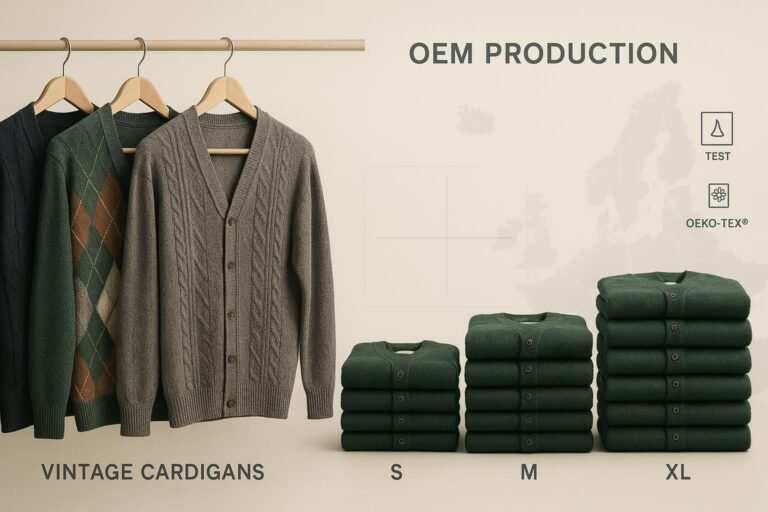
If you have a defined aesthetic and detailed specs, OEM is the straight path: you own the design, the factory executes with process engineering and sourcing support. If you need design support or a faster starting point, ODM can provide base bodies and stitch libraries you can customize. For DTC brands running capsule drops, a hybrid is common: start with an ODM base to cut concept time, then shift to OEM-level specs for repeatability and exclusivity once a style proves out. Either way, decide early how you’ll verify compliance claims and what inspection regime you’ll accept before you wire a deposit.
How an OEM knitwear manufacturer compresses the sampling sprint (3–5 days)
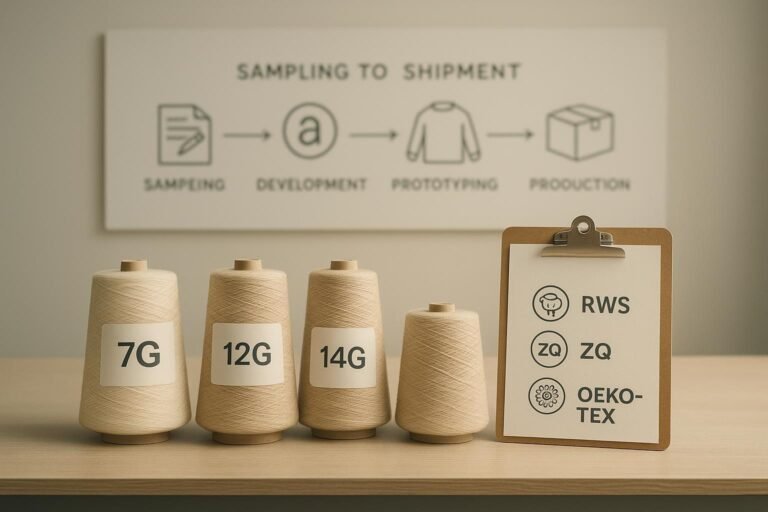
A 3–5 day target is real when two things are true on Day 0: yarn is confirmed (in-stock or swatchable) and your tech pack is complete. Think of the sprint in three arcs.
Arc 1 — Inputs locked: Your tech pack includes stitch/gauge, yarn/fiber details, measurement spec with tolerances, color reference (Pantone or lab dip), trims, label/care content, and wash/finish notes. The factory confirms machine gauge availability and books a sample slot. You both pre‑agree the approval windows you’ll hit (e.g., 24 hours turn for fit comments).
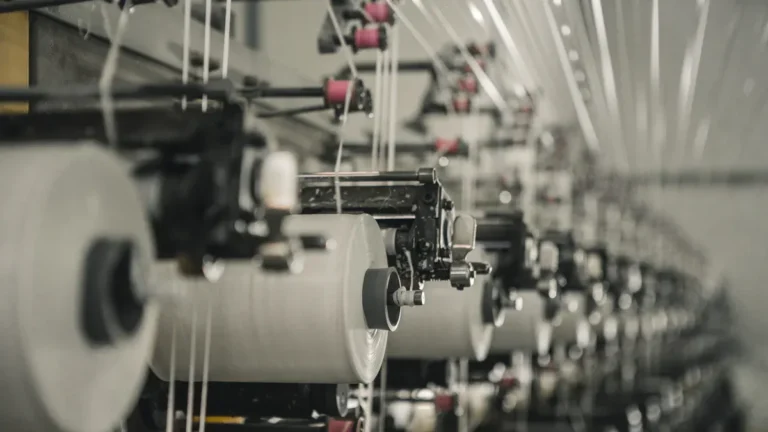
Arc 2 — Programming to first proto: The knitting team programs patterns and tension profiles, knits panels, then links, washes, and presses to the declared protocol. For styles at risk of shrinkage surprises, a quick‑wash using the philosophy of AATCC TM135 can flag problems early so you don’t waste a day on the wrong finishing path.
Arc 3 — Fit comments to SMS sign‑off: You receive fit photos and measurements or a couriered proto. You respond the same day with pass/hold notes and any graded spec adjustments. If the first proto passes, a salesman sample (SMS) with correct labels and finishing follows right away; if not, one revision cycle fits inside the 5‑day window when scope is stable.
A neutral, real‑world example: At AzKnit, a typical 3–5 day sprint starts once yarn and gauge are confirmed. Day 1 programs and knits; Day 2 links and finishes; Day 3 presses and measures; Day 4 ships the proto express if needed; Day 5 reserves the SMS slot pending your comments. Complex jacquards or new yarn sourcing can add a day or two—plan buffers for novelty.
Tech packs that prevent rework (and keep bulk aligned with sampling)
Your tech pack is the contract your line can live or die by. Include fiber/yarn details (e.g., 2‑ply 26s merino vs 1‑ply cashmere), stitch and gauge, a graded measurement chart with tolerances, finishing and pressing notes, and a clear wash protocol that will also apply in bulk. State shrinkage allowances in the pattern and measurement tables. For color, lock to Pantone or a lab dip and note acceptable Delta E where relevant. The closer your sampling wash/press protocol is to bulk, the fewer “surprise” deltas you’ll fight later. Here’s the deal: a clean spec up front saves two rounds of back‑and‑forth later when you have the least time to spare.
Quality control and lab testing that scale with speed
Fast doesn’t mean loose. It means you move gates earlier and define acceptance in plain language. Pair an ISO 9001‑style process mindset with concrete inspection and lab checks.
Agree your inspection regime in ISO 2859‑1 terms (AQL‑indexed plans) and define defect classes (critical/major/minor) you’ll accept at final inspection; use the same language with any third‑party inspector. According to the ISO organization’s quality management portal, the process approach and continual improvement principles sit at the heart of ISO 9001—align your SOPs to that mindset. See the overview on the official ISO site: ISO quality management portal.
Anchor lab tests to real risks: use AATCC TM135 for dimensional change targets, AATCC TM61 to stress colorfastness to laundering, and ISO 12945 for pilling resistance; specify acceptable ratings in your PO. Method resources: AATCC TM135 page, AATCC TM61 page, and the ISO catalogue entry for ISO 12945‑3:2020.
Keep a golden size set and control charts for replenishment; align sampling vs bulk finishing and pressing SOPs so your second order measures like the first. For inspection acceptance planning, reference the ISO 2859‑1 listing via the ISO Online Browsing Platform: ISO OBP index.
For labeling and compliance claims, consult OEKO‑TEX’s guidance on how STANDARD 100 labels may be used and verified; claims must be specific to certified articles and verifiable via Label Check. Review the overview here: OEKO‑TEX Labelling Guide and Label Check.
MOQ, pricing, and cost drivers you should expect
Low‑MOQ doesn’t have to mean chaos. Treat tiers as policy, not negotiation theater. A concise example table helps teams plan cash and inventory. These are illustrative planning tiers you can adapt with any OEM partner.
Tier | Pieces per style/color | Typical impact on unit cost | Notes |
|---|---|---|---|
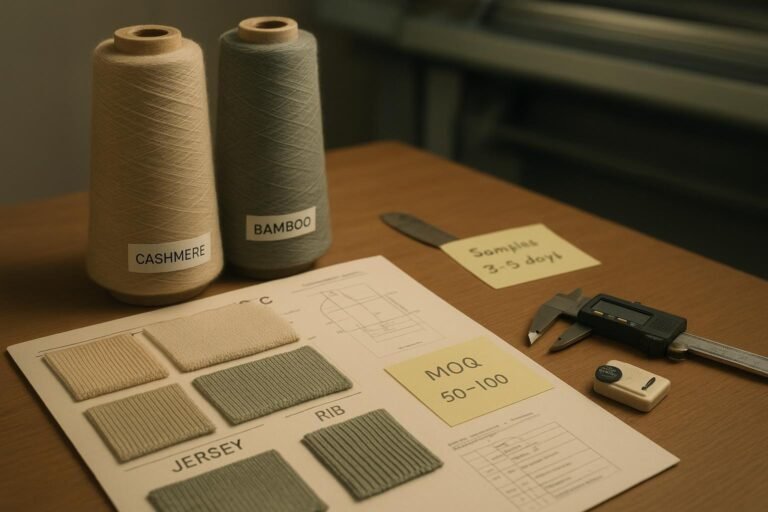
Test | 50 | Highest | Feasible for market testing; check yarn dye‑lot constraints and whether a surcharge applies. |
Pilot | 100 | High | Better efficiency; closer to economic order quantity for many yarns. |
Standard | 300 | Medium | Unlocks better knitting/linking efficiency and finishing batch sizes. |
Scale | 500 | Lower | Best alignment with dye lots; strongest leverage on price and lead time. |
Beyond count, cost moves with fiber price (cashmere vs merino), stitch complexity (e.g., jacquard, cables), gauge, linking intensity, washing/finishing time, and packaging. Clarify whether a 50‑piece tier is surcharge‑free for your style and fiber; some factories can waive small‑lot uplifts when yarn is in mill stock and operations slotting is predictable.
Four real scenarios, step by step
Use these walkthroughs to sanity‑check timelines and acceptance gates. They’re written for DTC teams that need speed without surprises.
7‑day pre‑live‑stream drop You’ve got a creator event next week. Day 0: confirm yarn and gauge, book a sample slot, and commit to 24‑hour approvals. Day 1–2: program/knit; Day 3: finish/press; Day 4: measure and courier. Your acceptance spec is a visual fit pass and measurements within tolerance; you publish studio shots from the sample on Day 6. Bulk kicks off with the same finishing SOP, and you pre‑book a 3‑week line slot contingent on Day‑4 pass.
Seasonal capsule small‑batch test You want four styles at 50 pcs each to probe demand. Pick low‑risk yarns with known shrinkage behavior and keep stitch complexity modest so samples hit in 3–5 days. Your acceptance criteria: TM135 shrinkage within your target range, TM61 colorfastness at acceptable grade, and pilling performance aligned to an ISO 12945 expectation. Use the “Test” or “Pilot” tier for the first run and lock learnings into the second buy.
Hot‑seller replenishment with size consistency The size run must match your golden set. Keep the finishing and pressing SOPs identical to sampling; hold tolerances tightly and track measurement means each day in bulk. Your acceptance criteria: no drift beyond tolerance on the golden size set, and a final inspection plan referenced to ISO 2859‑1 so you’re aligned with any third‑party check.
Scaling from 50 to 1,000 units Plan the ramp before you need it. Duplicate gauge capacity to avoid bottlenecks, align dye lots across the full quantity, and confirm that linking and finishing capacity scale with knitting. Keep lab methods constant between lots and lock labels/care to the same spec so you don’t trigger relabel delays. Your acceptance spec includes the same test methods and AQL levels you set at 50 units—consistency is the product.
Logistics and duties without surprises
Trade terms decide who carries risk and cost at each step. For many DTC teams, FOB offers control and transparency, while DDP can remove complexity at a price. If you’re not sure, review the International Chamber of Commerce’s official rules hub for the latest Incoterms definitions: ICC Incoterms rules hub. When you need to estimate U.S. duties for a knit pullover (HS 6110 family), use the U.S. International Trade Commission’s live database and check the exact 10‑digit code: USITC HTS search. In the EU, verify current MFN duty via the EU TARIC consultation tool before you quote a landed price.
Next steps: a vendor‑qualification checklist you can run this week
Confirm the sampling SLA (3–5 working days) and production target (~3 weeks) in writing with prerequisites listed (yarn availability, approvals, slotting), and define the escalation path if a gate slips.
Share a complete tech pack and agree on wash/finish protocols for both sampling and bulk; embed shrinkage allowances and tolerances in your measurement tables.
Set your QC and lab framework up front: reference ISO 2859‑1 for inspection plans and require AATCC TM135/TM61 and ISO 12945 where relevant; request reports from accredited labs and keep a golden size set.
References and tools mentioned (original sources):
OEKO‑TEX labeling and verification guidance: OEKO‑TEX STANDARD 100 labelling guide.
ISO Quality Management (ISO 9001 principles and process approach): ISO quality management portal.
ISO 2859‑1 (AQL framework) access point: ISO OBP index.
ISO 12945‑3:2020 pilling method: ISO catalogue entry.
AATCC TM135 (dimensional change after laundering): AATCC catalogue entry.
AATCC TM61 (colorfastness to laundering): AATCC catalogue entry.
ICC Incoterms rules hub: ICC official page.
USITC HTS database: Chapter 61 and HS 6110 lookups.