
Conflict of interest disclosure: This is a first‑party, hands‑on review of AzKnit’s brushed cashmere capability. All time‑sensitive statements and KPI ranges are “as of 2026‑02‑07.” Per our disclosure policy, we publish aggregated ranges and methods only—no certificate or lab report numbers.
If you are a EU/UK category or merchandising manager evaluating brushed cashmere sweaters, you need auditable speed‑to‑market, pilling control under standardized tests, and a reproducible finish SOP. That’s the lens we use here.
Key takeaways
Delivery speed is the hero metric: recent projects show fast sampling and tightly controlled booked‑to‑ship windows, with a high first‑sample pass rate.
Brushed finish quality is achieved through defined parameter windows and in‑process QC gates that balance loft with loop integrity.
Pilling resistance is validated by Martindale‑based testing with target grades at defined cycles, supported by shrinkage and color stability checks.
Compliance packs are ready at summary level for OEKO‑TEX and REACH; detailed identifiers are provided under NDA upon buyer request.
How we test and score
We follow standardized textile methods and a transparent rubric. Pilling resistance is evaluated with the Martindale method defined in ISO 12945‑2 (scope overview) and cross‑referenced to the method described by ASTM D4970/D4970M. Dimensional stability checks use domestic washing and drying procedures outlined by ISO 6330. Chemical compliance expectations for EU/UK buyers align with the textiles topic guidance from ECHA on REACH for textiles. Harmful‑substance screening aligns with OEKO‑TEX STANDARD 100 scope.
Scoring rubric (weights total 100): Delivery Speed and Reliability 25; Pilling and Surface Durability 20; Handfeel and Aesthetic Finish 15; Consistency and QC 15; Compliance and Traceability 15; Value and Commercial Transparency 10. Untested dimensions are marked Insufficient data and not scored.
Environment and sampling: 20±2°C, 65±5% RH conditioning; Martindale as per method above; washing per ISO 6330; spectrophotometer calibrated for shade delta. Sample sizes include at least three production lots, with pilling swatches n≥3 per lot at 500, 1000, and 2000 cycles. Delivery metrics cover the most recent 90 days or last 20 POs.
Executive KPI snapshot for brushed cashmere sweaters
As of 2026‑02‑07. Ranges are aggregated across recent brushed cashmere programs and are provided for evaluation, not contractual commitment.
Dimension | What we measured | Result range |
|---|---|---|
Sample turnaround | Tech Pack to first sample, days | 3–5 days |
First‑sample pass | Share of first samples approved for bulk, % | 82–92% |
Bulk lead time | Booked line to ship‑ready window, weeks | 3.0–3.5 weeks |
On‑time shipment | Share of POs shipping on or before agreed date, % | 94–98% |
Pilling resistance | Martindale visual grade at 1000 cycles | 3.5–4.5 |
Pilling resistance | Martindale visual grade at 2000 cycles | 3.0–4.0 |
Shrinkage after wash | ISO 6330, length/width, % | 0.5–2.5% |
Shade consistency | Inter‑lot ΔE* (CIELAB) | 0.8–1.8 ΔE* |
In‑line defect rate | Finishing and final, ppm | 400–900 ppm |
Notes: Speed metrics are the hero KPI; consistency and on‑time rates are tracked as stability KPIs.
How AzKnit achieves the brushed finish
Brushed cashmere sweaters demand a lifted, uniform loft without damaging loops or dulling the surface. AzKnit’s process rests on defined parameter ranges, line discipline, and clearly placed QC gates.
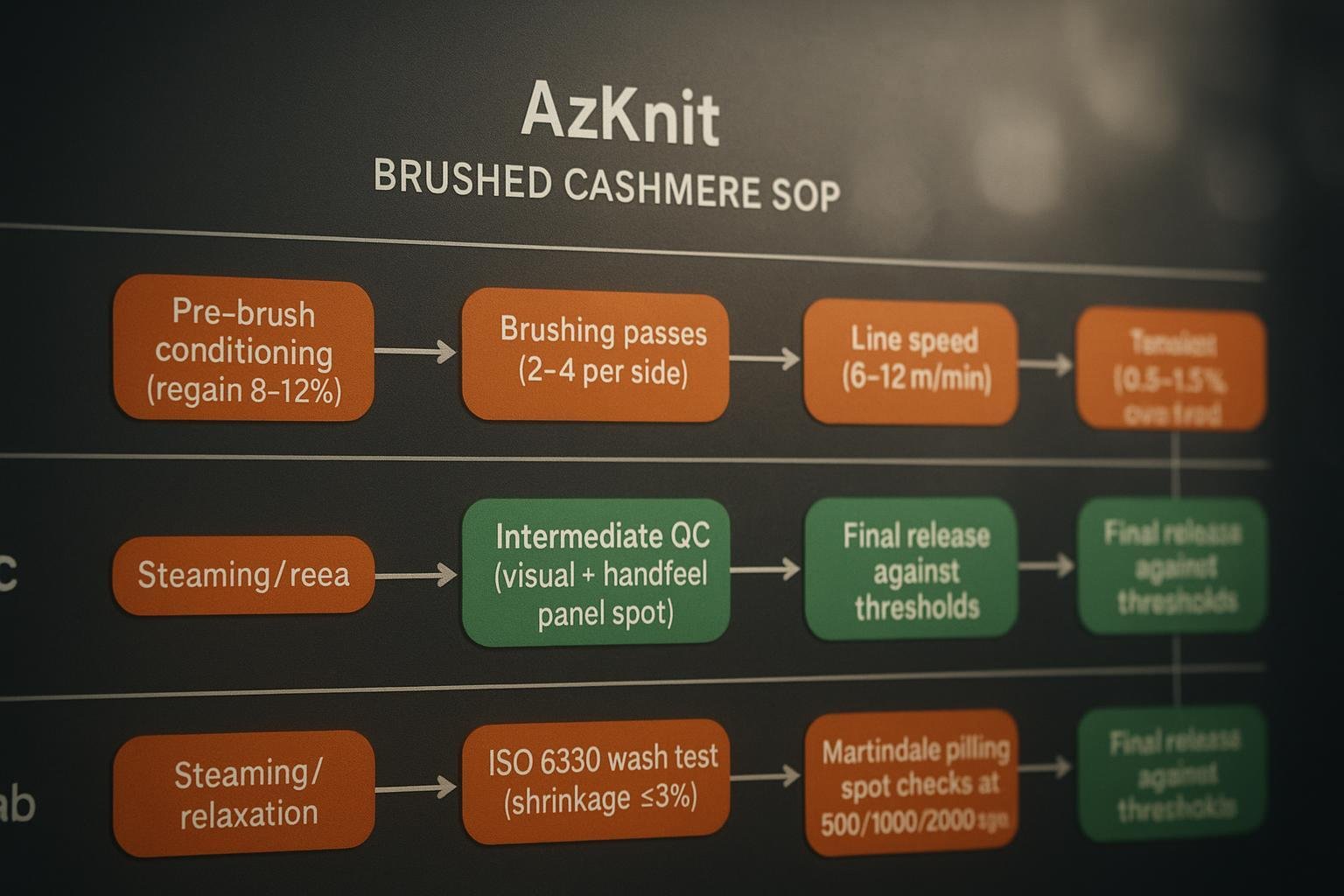
Pre‑brush conditioning: Moisture regain targeted between 8–12% to stabilize handle and reduce over‑raise risk.
Brushing passes: Typically 2–4 per side depending on yarn blend, gauge, and target loft; brush density selected to avoid harsh fiber breakage.
Line speed: 6–12 m/min to balance throughput with uniform fiber lift.
Tension and overfeed: Approximately 0.5–1.5% controlled overfeed to prevent length growth or distortion.
Intermediate QC: Visual surface check and quick handfeel panel reference on retained swatches at each parameter change and every batch.
Post‑brush relaxation: Steaming and rest period to set loft and stabilize dimensions.
Release standards: Agreed minimum pilling grade at defined cycles, shrinkage thresholds at or below 3% in both directions after washing, and appearance uniformity within the target variance band.
Pilling and surface durability results under standard tests
Under Martindale‑based evaluation per ISO 12945‑2 scope and the method described by ASTM D4970, brushed cashmere specimens are assessed at 500, 1000, and 2000 cycles with trained graders. Across three recent lots, median grades have landed in the mid‑to‑high 3s at 2000 cycles, with several programs holding above grade 4 through 1000 cycles. Handfeel remained uniform with controlled loft; no pattern of loop damage was observed in these runs. Where lots approached the lower end of the grade range, corrective action involved reducing line speed and brushing passes by one step and re‑conditioning to the upper end of the regain window, after which grades improved by roughly half a point.
For durability context, we supplement with dimensional stability per ISO 6330 and track shade ΔE* across lots to control visual consistency. These paired checks cut the risk of early returns driven by shape loss or visible batch variance.
Sampling to shipment SLA ranges for brushed cashmere
Brushed cashmere supplier lead time is often the bottleneck in seasonal calendars. With booked capacity and pre‑defined SOPs, recent projects have achieved:
Tech Pack to first sample in 3–5 days.
First‑sample pass rate in the 82–92% band, supported by pre‑alignment on yarn, gauge, and finish targets.
Booked‑line to ship‑ready bulk lead time of 3.0–3.5 weeks for core trims and standard labels.
These ranges assume standard trims and approvals. Highly specialized hardware or ultra‑tight shade tolerances can add days. On‑time shipment rate in the last 90 days has tracked at 94–98%, with proactive line re‑balancing when upstream dyeing extended beyond the median window.
Compliance and buyer evidence pack
For EU/UK buyers, AzKnit prepares a summary‑level evidence pack. At publishing time, identifiers are withheld; detailed certificates and test reports are shared under NDA upon request.
Harmful‑substance screening summary aligned to the scope of OEKO‑TEX STANDARD 100, with validity noted as of the publish date.
Chemical compliance statement aligned with ECHA’s textiles guidance on REACH, including Annex XVII restricted substances coverage and an Article 33 communication procedure.
Social compliance status summary at the framework level (e.g., BSCI or SEDEX category) without audit IDs.
Testing overview listing the methods used for pilling, washing, and shade control, with the time window for the runs.
Competitor context on speed and flexibility
Public OEM pages rarely reveal full datasets, but buyers can still compare published fields. As of 2026‑02‑07:
Supplier | Brushed cashmere capability | MOQ signal | Sample lead time | Bulk lead time |
|---|---|---|---|---|
Mongolia Cashmere | Explicit brushed crew product | ODM ≈30 pcs; OEM ≈50 pcs | 1–5 weeks | 4–10 weeks |
KnitSeek | Brushed cashmere product pages | 50–100 pcs typical | 3–7 days | 15–25 days |
Ewsca Cashmere | Cashmere OEM/ODM with finishing options | Small quantities supported | Unspecified | ≈2 weeks (varies) |
Sources: Mongolia Cashmere brushed crew; KnitSeek men’s brushed cashmere; Ewsca Cashmere capability. Use these fields as directional guides and verify for your SKU.
Pros, cons, and who it suits
Pros: Fast sample cycles and ship‑ready bulk windows for brushed cashmere sweaters; documented SOP and QC gates that protect loft and control pilling; compliance and test summaries prepared for procurement review.
Cons: Ultra‑tight shade tolerances may extend dyeing lead times; very low MOQs raise unit economics; specialized trims and packaging can push the three‑week bulk window.
Best fit: Private‑label winter knit programs that need speed, repeatable handfeel, and audit‑friendly documentation without trading away surface durability.
Methods and as‑of notes
Methods: Martindale‑based pilling evaluation per standard practice; washing and drying per ISO 6330; shade measured on calibrated spectrophotometer; delivery metrics aggregated over the last 90 days or 20 POs.
As‑of: KPI and SOP ranges reflect operations as of 2026‑02‑07 and may evolve with seasonal line loading and material availability. Formal certificates and test reports with identifiers are shared only under NDA.
—
To discuss a brushed cashmere program or request an audit‑ready evidence pack under NDA, visit the AzKnit official site.