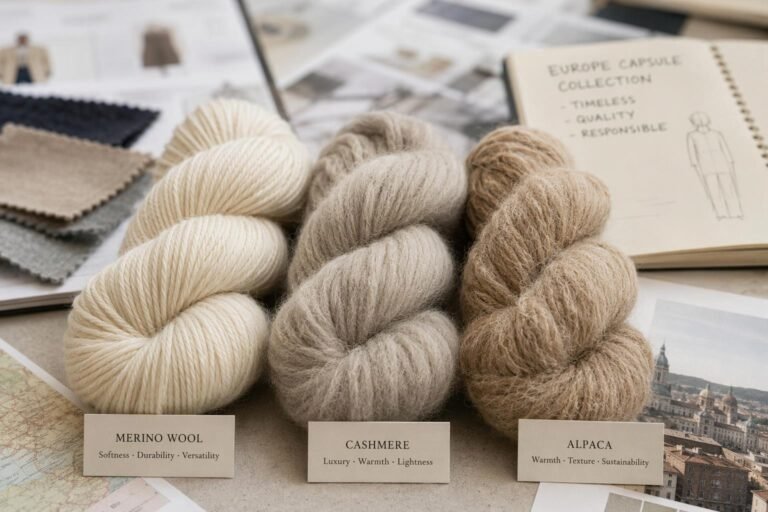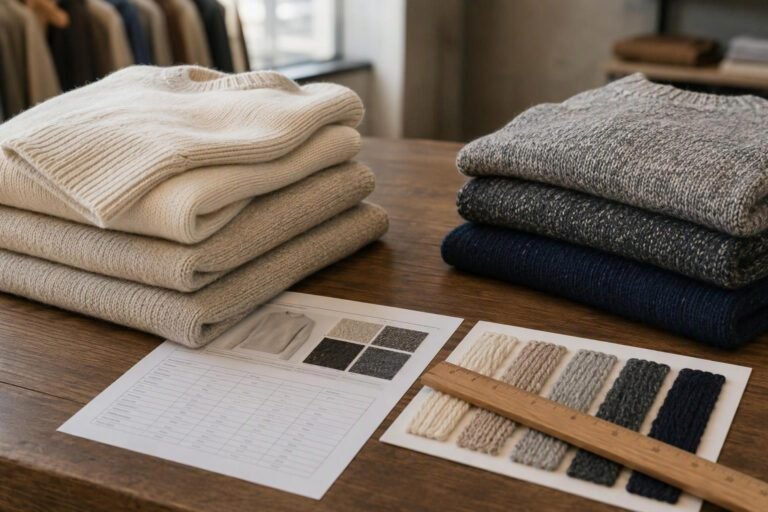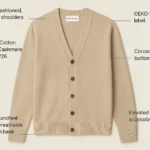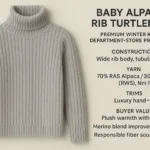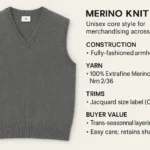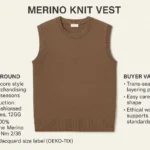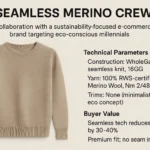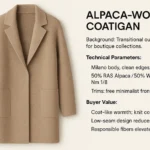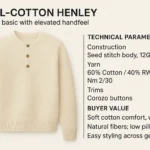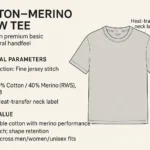


The question that stalls most first European knitwear capsules is “which fibre is best?” It is the wrong question, and it produces the wrong spreadsheet. Merino, cashmere and alpaca are not three candidates for one slot; they are three different jobs inside an assortment, and each one carries its own price architecture, care burden, certification trail and SKU cost. A capsule that treats them as interchangeable ends up with three overlapping mid-priced sweaters and a sourcing file full of half-finished traceability questions.
The useful question is narrower: which fibre anchors the range, which one carries the halo, and which one supplies texture — and how few yarn qualities can deliver all three? This article compares the fibres on the six criteria that decide that allocation: warmth, softness, durability, price tier, care and sustainability/traceability. It opens with a summary matrix, works through each criterion with the numbers and their limits, then closes with a fibre-role map and a self-selection guide for different retail footprints.
Key Takeaways
Merino is the default anchor. It spans the widest usable range — fine enough for next-to-skin, robust enough for everyday retail — and it is the fibre most likely to survive a first season’s quality and compliance review.
Cashmere is a halo, not a backbone. Its cost floor is set by scarcity, and its short fibres trade softness against abrasion resistance in high-wear styles. Keep it to a small number of gifting or premium styles.
Alpaca is a differentiation play. Its loft and texture do work that merino cannot, but grade names (Royal, Baby, Superfine) are not standardised across markets. Specify micron, not the name.
Cap the yarn qualities, not just the styles. One anchor quality, one halo quality and one texture quality is usually enough; every extra quality multiplies dye lots, test reports, care labels and colourway minimums.
Ask certification questions before accepting a sustainability claim. RWS/RMS, SFA Cashmere Standard, RAS and OEKO-TEX STANDARD 100 each answer a different question, and the EmpCo rules on green claims take effect on 27 September 2026.
Care burden is a returns-risk lever. Fine animal fibres need cool washing, wool-safe detergent and flat drying; the product page and hangtag are risk-control tools, not boilerplate.
The Comparison at a Glance
Criterion | Merino | Cashmere | Alpaca |
|---|---|---|---|
Warmth | High, with strong temperature regulation and breathability across gauges | High warmth-to-weight in fine-gauge constructions | High loft and warmth; best suited to statement and textured pieces |
Softness | Fine grades (below ~19.5 µm) are next-to-skin soft; coarser grades are not | Very high; finest grades sit near 14–16 µm | High in fine grades, but grade names vary by market |
Durability | Good; crimp structure supports elasticity and wrinkle recovery | Moderate in high-wear styles; short fibres and soft handfeel can trade against abrasion resistance | Moderate; loft suits lower-abrasion statement pieces |
Price tier | Wide range by micron and certification; mid to upper-mid | Highest tier; scarcity sets a cost floor | Between merino and cashmere depending on grade and blend |
Care | Moderate; cool wash, wool-safe detergent, flat dry | Moderate–high; same protocol, higher replacement cost | Moderate–high; same keratin-fibre protocol |
Sustainability / traceability | RWS/RMS available; non-mulesing is a common buyer requirement | SFA Cashmere Standard and chain of custody | RAS covers animal welfare and chain of custody |
Relative positioning guidance for capsule planning, not measured performance data. Micron, yarn count, ply and knit structure change outcomes within each fibre, so treat the table as a starting allocation and confirm the specifics against the yarn you actually buy.
Read the table by column, not by row. Each column describes a fibre’s typical role in an assortment; each row tells you where the trade-offs sit. A cell reading “moderate” is not a defect — it is a signal that the fibre needs the right construction and the right care message to perform in that dimension.
Warmth: Matching Fibre to Market Climate and Occasion
Warmth is the criterion most often attributed to fibre alone, and that is where capsule planning goes wrong. A garment’s warmth comes from the air trapped in the structure as much as from the fibre: yarn count (Nm), gauge, ply and finished garment weight all move the result. The same merino quality can produce a lightweight crew for a mild market and a heavy winter knit, and the two will not feel like the same product.
Merino is the most versatile of the three on this axis because it regulates rather than simply insulates. Wool’s fibre structure manages moisture vapour and odour, and its crimp gives the fabric elasticity and recovery, which is why merino works across base layers, fine knitwear and outerwear. For a capsule that has to cover transitional weather as well as cold snaps, that range is the practical argument for merino as the anchor.
Cashmere delivers warmth-to-weight: ultra-fine, springy fibres trap air efficiently, so a fine-gauge cashmere knit feels warm for its weight. That makes it well suited to lighter, more refined silhouettes and to gifting pieces where handfeel matters more than bulk. It is less suited to the heavy, hard-wearing end of the range.
Alpaca brings loft. Its fibres produce a fuller, more textured fabric, which is why it suits statement knits, oversized shapes and colder-market pieces where visual warmth is part of the sell. In a milder market, an alpaca style can read as too heavy unless it is worked in a finer gauge or blended.
Regionally, the split is straightforward. A capsule aimed at milder EU/UK markets can lean on finer-gauge merino and lightweight cashmere blends; a capsule for colder markets has room for heavier merino and alpaca texture. This is reasoning from fibre properties and climate, not survey data — check it against your own sell-through history for comparable weights before committing.
Softness: Micron Ranges, Prickle Thresholds and What “Soft” Actually Means on a Label
“Soft” is the least useful word in a sourcing brief and the most useful number is micron — the fibre’s average diameter. Fineness drives how a fibre feels against skin, and it is the one specification that travels between suppliers without translation.
Merino fibre diameter typically ranges from less than 17.5 microns to around 22–24 microns. Finer fibres, generally below about 19.5 microns, are prized for next-to-skin garments such as base layers and fine knitwear; medium-range fibres around 19.5–22 microns are common in knitwear and outerwear. Broader fibres above that range are less common in apparel. In practice, an extra-fine merino at 17.5–19.5 µm and a regular merino at 20–23 µm are different products with different price points, even though both are labelled “merino”.
Cashmere is finer still. AzKnit’s yarn parameter guidance puts cashmere at roughly 14–16 µm for ultra-soft luxury; other commercial sources describe genuine cashmere as typically around 14–19 µm, with the finest grades near 14–15.5 µm. Treat the range as guidance rather than a universal standard — the number to fix in your brief is the micron band and its upper boundary, not the adjective.
Alpaca is where vocabulary causes real commercial risk. The familiar grade names — Royal, Baby, Superfine — come from the Peruvian and commercial garment trade, and their cutoffs wander by a micron or two between sellers. In 2021 the US Alpaca Owners Association published a numbered 0–6 grading system and deliberately left the names out because they are inconsistent worldwide. Australian commercial ceilings differ again: Royal up to 19.0 µm, Baby up to 22.5 µm, Superfine up to 26.5 µm. “Baby alpaca” alone has been defined across sources as anywhere from 19 to 25 µm — a spread of up to four or five microns at the upper boundary. The only number that travels unchanged is the micron count.
Why it matters physically: fibre ends above roughly 30 microns are stiff enough to press into the skin rather than bend, which is the mechanism behind wool itch. The comfort factor — the percentage of fibres at 30 microns and under — is the metric that predicts prickle. A yarn can be fine on average and still prickle if its distribution has a coarse tail.
The practical takeaway for the sourcing brief: specify micron and the upper boundary, ask for the comfort factor where the supplier can provide it, and do not accept a grade name as a substitute for a number.
Durability: Pilling, Abrasion and the Role of Yarn Construction
Durability in knitwear is a construction story as much as a fibre story, and the category manager’s quality complaints — pilling, shrinkage, weight deviation — usually trace back to both.
Three variables do most of the work. Staple length determines how well fibres hold together: longer fibres spin into stronger yarns and shed fewer loose ends to form pills. Twist sets the surface: high twist gives a stronger, crisper yarn that resists pilling; low twist gives a softer, fluffier handfeel that fuzzes more easily. Ply adds balance and strength — a 2-ply yarn is the workhorse for scalable retail durability, while ultra-fine 1-ply suits premium handfeel.
On the fibres themselves:
Merino has a crimp structure that supports elasticity and wrinkle recovery, and its cortical cell structure contributes strength and abrasion resistance. It is the most forgiving of the three in high-wear everyday styles, particularly in a 2-ply, medium-twist construction.
Cashmere‘s short fibres and soft handfeel can trade against abrasion resistance. A low-twist, low-ply cashmere is beautiful and delicate; in a high-wear style it will pill and wear faster. The fix is construction and positioning, not denial — keep cashmere in lower-abrasion roles and say so in the care copy.
Alpaca‘s loft suits statement and textured pieces where abrasion is lower. Its crimp varies by breed — Huacaya runs higher crimp, Suri much lower — which changes how the yarn behaves in the knit.
Knit structure interacts with all of this. Basic jersey and rib structures support scalability and durability for mass retail; fine-gauge links-links, mesh and fully fashioned jacquards create the refined textures luxury buyers expect, and pair naturally with cashmere or extra-fine merino. Choosing a delicate structure in a delicate fibre for a high-wear price point is the combination that generates returns.
When you write the quality section of the tech pack, specify the test protocol you expect — pilling, dimensional stability after washing, and weight tolerance per garment — rather than assuming the fibre name guarantees the outcome.
Price: Relative Tiers and How to Compare Supplier Quotes Without Invented Figures
Relative price tiers first, because they set the architecture. Cashmere is the highest-cost fibre of the three, and the reason is physical scarcity: each goat produces only a small amount of usable down per year, so a single sweater represents a season’s combings from several animals, then sorted, de-haired and spun. That cost floor does not move with fashion cycles. Merino spans the widest range, because price tracks micron and certification — an extra-fine certified merino can cost several times a standard quality. Alpaca sits between depending on grade and blend, with fine grades moving toward cashmere territory and coarser grades competing with mid-range wool.
What not to do is compare yarn price per kilo and call it a cost comparison. The number that matters is usable garment cost: yield per kilogram after wastage, the gauge and garment weight the design requires, and the colourway minimums attached to the yarn. A cheaper yarn that wastes more or forces a higher minimum order can cost more per sellable unit.
A useful framing device for where each fibre can sit comes from CBI’s market-entry guidance: the retail price of a knitwear item is on average 4–8 times the FOB price, which means FOB is on average 12.5–25% of retail. Exceptions occur — some large European retail chains in the budget market may mark up closer to 2x. Use the ratio to test whether a fibre’s FOB tier can support the retail price your customer expects, not as a rule for setting prices.
Two further budgeting factors deserve a line in the quote comparison. First, currency: if you quote in EUR or GBP and the yarn is bought in another currency, exchange-rate movement sits between your cost and your margin, and the exposure should be visible in the budget rather than discovered at settlement. Second, certification and colourway minimums should be normalised across quotes — a supplier quoting a certified yarn with a low colourway minimum is not comparable to one quoting an uncertified yarn with a high one until both are expressed per sellable unit.
Care: Laundry Burden, Returns Risk and Consumer Messaging
Care is usually treated as a label detail. In an online apparel business it is a returns-risk variable: the more demanding the care protocol, the greater the chance a customer damages the garment and claims it arrived faulty, and the more likely a negative review about shrinkage or pilling.
The protocol for all three fibres is broadly the same, because wool, cashmere and alpaca are all keratin animal fibres with overlapping felting behaviour. Wash cool — at or below 30°C — with a wool-safe or cashmere-safe detergent, avoid fabric softener (it coats the fibre and encourages pilling), and dry flat rather than hanging, since a wet sweater can hold several times its dry weight and will stretch at the shoulders. Airing between wears extends the wash interval considerably, because wool releases absorbed odours within about a day.
What differs is the tolerance for error. A coarser or blended knit forgives a warm wash and a tumble; fine merino and cashmere do not, and cashmere’s replacement cost makes a ruined garment an expensive return. Untreated cashmere, alpaca and chunky hand-knits are best hand-washed; a modern machine wool cycle at 30°C and low spin is often gentler than vigorous hand-washing, but only if the care label allows it.
That translates into messaging decisions:
Everyday wear in milder markets benefits from a “care confidence” angle — clear, short instructions that make the garment feel low-maintenance rather than precious.
Gifting pieces need care copy written for the recipient, not the buyer, because the person doing the washing did not read the product page at purchase. A care card in the box is cheap insurance.
Blends should be labelled to the more demanding fibre’s protocol, and the label should say so plainly.
None of this requires inventing a return-rate figure. The reasoning is enough: higher care burden raises the probability of customer-caused damage, and clear care messaging lowers it.
Sustainability and Traceability: Certification Questions to Put to a Supplier
Sustainability claims in this category are only as good as the certificate behind them, and each standard answers a different question. The useful move is to convert the topic into a supplier interrogation checklist.
Animal welfare and chain of custody
Merino: Is the wool RWS (Responsible Wool Standard) certified, and is it non-mulesing? CBI notes that buyers may require both, and RWS covers animal welfare and environmental criteria alongside chain of custody.
Cashmere: Is the fibre covered by the SFA Cashmere Standard, and can the supplier show chain-of-custody certification? The standard addresses animal welfare, land management, herder livelihoods and fibre quality.
Alpaca: Is the fibre RAS (Responsible Alpaca Standard) certified? RAS addresses animal welfare and provides chain of custody from certified farms to the final product. Note that a garment can be made from genuinely fine alpaca by micron measurement without the supply chain being RAS-certified — the two are separate evidence layers.
Chemical safety
OEKO-TEX STANDARD 100: Every item bearing the label is certified as having passed tests for harmful substances against a list of over 1,000 substances. For a B2B buyer, the label alone is not proof: ask for the valid certificate, check that the label number and certification body match, and confirm the product is within the certificate’s scope. The Label Check QR code or certificate number allows verification.
REACH: CBI notes that with small orders most European buyers will not ask for expensive testing, but if illegal chemicals are discovered after delivery, the supplier bears all expenses involved. Ask what testing is done at yarn and garment stage, and who holds the reports.
Regulatory context to build into the timeline
Regulation (EU) 1007/2011 governs fibre-composition labelling: multi-fibre products must list fibres in descending order by weight, and fibres collectively accounting for up to 15% of total weight may be designated “other fibres”. The Commission is reviewing this regulation, with a proposed revision planned.
EmpCo Directive (EU) 2024/825 bans misleading environmental claims and generic terms such as “eco-friendly” or “sustainable” unless the company can demonstrate recognised excellent environmental performance. It applies from 27 September 2026 — before most next-season ranges land.
The Green Claims Directive remains pending; the Commission’s proposal is not yet adopted law, so treat it as a direction of travel rather than a current obligation.
Frame all of this as questions to put to a supplier, not as assertions about any named factory. A supplier who can answer them with documents is a different risk profile from one who answers with adjectives.
Capping SKU Complexity: Yarn Count, Colourway Count and Style Count
SKU complexity in knitwear does not come from the number of styles alone. It comes from the multiplication of yarn qualities, colours, gauges and plies, each of which generates its own dye lot, test report, care label and minimum order.
A workable capping framework for a first capsule:
Cap the yarn qualities at three. One anchor merino quality (the volume driver), one halo cashmere quality (the gifting or premium piece), one texture alpaca quality (the differentiation piece). Every additional quality adds a supply relationship, a certification file and a colourway minimum.
Cap colourways per quality. Anchor qualities can carry more colours because they carry more volume; halo and texture qualities should carry fewer, because their colourway minimums are harder to absorb.
Cap styles per fibre role. One or two anchor styles, one halo style, one texture style is a capsule. Three styles per fibre is a collection, and a collection is what creates the markdown risk.
The mechanics behind this: yarn count (Nm) and gauge are linked — a high Nm gives a finer, lighter garment, a low Nm a thicker, heavier one — and ply adds a further variable. A luxury cashmere pullover might run Nm 2/48 at 14 gauge and around 220 g; a merino business sweater Nm 2/30 at 12 gauge and around 350 g; an oversized chunky knit Nm 1/8 at 3 gauge and around 900 g. Each of those is a different yarn, a different machine setting and a different cost base. Multiply by colourways and you have the real SKU count.
Fewer yarn qualities also means fewer dye lots to match, fewer test reports to collect and simpler care labelling — all of which shorten the path from sample to shelf. As an optional manufacturing-partner example, AzKnit publishes a standard MOQ of 100 pieces per design with flexible solutions from 50 pieces for new or experimental styles, and sampling in 3–5 working days, which is the kind of arrangement that lets a buyer test a fibre role before committing to a full season’s volume. Whether that fits depends on your own framework agreement and calendar.
Building Regionally Relevant Capsules: A Fibre-Role Map for EU/UK Markets
The role map translates the criteria into an assortment structure. Two axes do most of the work: climate (colder versus milder markets) and occasion (everyday versus gifting).
Merino — the anchor. Everyday, transitional-climate capsules. It covers the widest weight range, carries the least care anxiety, and has the most mature certification route. In a milder market it can run finer gauge and lighter weight; in a colder market the same quality moves to heavier gauges and 2-ply constructions.
Cashmere — the halo. Gifting and premium positioning. Keep it to a small number of styles, in lower-abrasion constructions, with care copy written for the recipient. It earns its place by lifting the perceived level of the whole range, not by carrying volume.
Alpaca — the texture. Differentiation and colder-market statement pieces. Its loft does visual work that merino cannot, which makes it the natural choice for the style that has to look different on a crowded category page. It needs the micron specification resolved before it goes into the brief.
A single capsule can carry all three without sprawl if each fibre stays in its job. A mild-market capsule might read: two merino everyday styles in three colourways, one fine-gauge cashmere gifting style in two colourways, one alpaca texture piece in one or two colourways. A cold-market capsule shifts the weight: heavier merino anchor styles, an alpaca oversized knit, and cashmere held to a single refined piece. The fibre-role logic is the same; the weights and colour counts move.
This is guidance from fibre properties and assortment reasoning, not survey data. Validate it against your own sell-through by weight and fibre before locking the buy.
Who Should Choose Which
The honest answer is that it depends — but on four specific things, and once you name them the choice usually makes itself.
What it depends on:
Climate footprint. A retailer whose volume sits in colder markets can justify more weight and more alpaca; a milder-market footprint rewards finer merino and lighter cashmere blends.
Price architecture. Where the capsule needs to sit relative to your existing range determines whether cashmere is a halo or an aspiration.
Care tolerance. A customer base that expects low-maintenance laundry will punish a delicate fibre with returns; a gifting-led base will not.
Certification capacity. If your sustainability team cannot verify a fibre’s chain of custody in time for launch, that fibre is not ready for the range regardless of how it feels.
The self-selection summary:
First-season brand with tight MOQ and cash flow: merino anchor; cashmere halo only if gifting is core to the proposition. Alpaca can wait, or enter as a single texture style once the micron question is resolved.
Retailer with a cold-market footprint: merino anchor plus alpaca texture. Cashmere as a limited gifting piece if the price architecture supports it.
Premium or luxury positioning: cashmere halo supported by fine-gauge extra-fine merino. The merino does the volume work at a quality level that does not undercut the cashmere.
Marketplace or DTC mix with a broad price ladder: merino across two qualities (extra-fine and regular) rather than three fibres, with cashmere and alpaca as seasonal tests.
If two of the four factors point in different directions, anchor on merino and treat the other two fibres as tests rather than commitments. That keeps the downside small while the sell-through data accumulates.
Verdict
For a first European capsule, merino is the default anchor. It has the widest usable weight and micron range, the most mature certification route, the most forgiving care profile and the least price volatility of the three. It can carry the volume, the everyday price points and the transitional-climate styles without forcing a construction compromise.
Cashmere should be a deliberately limited halo. Its scarcity sets a cost floor that does not move, and its short fibres trade softness against abrasion resistance. A small number of gifting or premium styles, in lower-abrasion constructions, with care copy written for the recipient, is the right allocation.
Alpaca is a differentiation play, contingent on resolving two questions first: what micron band and upper boundary the supplier is actually applying to the grade name, and whether the fibre supply chain carries RAS chain of custody. Until both are answered with documents, alpaca belongs in the test budget rather than the core buy.
Underneath all three sits the SKU-cap discipline: one anchor quality, one halo quality, one texture quality; capped colourways per quality; capped styles per fibre role. Fewer yarn qualities means fewer dye lots, fewer test reports, simpler care labelling and a shorter path from sample to shelf.
If it would help to test a fibre role before committing to a season, AzKnit can share its yarn parameters and sampling options — including the qualities it develops in certified wool, cashmere and alpaca — so you can compare handfeel and construction against your own brief. Request the yarn book or a sampling consult when you are ready to put numbers against the plan.
FAQ
Which fibre should anchor a first capsule, and which should be the halo? Merino anchors; cashmere is the halo. Merino covers the widest weight and micron range with the most forgiving care and certification profile. Cashmere earns its place as a small number of premium or gifting styles, not as a volume driver.
How do I cap yarn, colourway and style counts? Limit the capsule to three yarn qualities — one anchor merino, one halo cashmere, one texture alpaca — cap colourways per quality according to the volume each carries, and cap styles per fibre role at one or two. Every extra quality adds dye lots, test reports, care labels and colourway minimums.
Which fibre roles fit colder versus milder markets, and gifting versus everyday? Milder markets reward finer-gauge merino and lightweight cashmere blends; colder markets have room for heavier merino and alpaca texture. Everyday wear suits merino; gifting suits cashmere, with care copy written for the recipient.
What certification and traceability questions should I ask a supplier? Ask whether the merino is RWS-certified and non-mulesing; whether the cashmere carries the SFA Cashmere Standard and chain of custody; whether the alpaca is RAS-certified; and for the valid OEKO-TEX STANDARD 100 certificate, with the label number and certification body matching and the product within scope. Ask what REACH testing is done and who holds the reports.
How does care burden map to returns risk and messaging? Fine animal fibres need cool washing, wool-safe detergent and flat drying. The more demanding the protocol, the greater the chance of customer-caused damage, so clear care copy on the product page and hangtag is a risk-control tool — especially for gifting, where the recipient does the washing.
How do I compare supplier quotes without inventing currency figures? Compare usable garment cost rather than yarn price per kilo: yield after wastage, gauge and garment weight, and colourway minimums, all normalised for micron and certification. Use the CBI observation that retail is on average 4–8 times FOB (FOB typically 12.5–25% of retail, with exceptions such as budget chains marking up closer to 2x) to test whether a fibre’s tier supports your retail price, and keep currency exposure visible in the budget.